The Tiny Habit That Prevents Big Confusion
If you want to sound smarter in almost any conversation, meeting, essay, debate, or dinner-table discussion, here’s a surprisingly powerful move:
Define your terms.
That’s it. Not “use more syllables.” Not “quote ancient philosophers.” Not “say ‘paradigm’ while holding a mug thoughtfully.”
Just pause and clarify what you mean by the key words you’re using.
It sounds almost too simple, but defining your terms is one of the clearest signs of careful thinking. It shows that you’re not just tossing around impressive words and hoping they land somewhere sensible. You’re making sure everyone is talking about the same thing.
Because here’s the problem: many arguments are not really arguments about facts. They are arguments about meanings.
Two people can use the same word and mean completely different things. One person says, “Success means freedom.” Another says, “Success means achievement.” A third says, “Success means getting through the week without losing your keys.” All valid, but not the same.
Before a conversation can become useful, the words need to stop wobbling.
Why Smart People Define Words Before Fighting About Them
Imagine two people arguing:
“Social media is bad for young people.”
“No, it isn’t. It helps them connect.”
They might go back and forth for twenty minutes. But what does “bad” mean? Bad for mental health? Bad for grades? Bad for attention span? Bad compared with what? And what counts as “young people”? Teenagers? Children under 13? College students who still say “adulting”?
Without definitions, the discussion becomes foggy. Everyone is swinging at shapes in the mist.
Now imagine someone says:
“By ‘bad for young people,’ I mean that frequent social media use may contribute to anxiety, sleep disruption, or lower self-esteem in teenagers.”
That sentence immediately sounds sharper. Why? Because it narrows the claim. It gives people something specific to agree with, question, or test.
Defining your terms does not mean you are always right. It means you are making your thinking visible. That alone makes you sound more precise, fair, and thoughtful.
It also prevents one of the most common communication problems: talking past each other. This happens when people think they disagree, but they’re actually using words differently.
For example:
- “Discipline” might mean punishment to one person and self-control to another.
- “Freedom” might mean fewer rules to one person and more opportunities to another.
- “Healthy” might mean physically fit, emotionally balanced, low in calories, organic, or “contains a vegetable somewhere in the building.”
When you define a slippery word, you turn a vague discussion into a real one.
The Words Most Worth Defining
You do not need to define every word you say. That would be unbearable.
Imagine starting every conversation like:
“When I say ‘sandwich,’ I mean a food item consisting of filling placed between bread-like structures, though I am willing to entertain edge cases such as wraps.”
No one will invite you to lunch.
The trick is to define terms that carry the weight of your point. These are usually abstract, emotional, broad, or controversial words.
Here are some examples:
- Success
- Fairness
- Respect
- Intelligence
- Happiness
- Productivity
- Freedom
- Creativity
- Quality
- Leadership
- Value
- Safety
- Equality
- Culture
- Professionalism
These words are useful, but they are also stretchy. They can expand or shrink depending on who is using them.
Take “professionalism.” In one workplace, it might mean being punctual, prepared, and respectful. In another, it might mean wearing formal clothes and never using emojis. In a third, it might mean answering emails within six minutes, which is less “professionalism” and more “haunted by notifications.”
If you say, “We need to be more professional,” the phrase may sound good, but it is not yet clear. Better:
“By ‘professional,’ I mean responding to clients within one business day, keeping meeting notes, and avoiding slang in formal reports.”
Now people know what you mean. They can act on it.
A Simple Formula for Defining Your Terms
You do not need a dictionary voice to define your terms well. In fact, dictionary definitions are not always the best tool in conversation. They can be too broad or too rigid. What you usually need is a practical definition: the meaning of the word in this context.
Try this simple formula:
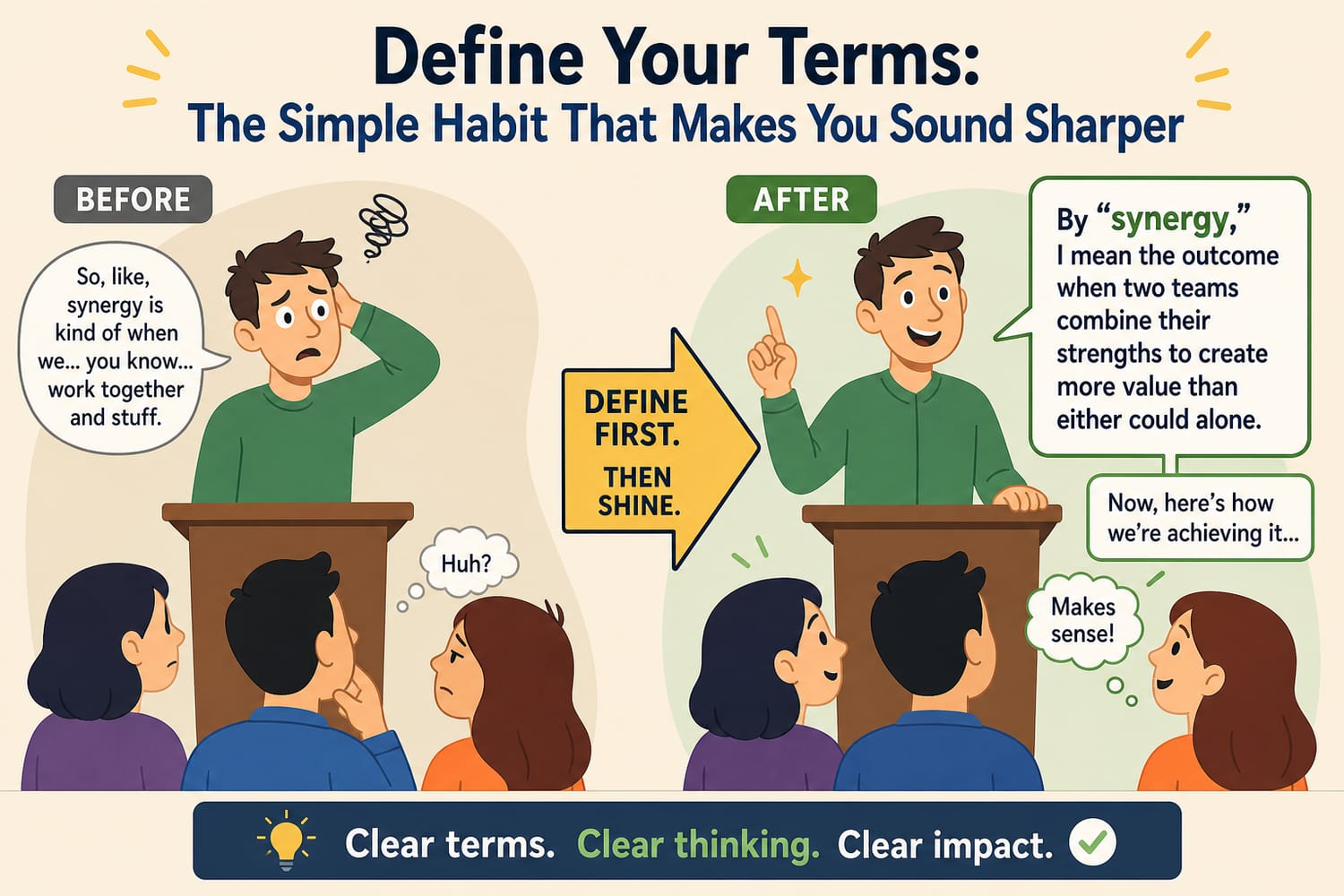
“By [term], I mean [specific meaning in this situation].”
Examples:
“By ‘productive,’ I mean finishing the three most important tasks, not just staying busy.”
“By ‘healthy,’ I mean something I can eat regularly that supports my energy, sleep, and long-term well-being.”
“By ‘good writing,’ I mean writing that is clear, engaging, and suited to its audience.”
“By ‘fair,’ I mean that the rules are applied consistently to everyone involved.”
This formula is useful because it does two things at once. It clarifies the word, and it limits the claim.
That second part matters. Many people sound less smart because they make huge, cloudy statements:
“Technology is ruining society.”
“Schools don’t teach useful things.”
“Nobody wants to work anymore.”
“Art is subjective.”
“People are too sensitive.”
These might contain a point worth discussing, but as stated, they are too broad. A more careful thinker asks, “What exactly do we mean?”
For instance:
“When I say technology can be harmful, I’m mainly talking about platforms designed to maximize attention through endless scrolling and notifications.”
Much better. You have moved from dramatic fog machine to focused flashlight.
Defining Terms Makes You More Persuasive
People often think persuasion comes from confidence. And yes, confidence helps. But confidence without clarity can become a very loud cloud.
Defining your terms makes you persuasive because it shows control. You are not relying on the emotional force of a big word. You are explaining what the word means and why it matters.
This is especially helpful when discussing sensitive topics. Words like “privilege,” “bias,” “censorship,” “harm,” “justice,” and “rights” can trigger strong reactions because people attach different meanings and experiences to them.
A good definition lowers the temperature.
Instead of saying:
“That policy is unfair.”
Try:
“I think the policy is unfair because it gives one group access to resources that another group with the same qualifications cannot access.”
Now the conversation has a specific claim. Someone can respond with evidence, a counterexample, or a revised definition. That is much more useful than two people simply taking turns saying “fair” and “unfair” with increasing eyebrow intensity.
Definitions also help you avoid accidental exaggeration. If you define “always,” “never,” “best,” “worst,” or “everyone,” you may realize your claim needs trimming.
For example:
“Everyone hates meetings.”
Really? Everyone? Somewhere out there is a person with a fresh notebook and a color-coded agenda who loves meetings deeply.
Better:
“Many people dislike meetings when they lack a clear purpose, agenda, or decision-making structure.”
That sounds smarter because it is more accurate.
The Difference Between Defining and Nitpicking
At this point, you may be wondering: “Isn’t constantly asking for definitions annoying?”
Yes. It absolutely can be.
Defining terms is helpful when it clarifies the conversation. It becomes irritating when it is used as a stalling tactic, a power move, or a way to avoid engaging with the point.
There is a difference between:
“When you say ‘effective,’ what outcome are you measuring?”
and:
“Ah, but what is ‘is’?”
The first question helps. The second makes people regret inviting you.
A good rule: define terms when the meaning affects the conclusion.
If someone says, “This soup is delicious,” you probably do not need to ask, “Please define delicious.” Just eat the soup or don’t.
But if someone says, “This educational program is successful,” definitions matter. Successful how? Higher test scores? Better graduation rates? Improved student confidence? Lower costs? More students finishing the program?
The usefulness of the definition depends on the stakes of the conversation.
How to Ask Others to Define Their Terms
One of the best ways to sound sharper is not only to define your own terms, but to politely ask others to define theirs.
The key word is politely.
Instead of saying:
“That word doesn’t mean anything.”
Try:
“What do you mean by that in this context?”
Instead of:
“Define your terms.”
Try:
“When you say ‘quality,’ are you thinking about durability, design, customer satisfaction, or something else?”
Instead of:
“That’s vague.”
Try:
“Can we make that more specific so we know what we’re aiming for?”
These questions are not just nicer. They are more effective. People are less likely to become defensive when they feel you are trying to understand them rather than trap them.
A helpful phrase is:
“Just so I’m understanding you…”
For example:
“Just so I’m understanding you, when you say the project needs to be ‘better,’ do you mean more visually polished, easier to use, or more complete?”
This makes you sound collaborative, not combative. You become the person helping the room think clearly. That is a very good person to be.
Use Examples to Make Definitions Stick
A definition is useful, but an example makes it memorable.
If you say:
“By ‘clear communication,’ I mean communication that is easy for the intended audience to understand.”
That’s good.
But add an example:
“For instance, a clear email states the decision, the deadline, and the next step in the first few lines.”
Now people can picture it.
Examples are especially helpful when defining abstract ideas. Let’s say you are discussing “confidence.” You might say:
“By confidence, I don’t mean believing you’re perfect. I mean being willing to act while knowing you may still have things to learn.”
That definition is strong because it separates confidence from arrogance.
Or take “creativity”:
“By creativity, I mean combining ideas in a way that is useful, surprising, or expressive—not just making something strange for the sake of being strange.”
That helps people understand what counts and what does not.
A good definition often includes both:
- What the term means
- What the term does not mean
For example:
“By ‘simple,’ I mean easy to understand, not shallow or incomplete.”
That little contrast can prevent a lot of misunderstanding.
The Quiet Confidence of Precision
Defining your terms is not flashy. It will not make people gasp. No one will whisper, “Did you hear how beautifully she clarified the operational meaning of ‘efficient’?”
Probably.
But they will notice something. They will notice that you are easier to understand. They will notice that your points are harder to dismiss. They will notice that you do not hide weak thinking behind big words.
Precision has a quiet confidence to it. It says, “I know what I mean, and I want you to know too.”
That is the heart of sounding smarter: not trying to appear impressive, but making your ideas clearer, stronger, and more useful.
So the next time you are about to use a big, abstract, emotionally loaded word, pause for two seconds and ask yourself:
“What do I mean by this?”
Then say it.
Your conversations will improve. Your writing will sharpen. Your arguments will become more honest. And you may even save yourself from a thirty-minute debate about “success” that turns out to be three people discussing money, purpose, and gym attendance.
Define your terms. It’s a small habit with a big payoff.