How to Answer Unexpected Questions Without Rambling
The Short Answer: Pause, Point, Prove, Stop
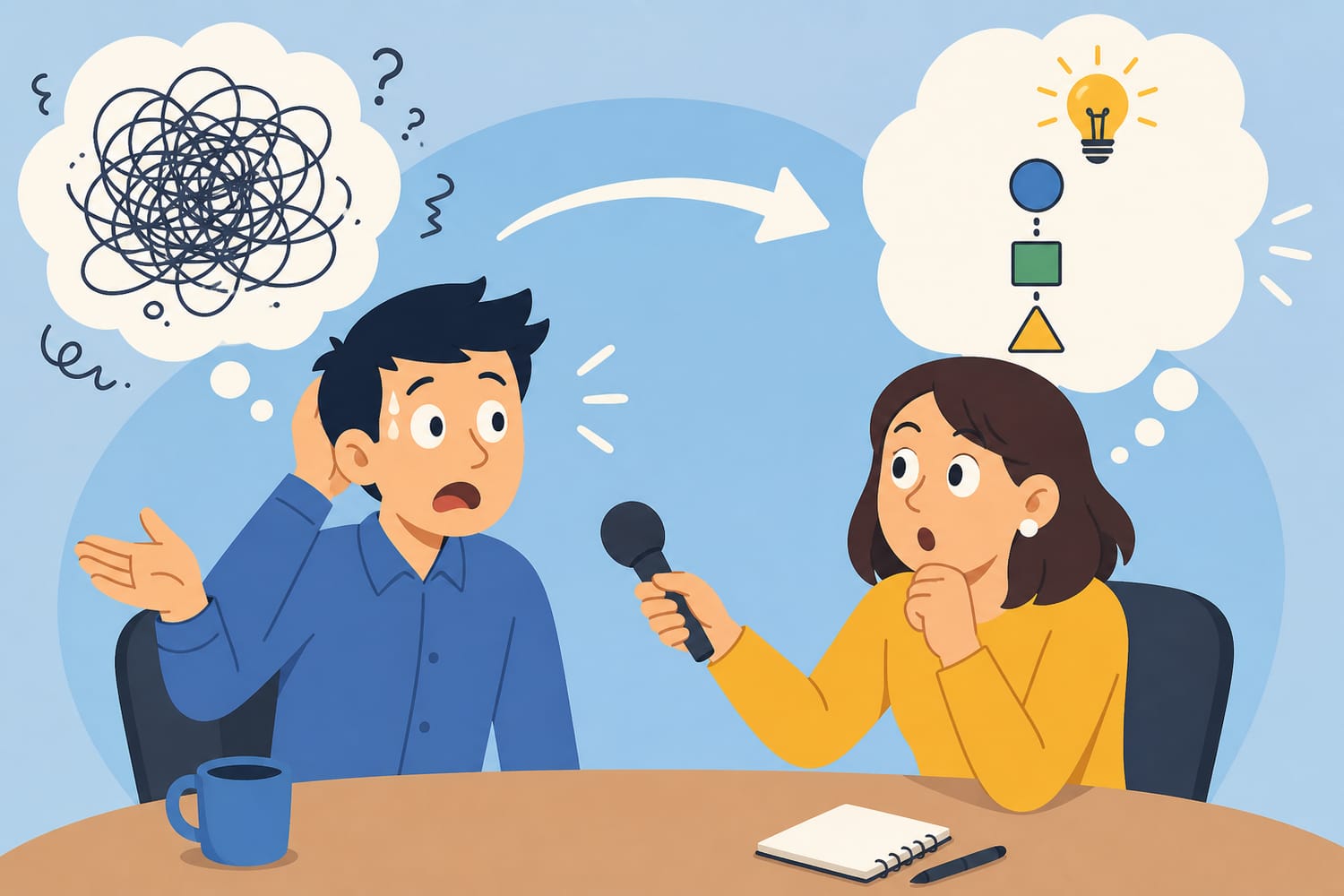
When an unexpected question lands in your lap, resist the urge to begin speaking immediately. Pause, identify the main question, state your answer in one sentence, add one useful reason or example, and then stop. You will sound more thoughtful—not because you know everything, but because your answer has a clear destination.
Why Surprise Questions Make Us Ramble
An ordinary conversation can turn into an accidental game show without warning.
Your manager asks, “Why did this project take longer than expected?” A friend says, “What do you think about artificial intelligence?” Someone at dinner suddenly wants your position on urban planning, despite your only relevant qualification being that you once played SimCity.
When a question catches us off guard, we often start talking before deciding what we want to say. We offer background, revise our opinion halfway through, introduce three side topics, and eventually forget the original question.
Rambling is not necessarily a sign that you lack knowledge. Often, it means you are trying to discover your answer out loud. Unfortunately, your listener must accompany you on that expedition—and nobody packed snacks.
The solution is not to become a walking encyclopedia. It is to give yourself a simple process for organizing whatever you do know.
Step One: Let the Question Land
A brief pause before answering is useful, not embarrassing. It gives you time to understand the question and prevents your first half-formed thought from escaping into public.
The Wharton Communication Program recommends pausing to ensure that you have heard and understood a question before stating your position, supporting it and concluding succinctly. Its guidance on handling questions and answers also warns against continuing after you have adequately answered.
Try one of these natural time-buying phrases:
- “That’s an interesting question.”
- “Let me think about that for a moment.”
- “The short answer is…”
- “There are two parts to that.”
- “My first reaction is…”
These phrases should be a runway, not a parking lot. “That’s a great question” buys you a moment. Repeating it four times begins to sound as though you are hoping the question will answer itself.
A two- or three-second pause may feel enormous from inside your head. To everyone else, it usually looks like you are thinking.
Step Two: Make Sure You Are Answering the Right Question
Some questions are broad, vague or secretly composed of six smaller questions wearing a trench coat.
Suppose someone asks:
“Why isn’t the new system working?”
What do they mean by “working”? Are they asking about technical performance, employee adoption, cost savings or a particular error?
Instead of guessing, clarify:
“Are you asking about the technical problems or why the team hasn’t fully adopted it?”
Clarification is especially helpful when the answer could affect a decision. It prevents you from delivering a polished response to a question nobody asked. For more ways to narrow a message without drowning it in detail, see this guide to clarifying without overexplaining.
You can also briefly reframe a loaded or overly broad question:
“If I understand correctly, you’re asking whether the benefits justify the additional cost.”
That sentence confirms the subject and gives your answer a sensible boundary.
Step Three: Lead With Your Main Point
Once you understand the question, answer it early. Do not bury your conclusion beneath the complete history of how you reached it.
Question:
“Should we postpone the launch?”
Rambling answer:
“Well, we started testing last week, and the design team sent over several changes, and then we noticed that some customers were having trouble with the checkout page…”
Point-first answer:
“Yes, I recommend postponing the launch by one week because the checkout problem could prevent customers from completing purchases.”
The second version gives the listener an answer, a reason and a useful detail. Everything has a job.
This is the central idea behind leading with the point: start with the conclusion, recommendation or key takeaway, then provide the context needed to understand it.
Helpful opening phrases include:
- “My view is…”
- “The main issue is…”
- “I recommend…”
- “The most likely explanation is…”
- “Yes, with one important condition.”
- “No, and the main reason is…”
Direct does not mean rude. It means your listener does not have to solve a verbal escape room to find your opinion.
Step Four: Use a Tiny Answer Structure
Unexpected questions become easier when you have a reusable framework. One of the simplest is PREP:
- Point: Give your answer.
- Reason: Explain why.
- Example: Add one specific example or piece of evidence.
- Point: Restate or sharpen the conclusion.
Toastmasters has long recommended structured approaches to impromptu speaking, while its guidance on thinking faster and speaking smarter in the moment also suggests the “What? So what? Now what?” framework. Both approaches give spontaneous answers a beginning, middle and end.
Here is PREP in action:
Question: “Is remote work good for productivity?”
Point: “It can be, although it depends on the role and the team.”
Reason: “Focused work may be easier at home, while collaboration can require more deliberate planning.”
Example: “A writing team might benefit from quiet work periods but still need scheduled discussions for feedback.”
Point: “So I would judge remote work by the work involved rather than treating it as universally good or bad.”
The framework keeps the answer balanced without turning it into a documentary series.
For practical questions, “What? So what? Now what?” may work even better:
- What? What is happening?
- So what? Why does it matter?
- Now what? What should happen next?
Step Five: Limit Yourself to One Main Idea
Many answers become messy because the speaker tries to include every relevant thought. A better goal is to give the listener the most useful thought first.
Before speaking, silently complete this sentence:
“If they remember only one thing, it should be…”
That is your main point.
Support it with one strong reason or example. If the listener wants more detail, they can ask. Conversation is collaborative; you do not have to anticipate and answer every possible follow-up in your opening statement.
When several points genuinely matter, announce the number:
“I see two main risks.”
Then give two risks—not two risks, a childhood anecdote and a surprise third risk discovered somewhere near the end.
Numbering creates a visible finish line for both you and your listener.
Step Six: Be Precise About What You Do Not Know
An unexpected question may ask for information you simply do not have. This is not an invitation to construct an answer from confidence, optimism and decorative fog.
Say what you know, identify what you do not know and explain how you would confirm it:
“I don’t have the final sales figures yet. The preliminary numbers show an increase, but I’d want to check the completed report before giving you a percentage.”
That sounds more credible than either bluffing or collapsing into a nervous apology. If you need more language for these moments, try these ways to say “I don’t know” without sounding unsure.
Useful phrases include:
- “I don’t have enough information to answer that accurately.”
- “My current understanding is…, but I’d like to verify it.”
- “I can speak to the general issue, though not that specific case.”
- “I don’t know yet. I can find out.”
- “That conclusion would be premature based on what we have.”
Intelligence includes recognizing the border between knowledge and guesswork.
Step Seven: Know When You Are Finished
One of the most valuable speaking skills is noticing when your answer has ended—even if your mouth has not received the memo.
After making your point, ask yourself:
- Have I answered the question?
- Have I given the necessary reason?
- Am I adding information or merely avoiding silence?
- Would another sentence improve understanding?
If the answer is no, stop.
You can close cleanly with:
- “That’s the main reason.”
- “So yes, I would support it.”
- “That would be my recommendation.”
- “Those are the two factors I’d consider.”
- “I’m happy to go into more detail if useful.”
The final phrase is especially handy. It gives the listener control over how much explanation they receive.
Practice Getting Ambushed—Politely
You do not need a stage or a panel interview to practise impromptu answers. Choose a random question and give yourself 30 seconds to respond using Point–Reason–Example–Point.
Try these:
- What makes someone a good leader?
- Should schools give less homework?
- What is one technology you could live without?
- Why do people enjoy scary movies?
- Is it better to be early or exactly on time?
Record a few answers. Listen for where your main point appears, how many ideas you introduce and whether you continue talking after reaching a natural conclusion.
The goal is not to sound rehearsed. It is to become comfortable building a small, sturdy structure while everyone else is still admiring the surprise question.
A Quick Anti-Rambling Checklist
Before answering, remember:
- Pause instead of filling the silence.
- Clarify vague or complicated questions.
- Lead with your main answer.
- Support it with one reason or example.
- Qualify uncertainty honestly.
- Stop when the question has been answered.
Sounding smart under pressure is less about producing an instant masterpiece and more about making your thinking easy to follow. Take a breath, choose a point and give it a clean ending. A concise answer followed by silence will almost always sound sharper than a brilliant answer that wanders off and misses its bus.