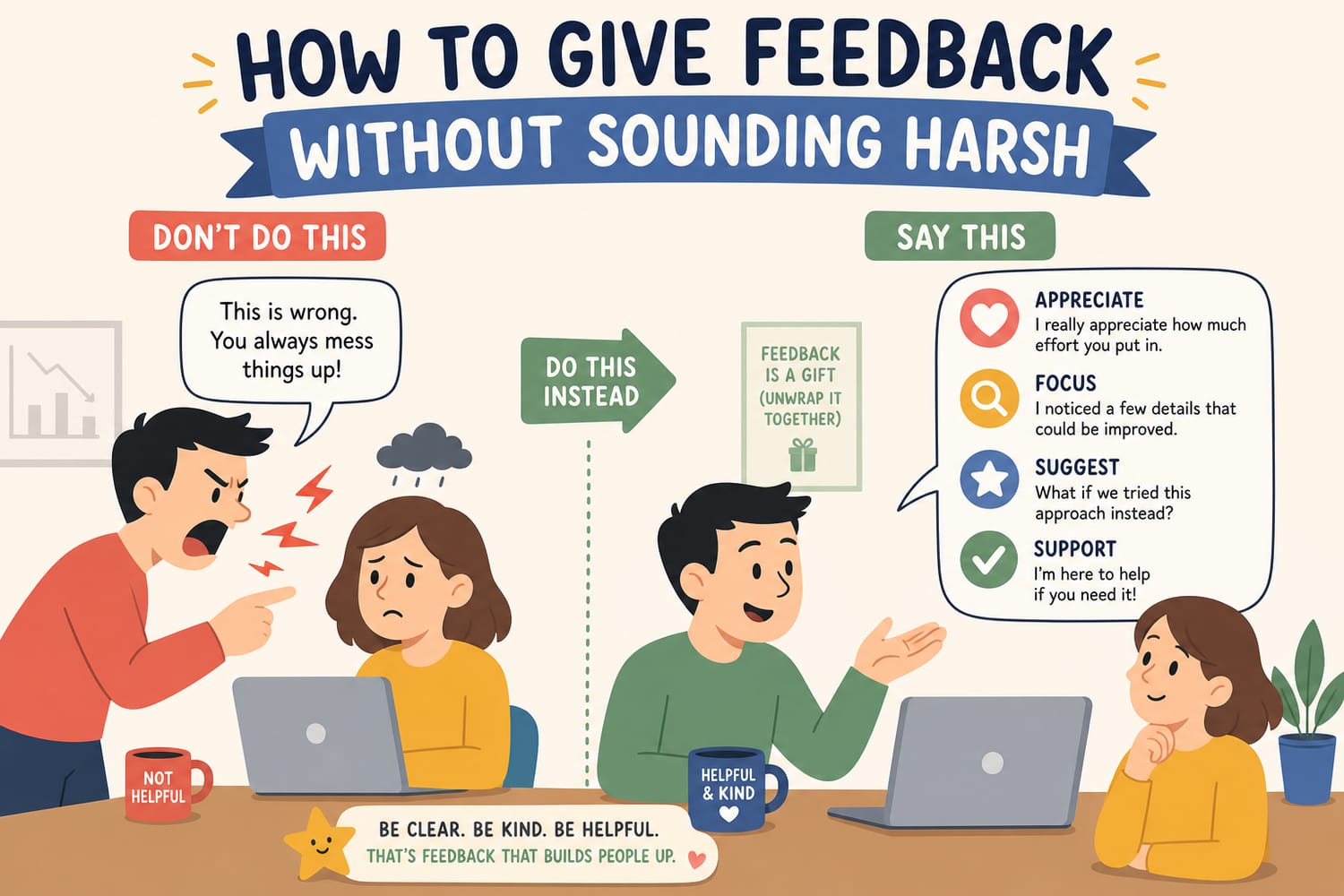
Feedback is one of those things everyone claims to want—right up until they receive it.
“Please be honest,” someone says, smiling bravely.
Then you say, “Sure. I think the opening could be clearer.”
Suddenly the room temperature drops.
Giving feedback is tricky because it sits at the intersection of truth, feelings, ego, relationships, timing, tone, and that mysterious human instinct to hear “this sentence is confusing” as “you have brought shame upon your ancestors.”
The good news? You can give honest, useful feedback without sounding harsh, superior, or like a villain in a workplace training video. It’s not about watering down the truth. It’s about delivering it in a way that people can actually hear, understand, and use.
Let’s look at how to do that.
Start With the Purpose, Not the Problem
Before giving feedback, ask yourself: What am I trying to achieve?
If the answer is “I need to prove I’m right,” pause. Maybe drink some water. Take a short walk. Rejoin society when ready.
Good feedback should help someone improve, make a project better, solve a misunderstanding, or prevent a future issue. It should not be a disguised complaint, a power move, or a chance to unload frustration you’ve been collecting like loyalty points.
A helpful mindset is:
“I’m on your side, and I want this to work.”
That attitude changes everything. Your words become less like a hammer and more like a flashlight. You’re not attacking the person; you’re pointing at something that can be improved.
Compare:
- “This report is a mess.”
- “I think we can make this report easier to follow by reorganizing the main sections.”
The first one is dramatic, memorable, and likely to ruin lunch. The second is specific and useful. Same general concern, very different effect.
Ask Permission When Possible
Not every situation allows this. If you’re a manager, teacher, editor, parent, or team lead, feedback may be part of your role. But when possible, asking permission makes feedback feel collaborative instead of ambush-like.
Try:
- “Would you be open to some feedback on this?”
- “Can I share one thought that might make this stronger?”
- “Do you want quick impressions or a more detailed review?”
This gives the other person a sense of control. It also helps you match the depth of your feedback to what they actually need.
Sometimes someone wants a full critique. Other times they want to know if the email sounds weird before they send it. These are different missions. Don’t bring a bulldozer to a flowerpot situation.
Be Specific, Because “Do Better” Is Not a Strategy
Vague feedback often sounds harsher than specific feedback because it leaves people guessing.
Consider these:
- “You need to be more professional.”
- “Your tone in the meeting came across as dismissive when you interrupted Jenna twice.”
The first one attacks someone’s general identity. The second identifies a behavior. That matters.
Specific feedback is easier to accept because it feels actionable. The person can think, “Okay, I can work on not interrupting,” instead of, “Apparently my entire personality needs renovations.”
Useful feedback often includes:
- The situation
- The behavior
- The impact
- A possible improvement
For example:
“In yesterday’s client meeting, when the timeline changed without explanation, the client seemed confused. Next time, it might help to briefly explain why the date moved.”
That’s clear, fair, and focused. No character assassination required.
Critique the Work, Not the Worth
One of the simplest ways to avoid sounding harsh is to separate the person from the issue.
Bad feedback makes people feel judged. Good feedback makes the work feel adjustable.
Instead of:
- “You’re bad at explaining things.”
Try:
- “This explanation might be clearer if we add an example.”
Instead of:
- “You’re careless.”
Try:
- “There are a few typos in the final section that we should fix before sending.”
Instead of:
- “You don’t listen.”
Try:
- “I noticed that my concern about the deadline wasn’t addressed. Can we revisit it?”
This is not just “being nice.” It’s also more accurate. People are complex. A single mistake does not define someone’s intelligence, professionalism, or potential.
When you focus on behavior and outcomes, you give people room to improve without forcing them to defend their entire self-image.
Use “I” Statements Without Making It All About You
“I” statements are popular for a reason: they reduce blame.
Instead of saying:
“You made the instructions confusing.”
You could say:
“I had trouble following the instructions after step three.”
That’s less accusatory and more grounded in your experience.
But use this tool carefully. “I” statements can still sound harsh if they’re just insults wearing a tiny mustache.
For example:
“I feel like you’re completely incompetent.”
That is not emotional intelligence. That is a grenade with feelings.
Better:
“I felt unsure about the next steps because the deadline and owner weren’t clear.”
This keeps the focus on the issue and gives the other person useful information.
Balance Honesty With Respect
Some people think being “direct” means removing all warmth from their voice and speaking as if they were assembled in a factory. But directness and kindness are not enemies.
You can be clear without being cruel. You can be honest without being blunt to the point of bruising.
Compare:
- Harsh: “This design doesn’t work.”
- Too vague: “Interesting! Lots to think about!”
- Clear and respectful: “The design has a strong visual style, but the call-to-action button may be too hard to notice. Could we make it more prominent?”
The respectful version doesn’t hide the concern. It simply presents it in a way that helps the person respond productively.
A good rule: don’t make feedback softer by making it unclear. Make it kinder by making it respectful.
Avoid the Classic “Compliment Sandwich” Trap
You may have heard of the “compliment sandwich”: say something nice, give criticism, then say something nice again.
Example:
“Great font choice. Your argument is confusing. Love the enthusiasm!”
The idea is well-intentioned, but many people can spot a compliment sandwich from a mile away. Once they notice the pattern, every compliment starts to sound suspicious.
That doesn’t mean you should avoid positive feedback. Positive feedback is important. But it should be genuine and specific, not decorative lettuce around a criticism burger.
Instead of forcing a sandwich, try a balanced observation:
“Your introduction grabs attention well. The middle section loses some focus, especially where you move from pricing to customer support. If we tighten that transition, the whole piece will feel stronger.”
That’s honest, constructive, and not pretending to be a deli item.
Pay Attention to Timing
Even beautifully phrased feedback can land badly at the wrong time.
Right before someone presents? Maybe not ideal.
In front of their peers? Dangerous.
At 5:58 p.m. on a Friday? A crime against morale.
Good timing depends on the situation, but in general, feedback is best when it is:
- Soon enough to be relevant
- Private if it involves sensitive criticism
- Given when the person has time to process it
- Not delivered in the heat of frustration
If emotions are high, wait. Feedback given while angry often becomes a speech, and not the inspiring kind.
Try:
“I want to talk about what happened in the meeting, but I’d like to do it when we both have a little space. Can we discuss it this afternoon?”
That small delay can turn a potential argument into a productive conversation.
Watch Your Tone, Especially in Writing
In person, your facial expression and voice help soften your message. In writing, your words are standing there alone under fluorescent lighting.
That’s why written feedback can sound harsher than intended. A brief comment like “Fix this” may seem efficient to you, but to the reader it can feel like a tiny slap.
Try adding context and warmth:
Instead of: “Wrong.”
Try: “I think this number may be off—can you double-check it?”
Instead of: “Unclear.”
Try: “This part was a little hard for me to follow. Could we clarify the main point?”
Instead of: “Needs work.”
Try: “This has a solid start. I think the next step is strengthening the examples.”
You don’t need to add seventeen exclamation marks and a smiling emoji parade. Just remember that short can sound sharp.
Offer Suggestions, Not Just Reactions
Feedback is most useful when it points toward improvement.
Saying “I don’t like this” may be honest, but it is not especially helpful. It also invites the response, “Well, I don’t like your face,” even if only internally.
A stronger approach is to explain what’s not working and suggest a possible direction.
For example:
“The conclusion feels a bit abrupt. Maybe we could add a sentence that connects back to the main idea.”
Or:
“The presentation has a lot of good data, but it may be too much for a 10-minute slot. Could we choose the three strongest points and move the rest to an appendix?”
Suggestions show that you are invested in the solution, not just pointing at the problem from a comfortable distance.
Make It a Conversation
Feedback should not feel like a verdict being handed down by a judge in a powdered wig. It should be a dialogue.
After sharing your observation, invite the other person’s perspective:
- “How does that sound to you?”
- “Was there a reason you approached it that way?”
- “What do you think would help?”
- “Does that match your experience?”
This is especially important because your feedback may be incomplete. You might not know the full context. Maybe the “rushed” report was written after three systems crashed, two people called in sick, and the printer developed a personal grudge.
When you make space for dialogue, you show respect. You also make the feedback more accurate.
Use the Right Level of Seriousness
Not every issue deserves a dramatic meeting with a subject line like “Concern.”
Some feedback is minor:
“Small note: this link is broken.”
Some is important:
“We need to talk about how deadlines are being communicated.”
Some is urgent:
“This error affects the client contract and needs to be fixed today.”
Matching your tone to the seriousness of the issue helps you sound reasonable. If you treat every typo like a national emergency, people will start ignoring your alarms. If you treat serious problems too casually, people may not understand the importance.
A smart communicator knows when to whisper, when to nudge, and when to ring the bell.
Remember to Give Positive Feedback Too
If the only time people hear from you is when something is wrong, your feedback will naturally feel heavier. Positive feedback builds trust and shows that you notice effort, not just mistakes.
The key is to make praise specific:
- “Your summary made the main issue really easy to understand.”
- “I appreciated how calmly you handled that difficult question.”
- “The examples you added made the lesson much clearer.”
Specific praise helps people know what to keep doing. It also makes future constructive feedback easier to receive because people understand that you are fair, not just fault-finding.
In other words, don’t be the human equivalent of a smoke alarm: only making noise when something burns.
Useful Phrases That Soften Without Weakening
Sometimes the hardest part is knowing what to say. Here are some phrases that keep feedback clear but respectful:
- “One thing that might make this stronger is…”
- “I noticed…”
- “Could we try…?”
- “This part may be clearer if…”
- “From my perspective…”
- “The main opportunity I see is…”
- “Can we revisit…?”
- “I wonder if…”
- “What if we approached it this way?”
- “The goal is strong; the next step is…”
These phrases work because they reduce blame and increase collaboration. They don’t hide the point. They simply make the point easier to hear.
The Bottom Line: Be Clear, Kind, and Useful
Giving feedback without sounding harsh is not about becoming fake, vague, or overly cheerful. Nobody needs feedback delivered in the voice of a children’s TV host.
It’s about communicating in a way that protects both the truth and the relationship.
The best feedback is:
- Specific
- Respectful
- Timely
- Focused on behavior or work
- Connected to impact
- Open to discussion
- Aimed at improvement
Before giving feedback, ask yourself three quick questions:
- Is it true?
- Is it useful?
- Is this the best way and time to say it?
If the answer is yes, go ahead.
You can be honest without being harsh. You can be direct without being cold. And you can help someone improve without making them wish they had never asked.
That, truly, is how to sound smarter: not by using bigger words, but by choosing better ones.