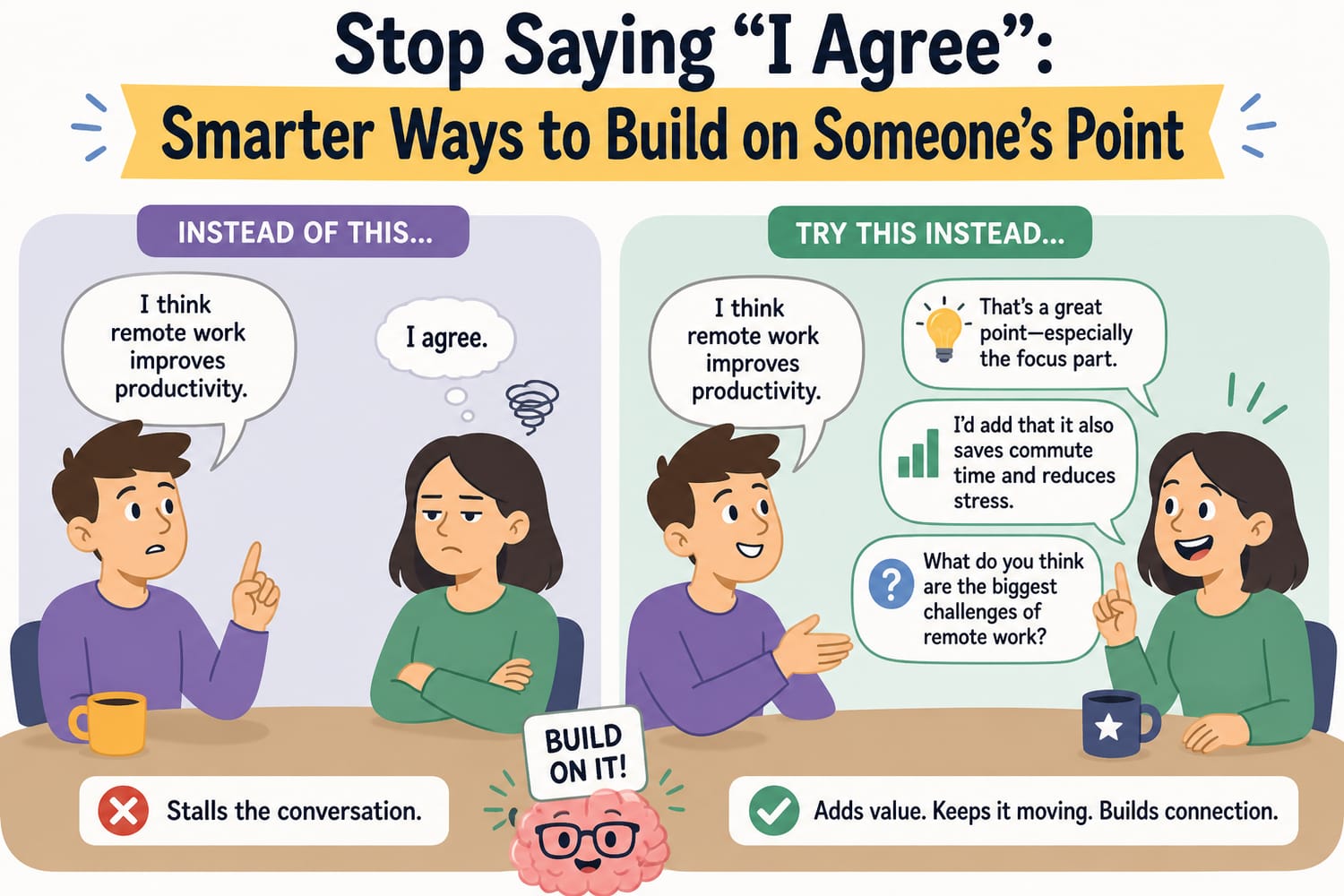
Why “I Agree” Often Falls Flat
“I agree” is perfectly fine. It is clear, polite, and useful. Nobody should be arrested by the Vocabulary Police for saying it.
But if you use it too often, it can start to sound a little flat. In conversations, meetings, essays, debates, interviews, and even casual chats, “I agree” sometimes acts like a verbal period. It confirms your position, but it does not always move the conversation forward.
Imagine someone says:
“Remote work can improve productivity because people have fewer office distractions.”
And you reply:
“I agree.”
That is not wrong. But it does not add much. Now compare it with:
“That’s a strong point, especially because fewer interruptions can help people do deeper, more focused work.”
Suddenly, you sound more engaged. You are not just nodding from the sidelines. You are building the idea.
That is the key: sounding smarter is not about using bigger words. It is about being more precise, thoughtful, and useful in how you respond.
The Difference Between Agreeing and Building
Agreement says, “Yes, I think so too.”
Building says, “Yes, and here is why that matters.”
When you build on someone’s point, you add value. You might explain the reason behind your agreement, offer an example, make a connection, add nuance, or extend the idea in a new direction.
Here is the basic difference:
| Simple Agreement | Smarter Build | |---|---| | “I agree.” | “That makes sense because…” | | “Same here.” | “I’d add that…” | | “You’re right.” | “That connects to…” | | “Exactly.” | “Another way to look at it is…” |
This does not mean you should turn every conversation into a TED Talk. If your friend says, “This pizza is amazing,” you do not need to respond, “Indeed, the cheese distribution supports your thesis.” Please do not be that person.
But in professional, academic, or thoughtful conversations, learning how to build on a point can make your communication sharper and more memorable.
Start With a Reason: “That Makes Sense Because…”
One of the easiest ways to upgrade “I agree” is to add a reason.
Instead of:
“I agree with your idea.”
Try:
“That makes sense because it addresses the biggest issue first.”
Or:
“I agree, especially because it focuses on the people most affected by the decision.”
This structure is simple:
That makes sense because + reason
It works because it shows you understand the point, not just that you approve of it. You are giving your listener evidence that you were paying attention.
Examples:
- “That makes sense because the timeline is our biggest constraint.”
- “I agree with that approach because it gives us room to test before committing.”
- “That’s a good point because it explains why customers might hesitate.”
This is especially helpful in meetings. Saying “I agree” can sound passive. Saying why you agree makes you sound analytical.
Add Evidence: “We’ve Seen This With…”
Another smart way to build on someone’s point is to support it with an example or evidence.
Someone says:
“Clear instructions reduce mistakes.”
You could say:
“Absolutely. We’ve seen this with onboarding—when the checklist is clearer, new team members ask fewer repeat questions.”
Now you are not just agreeing. You are strengthening the argument.
Useful phrases include:
- “We’ve seen this with…”
- “A good example of that is…”
- “That reminds me of…”
- “There’s evidence for that in…”
- “That lines up with…”
Examples:
“That lines up with the survey results, where most people said they wanted simpler instructions.”
“A good example of that is the last project, where early feedback helped us avoid bigger changes later.”
“That reminds me of how schools use practice tests—not to create stress, but to show students where they need help.”
This approach is powerful because examples make ideas easier to understand. Humans love examples. We are basically walking story-processing machines wearing shoes.
Extend the Idea: “Building on That…”
If you want to sound collaborative, not competitive, use phrases that signal you are expanding the original thought.
Try:
- “Building on that…”
- “To add to your point…”
- “Taking that a step further…”
- “Another layer to that is…”
- “That also raises the question of…”
For example:
“Building on that, we might also think about how this affects customer support.”
Or:
“To add to your point, the cost savings are important, but the time savings may be even more valuable.”
These phrases are excellent because they give credit to the first speaker. You are not stealing the spotlight. You are saying, “Your idea created a useful path, and I’m going to walk a little farther down it.”
That is a very smart conversational move.
Make a Connection: “That Connects To…”
Smart people often sound smart because they connect ideas. They do not treat each point as isolated. They show how one idea relates to another.
Instead of:
“I agree.”
Try:
“That connects to what we discussed earlier about customer trust.”
Or:
“That ties into the broader issue of accessibility.”
Other useful phrases:
- “That connects to…”
- “That ties in with…”
- “That relates to…”
- “That supports the larger point that…”
- “That fits with…”
Examples:
“That connects to our earlier conversation about making the website easier to navigate.”
“That ties in with the idea that people are more likely to use tools that feel simple from the start.”
“That supports the larger point that communication is not just about information—it’s about clarity.”
Connections help your audience see the bigger picture. They also show that you are listening beyond the current sentence.
Add Nuance: “I’d Agree, With One Addition…”
Sometimes you mostly agree, but you want to add a condition, caution, or exception. This is where nuance comes in.
Nuance means recognizing that something is not completely black and white. It is one of the easiest ways to sound more thoughtful—because real life is rarely simple.
Instead of:
“I agree.”
Try:
“I’d agree, with one addition…”
Or:
“I think that’s right, though I’d add one caveat.”
A caveat is a warning, condition, or limitation. It is a useful word, but use it naturally. Do not throw it into a sentence like a fancy crouton.
Examples:
“I’d agree, with one addition: we should make sure the plan is realistic for smaller teams.”
“That’s a strong point, though I’d add that cost may still be a barrier for some people.”
“I think that’s right overall, but the timing will matter.”
This approach is helpful when you do not want to sound negative, but you also do not want to ignore complexity. You are saying, “Yes—and let’s be careful.”
Reframe It: “Another Way to Put That Is…”
Reframing means expressing the same idea in a slightly different way. It can make a point clearer, sharper, or more memorable.
Someone says:
“People don’t like using systems that are too complicated.”
You might respond:
“Exactly. Another way to put that is: convenience often determines whether people actually use a tool.”
That is more than agreement. You have translated the idea into a broader principle.
Useful phrases:
- “Another way to put that is…”
- “In other words…”
- “So the key issue is…”
- “What I’m hearing is…”
- “That suggests…”
Examples:
“In other words, the problem isn’t just the product—it’s the experience around the product.”
“So the key issue is not whether the policy exists, but whether people understand it.”
“What I’m hearing is that consistency matters more than intensity.”
Reframing is especially useful when conversations are messy. It helps organize ideas and gives people a clearer sentence to remember.
Ask a Smart Follow-Up Question
One underrated way to build on someone’s point is to ask a good question.
A strong follow-up question shows curiosity and moves the conversation forward. It also prevents you from sounding like you are just waiting for your turn to talk.
Instead of:
“I agree.”
Try:
“That’s interesting. What do you think would be the best way to put that into practice?”
Or:
“That makes sense. How would that work for a smaller team?”
Good follow-up questions often begin with:
- “How would that affect…?”
- “What would happen if…?”
- “What do you think is the main reason…?”
- “How could we apply that to…?”
- “What would be the next step?”
Examples:
“That’s a strong point. How would we measure whether it’s working?”
“I agree with the direction. What would be the first thing to change?”
“That makes sense. What risks should we watch for?”
Questions like these show that you are not just approving an idea—you are thinking with it.
Give Credit While Adding Your Voice
In group conversations, it is useful to acknowledge the person who made the point before you build on it. This is polite, but it is also strategic. It makes you sound generous and confident.
Try:
“I think Maya’s point about timing is important. I’d add that the rollout plan should be just as clear.”
Or:
“To build on what Jordan said, the issue is not only speed but sustainability.”
This kind of phrasing does two things at once:
- It shows respect for the original speaker.
- It allows you to contribute your own thinking.
That is much better than pretending the idea floated down from the clouds directly into your brilliant mind.
Useful phrases:
- “To build on what [Name] said…”
- “I think [Name]’s point is important because…”
- “Adding to [Name]’s idea…”
- “That relates to [Name]’s earlier point about…”
This is especially valuable in workplaces and classrooms, where collaboration matters.
A Quick Phrase Bank for Smarter Agreement
Here are some easy alternatives to “I agree,” depending on what you want to do.
To explain why you agree:
- “That makes sense because…”
- “I think that’s right, especially because…”
- “That’s a strong point since…”
To add an example:
- “A good example of that is…”
- “We’ve seen this with…”
- “That lines up with…”
To extend the idea:
- “Building on that…”
- “To add to your point…”
- “Taking that a step further…”
To add nuance:
- “I’d agree, with one caveat…”
- “That’s true, though I’d also consider…”
- “I think that’s right overall, but…”
To make a connection:
- “That connects to…”
- “That ties in with…”
- “That supports the larger idea that…”
To ask a follow-up:
- “How would that work in practice?”
- “What would be the next step?”
- “What do you think is driving that?”
The One Rule: Add Value, Not Noise
The goal is not to replace “I agree” with something longer every single time. Sometimes “I agree” is exactly right. Sometimes “Absolutely” or “Exactly” is enough.
The real goal is to notice when a conversation would benefit from more: a reason, example, connection, question, or thoughtful caveat.
A smarter response usually does one of five things:
- Clarifies the idea
- Supports it with evidence
- Expands it in a useful direction
- Connects it to something bigger
- Questions it in a constructive way
So the next time you are tempted to say “I agree,” pause for half a second and ask yourself: “Can I add something useful?”
If the answer is yes, try:
“That makes sense because…”
“Building on that…”
“A good example is…”
“That connects to…”
“I’d add one caveat…”
You will sound more thoughtful, more engaged, and yes—probably a little smarter.
Not because you used fancy language, but because you helped the conversation go somewhere.