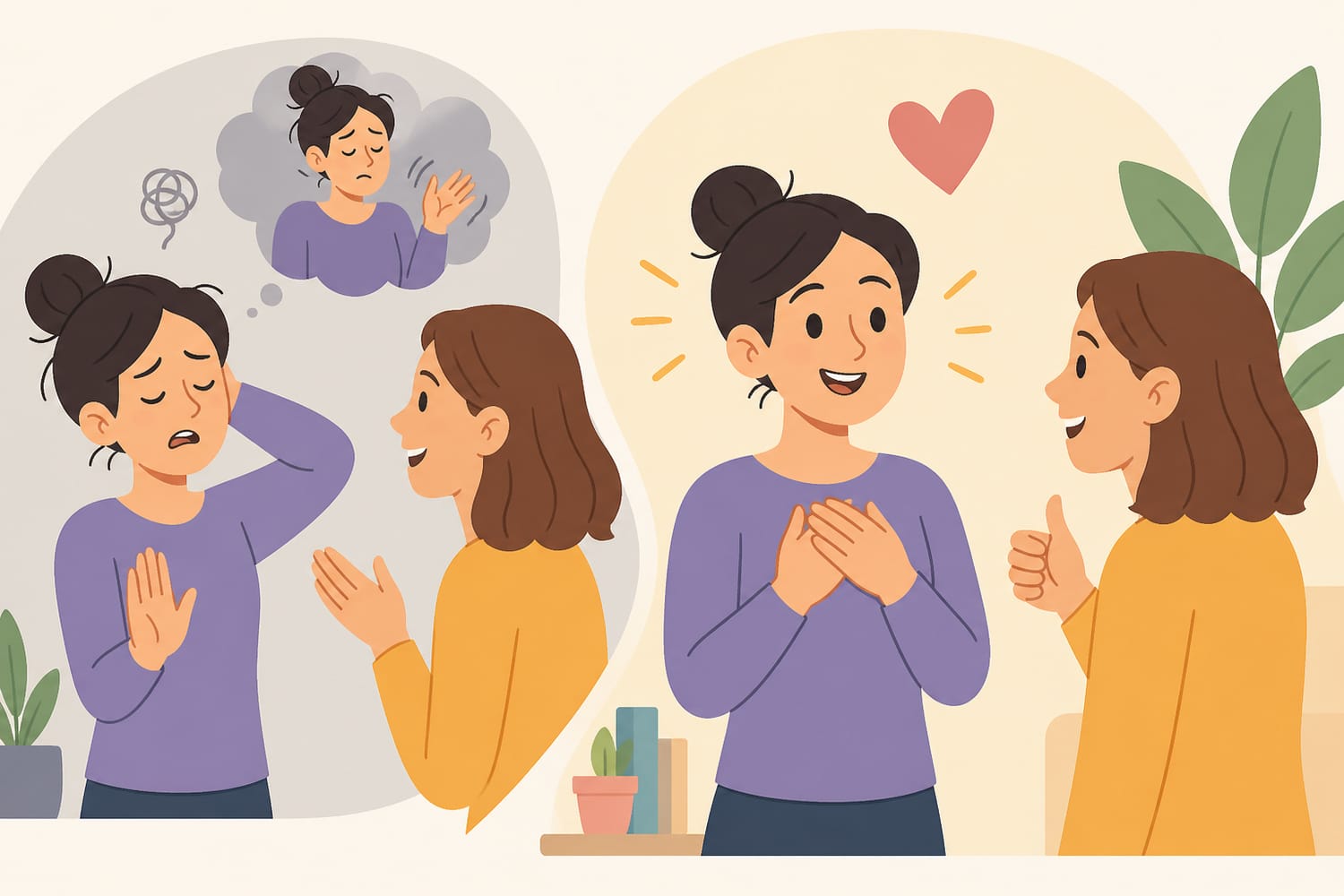
To accept a compliment without downplaying yourself, start with “Thank you.” If you want to add more, acknowledge your effort, explain why the praise matters, or share credit accurately. You don’t need to agree that you’re extraordinary. The goal is simply to receive someone’s kind words without arguing against them.
Easy enough—until someone says, “You did a fantastic job,” and your mouth immediately announces that anyone with a pulse could have done it.
You meant to sound modest. Instead, you’ve volunteered as the opposing counsel in a case against your own competence.
There’s a better way. And, happily, it requires neither a victory speech nor the phrase “I humbly accept this honor.”
Why a Nice Comment Can Feel Surprisingly Awkward
Praise can create a mismatch between how someone sees you and how you see yourself. University of Rochester psychologist J. MacLaren Kelly explains that people may discount positive feedback when it conflicts with their existing self-image. Discomfort can also come from disliking the attention that praise brings.
That doesn’t mean every awkward response reveals a deep confidence problem. For this exercise, skip the self-diagnosis. Just notice what you tend to say:
- The denial: “No, it really wasn’t that good.”
- The disappearing act: “I barely did anything.”
- The flaw inventory: “Thanks, but the ending was terrible.”
- The luck explanation: “I just got lucky.”
Kelly’s guide to receiving praise describes similar ways people minimize their achievements or redirect attention toward unfinished work.
Rather than judging the impulse, try interrupting it. You can feel embarrassed and still give a gracious answer.
“Thank You” Is Not the Same as “I Am Clearly a Genius”
Imagine telling a friend, “That dinner was delicious.”
They reply, “Thank you.”
Would you think, Well, someone’s become unbearable?
Probably not. Apply that same generous standard to yourself.
For this purpose, think of accepting praise as acknowledging someone’s appreciation, not declaring your superiority. “Thank you” doesn’t mean “I have no weaknesses.” It means “I heard what you said, and I appreciate it.”
Compare these responses:
Downplaying: “It was nothing. Anyone could have done it.”
Accepting: “Thank you. I’m glad it helped.”
Boasting: “Thanks. Honestly, nobody else could have pulled that off.”
Aim for the middle. You don’t have to choose between erasing yourself and ordering a commemorative statue.
For more on that balance, explore how to sound confident without sounding arrogant.
Use This Simple Formula: Thank, Add, Stop
Try this three-part approach the next time praise catches you off guard.
1. Thank Them
Begin with something uncomplicated:
- “Thank you.”
- “Thanks—I appreciate that.”
- “That’s kind of you to say.”
Kelly specifically recommends starting with “Thank you” and allowing yourself a few moments to attend to the compliment rather than immediately shifting away from it.
No elaborate wording required. This is gratitude, not a diplomatic summit.
2. Add One Honest Sentence—If You Want
Choose a detail that fits the moment:
Acknowledge effort:
“Thank you. I put a lot of thought into that.”
Acknowledge the outcome:
“Thanks. I’m glad the explanation made things clearer.”
Explain why it matters:
“Thank you. That means a lot coming from you.”
Share your enjoyment:
“Thanks! I had fun making it.”
The extra sentence is optional. Don’t turn it into a compulsory disclaimer, an itemized receipt, or a miniature autobiography.
3. Stop Before the Rebuttal
For this exercise, finish your answer before adding “but.”
“Thank you. I’m pleased with how it turned out.”
Full stop.
Not:
“Thank you. I’m pleased with how it turned out, but you should have seen the first version, and honestly the software did most of it…”
Let the nice sentence survive.
If you’re tempted to supply every qualifying detail, the same restraint used in clarifying without overexplaining is worth practicing here: provide what’s useful, then leave room for the conversation.
Better Responses for Everyday Compliments
Keep a few phrases ready so you don’t have to invent a personality while blushing.
When Someone Praises Your Work
They say: “That presentation was excellent.”
Try: “Thank you. I worked hard to make the main points clear.”
You’ve acknowledged the preparation without announcing that public speaking has reached its historical peak.
When Someone Likes Your Appearance
They say: “That jacket looks great on you.”
Try: “Thanks! I love the color.”
You can mention the bargain if you genuinely want to discuss shopping. Just try accepting the compliment before explaining that the jacket cost less than lunch.
When Someone Appreciates Your Help
They say: “You made that so much easier.”
Try: “I’m really glad I could help.”
Here, “It was nothing” isn’t automatically wrong. You might mean, “You haven’t inconvenienced me.” If that’s your intention, say it more directly:
“You’re welcome—I was happy to do it.”
When Praise Arrives by Email
They write: “Excellent work on the report.”
Try: “Thank you for the feedback. I’m glad the report was useful.”
Resist drafting three paragraphs to explain why their enthusiasm is technically excessive.
Share Credit Without Writing Yourself Out
If other people contributed, name their work—and yours.
Compare:
“Oh, it was all Maya. I didn’t really do anything.”
With:
“Thank you. I handled the analysis, and Maya turned it into a really clear visual story.”
The second response gives an accurate account rather than treating credit as something only one person can hold.
For a group achievement, try:
“Thank you. We’re proud of the result. Jordan led the research, and I coordinated the launch.”
If the praise genuinely belongs elsewhere, correct the attribution:
“I appreciate that, but Sam designed this section. I’ll pass your feedback along.”
Accepting compliments doesn’t require accepting inaccurate credit. Be generous with recognition and precise about contributions—including your own.
What If You Don’t Believe the Compliment?
You don’t have to settle your entire self-image before replying.
Suppose someone says, “You’re such a good writer,” while you’re mentally reviewing seventeen awkward sentences.
Try:
“Thank you. I’m glad you enjoyed reading it.”
That response acknowledges their experience without requiring you to endorse a grand statement about your abilities.
Later, ask yourself what the praise actually referred to. Was your explanation clear? Did a joke land? Did your advice help someone make a decision? Kelly recommends examining the automatic thoughts that lead you to discount praise and considering the evidence for another interpretation.
Keep the compliment proportional. “That was helpful” doesn’t mean “You must now be helpful every second until retirement.”
It can simply describe something you did well.
You Don’t Owe a Compliment in Return—or Gratitude for an Insult
If you genuinely admire something about the other person, say so. But don’t make reciprocation the price of admission for receiving praise.
“Thanks! Your… shoelaces are extremely organized.”
No emergency compliment is necessary.
It’s also worth separating sincere praise from a comment you don’t welcome. If someone says, “You’re surprisingly articulate,” you can ask:
“What do you mean by ‘surprisingly’?”
For unwanted appearance comments, you can say:
“I’d prefer not to discuss my appearance.”
The goal is to stop reflexively rejecting genuine kindness—not to make yourself accept every remark packaged as a compliment.
Let the Kind Words Land
Research discussed in Chicago Booth Review’s exploration of compliments and connection found that people underestimated how happy their compliments would make familiar recipients feel. Even people who knew each other well misjudged the impact of their kind words.
Treat your next sincere compliment as a small opportunity to practice:
- Pause.
- Say “Thank you.”
- Add one honest sentence if you want.
- Skip the argument against yourself.
You don’t have to become dazzlingly comfortable with praise overnight. Start by letting one positive comment stand without attaching a correction.
“It was nothing” can take the afternoon off.
“Thank you” has this covered.