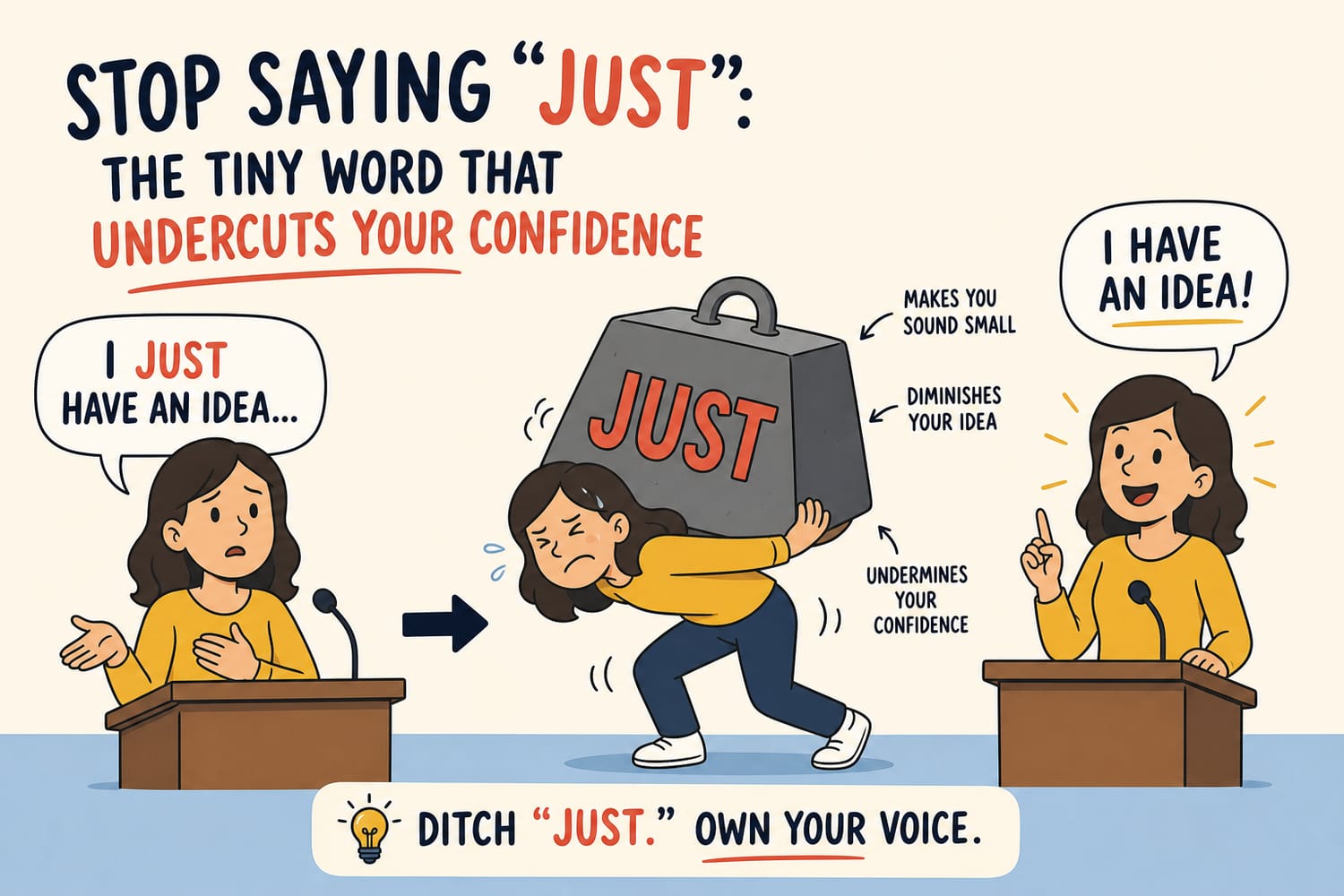
The Small Word With a Big Reputation
“Just” is a tiny word. Four letters. One syllable. It looks harmless, like a polite little doormat.
And yet, in everyday communication, “just” has a sneaky habit of making strong ideas sound weaker than they are.
Consider the difference:
“I’m just checking in to see if you received my email.”
versus:
“I’m checking in to see if you received my email.”
Or:
“I just wanted to ask a question.”
versus:
“I wanted to ask a question.”
Nothing dramatic changed. No fireworks. No grammar police sirens. But the second version sounds more direct, more confident, and more purposeful.
That is the strange power of “just.” It often slips into sentences when we are trying to soften ourselves. We use it to sound less demanding, less intrusive, less certain, less… well, present.
This article is not a campaign to ban “just” from the English language. “Just” is a perfectly good word with several useful meanings. But if your goal is to sound smarter, clearer, and more confident, it is worth noticing when “just” is helping you — and when it is quietly shrinking your message.
What “Just” Actually Means
Before we start blaming “just” for every awkward email ever written, let’s give it a fair trial.
“Just” can mean several things, including:
- Only: “I have just one question.”
- Exactly: “That’s just what I meant.”
- Very recently: “She just arrived.”
- Fair or morally right: “It was a just decision.”
- Simply: “Just press this button.”
So no, “just” is not wrong. It is not sloppy. It is not a forbidden filler word like “um” in a speech contest.
The issue is not the word itself. The issue is how often people use it unconsciously to soften statements that do not need softening.
For example:
“I’m just following up on the report.”
Here, “just” does not add much meaning. Instead, it can make the action sound apologetic, as if following up is somehow unreasonable.
Compare:
“I’m following up on the report.”
This version is clear, calm, and professional. You are not barging into someone’s house with a marching band. You are simply following up.
That is the key: when “just” adds meaning, keep it. When it adds hesitation, consider cutting it.
How “Just” Undercuts Confidence
Language shapes how people perceive us. It also shapes how we perceive ourselves.
When you say, “I just think…” or “I just wanted…” you may be trying to sound polite. But the effect can be self-minimizing. It can make your thought sound less important before anyone has even had a chance to respond.
Look at these examples:
“I just think we should consider another option.”
Now compare:
“I think we should consider another option.”
The second version is not rude. It is not aggressive. It is simply cleaner.
Here is another:
“I’m just wondering if we could move the deadline.”
versus:
“Could we move the deadline?”
The first sentence tiptoes. The second sentence asks.
Of course, tone matters. Context matters. Relationships matter. You probably would not speak to your boss, your best friend, your landlord, and a confused barista in exactly the same way. But in many cases, removing “just” does not make you sound harsh. It makes you sound sure.
And sounding sure is not the same as sounding arrogant.
Confidence says, “My message belongs here.”
Arrogance says, “Only my message belongs here.”
Dropping unnecessary “just” usually moves you toward the first, not the second.
The Politeness Trap
Why do we use “just” so much?
Often, because we are trying to be considerate. We do not want to sound pushy, demanding, bossy, or inconvenient. This is especially common in workplace emails, customer service messages, and conversations where there is a power difference.
For instance:
“I’m just reaching out to ask if you’ve had a chance to review my application.”
That sentence is polite, but it also sounds as if the writer is apologizing for existing in the inbox.
A stronger version might be:
“I’m reaching out to ask if you’ve had a chance to review my application.”
Still polite. Still respectful. Less tiny.
Many people, especially those who have been socially conditioned to be accommodating, use softening language to avoid seeming difficult. This can include words and phrases like:
- “just”
- “sorry to bother you”
- “I may be wrong, but…”
- “kind of”
- “sort of”
- “does that make sense?”
- “I was wondering if maybe…”
None of these phrases are bad in every context. They can be useful. But overusing them can make your communication sound uncertain even when you are perfectly competent.
Politeness is good. Self-erasure is not required.
You can be kind and direct at the same time.
The Email Test: Delete It and See What Happens
One of the easiest ways to improve your writing is to use the “delete it and see” test.
When you spot “just” in an email, message, proposal, or presentation, delete it. Then reread the sentence.
If the meaning stays the same but the sentence sounds stronger, leave it out.
Example:
“I just wanted to remind you that the meeting starts at 2 p.m.”
Delete “just”:
“I wanted to remind you that the meeting starts at 2 p.m.”
Even better:
“Reminder: the meeting starts at 2 p.m.”
Shorter. Clearer. No apology in sight.
Another example:
“I’m just checking whether the invoice has been processed.”
Without “just”:
“I’m checking whether the invoice has been processed.”
Or more directly:
“Has the invoice been processed?”
The best version depends on the situation. But once you remove “just,” you can see the sentence more clearly. It is like wiping fog off a mirror.
Here are a few common before-and-after examples:
| Instead of saying… | Try saying… | |---|---| | “I just wanted to ask…” | “I wanted to ask…” | | “I’m just following up…” | “I’m following up…” | | “I just think…” | “I think…” | | “I’m just wondering…” | “I’m wondering…” / “Could we…” | | “Just checking in…” | “Checking in…” | | “I just need…” | “I need…” |
Notice that the revised versions are not rude. They are simply less padded.
When “Just” Is Actually Useful
Let’s be fair to our tiny friend. Sometimes “just” earns its place.
For example, if you mean only, it can be necessary:
“I need just five minutes.”
Here, “just” tells the listener the request is small. It adds real meaning.
If you mean recently, it is also useful:
“I just spoke with the client.”
That tells us the conversation happened a moment ago or very recently.
If you mean exactly, keep it:
“That’s just what I was looking for.”
And sometimes “just” can create warmth or ease:
“I just wanted to say thank you.”
Could you write “I wanted to say thank you”? Yes. But in some personal contexts, “just” may sound gentle and sincere. Language is not math. There is no universal formula where one word always produces one effect.
The point is not to eliminate “just.” The point is to choose it.
A chosen “just” is fine.
An automatic “just” is worth questioning.
Stronger Ways to Sound Polite
If you remove “just,” you may worry that your message sounds too blunt. Good news: there are many ways to be polite without making yourself smaller.
Instead of softening your entire message, use clear and respectful phrasing.
Try:
“Could you send the file by Friday?”
instead of:
“I was just wondering if you could possibly send the file by Friday?”
Try:
“When you have a chance, please review the attached draft.”
instead of:
“I just wanted to see if you might have a chance to review the attached draft.”
Try:
“Thank you for your help with this.”
instead of:
“Sorry to bother you, I just need your help with this.”
You can also use warmth at the beginning or end of a message:
“I hope your week is going well. I’m following up on the contract we discussed.”
Or:
“Thanks again — I appreciate your help.”
These phrases create friendliness without weakening the main point.
A useful structure is:
- Friendly opening
- Clear request or statement
- Helpful details
- Appreciative closing
For example:
Hi Maya,
I hope your week is going well. I’m following up on the design draft for the homepage. Could you send your feedback by Thursday afternoon? That will give us time to make revisions before Monday’s meeting.
Thanks — I appreciate it.
No “just” required. Still human. Still pleasant. Not a robot wearing a blazer.
“Just” in Speech: The Confidence Tune-Up
This is not only about writing. “Just” also appears in speech, especially when we are nervous.
You might hear yourself say:
“I just have a quick question.”
Or:
“I just wanted to add something.”
Or:
“I just think maybe we should wait.”
In meetings, interviews, presentations, and difficult conversations, these phrases can make your contribution sound tentative.
Try:
“I have a question.”
“I’d like to add something.”
“I think we should wait.”
These sentences have more spine.
If removing “just” feels uncomfortable, practice gradually. You do not need to transform overnight into a courtroom attorney delivering closing arguments under dramatic lighting.
Start with one phrase. For example, replace:
“I just wanted to say…”
with:
“I wanted to say…”
Then try:
“I’d like to say…”
Then:
“Here’s my thought…”
The more you practice direct language, the more natural it feels.
Confidence is often a habit before it becomes a personality trait.
The Bigger Lesson: Stop Pre-Apologizing
“Just” is part of a larger pattern: pre-apologizing.
Pre-apologizing happens when we weaken, cushion, or apologize for a message before delivering it.
Examples include:
“Sorry, this may be a stupid question…”
“I’m no expert, but…”
“I could be totally wrong…”
“This is probably obvious…”
Sometimes humility is appropriate. If you are genuinely uncertain, say so. If you are outside your area of expertise, acknowledge it. Accuracy matters.
But do not use humility as a hiding place.
There is a big difference between:
“I may be missing something, but can we review the numbers again?”
and:
“Sorry, this is probably wrong, but I just thought maybe the numbers might not add up?”
The first is thoughtful. The second is wrapped in bubble wrap.
Clear communication helps everyone. It saves time, reduces confusion, and makes your ideas easier to evaluate. When you remove unnecessary softeners, people can focus on what you are saying instead of wading through hesitation.
A Quick “Just” Audit
Here is a simple challenge: for the next week, notice every time you write “just.”
Do not judge yourself. Do not spiral. Do not dramatically whisper, “I’ve been undermining myself for years,” while staring out a rainy window.
Just notice. Yes, that “just” was intentional.
When you find the word, ask:
- Does it change the meaning?
- Does it make the sentence clearer?
- Am I using it to sound polite, or to sound smaller?
- Would the sentence be stronger without it?
If the word is doing useful work, keep it.
If not, cut it.
You may be surprised by how often your sentences improve instantly.
The Takeaway: Be Clear, Not Tiny
“Just” is not your enemy. It is a tool. But like any tool, it can be overused. You would not use a teaspoon to dig a swimming pool, and you do not need “just” to soften every request, idea, or follow-up.
When you remove unnecessary “just,” your language often becomes:
- clearer
- shorter
- more confident
- more professional
- easier to understand
The goal is not to sound harsh. The goal is to stop hiding your message behind unnecessary padding.
So the next time you write, “I’m just checking in,” pause.
Try: “I’m checking in.”
The next time you say, “I just think,” try: “I think.”
Small change. Big difference.
After all, sounding smarter is not always about using bigger words. Sometimes it is about trusting the simple ones you already have.