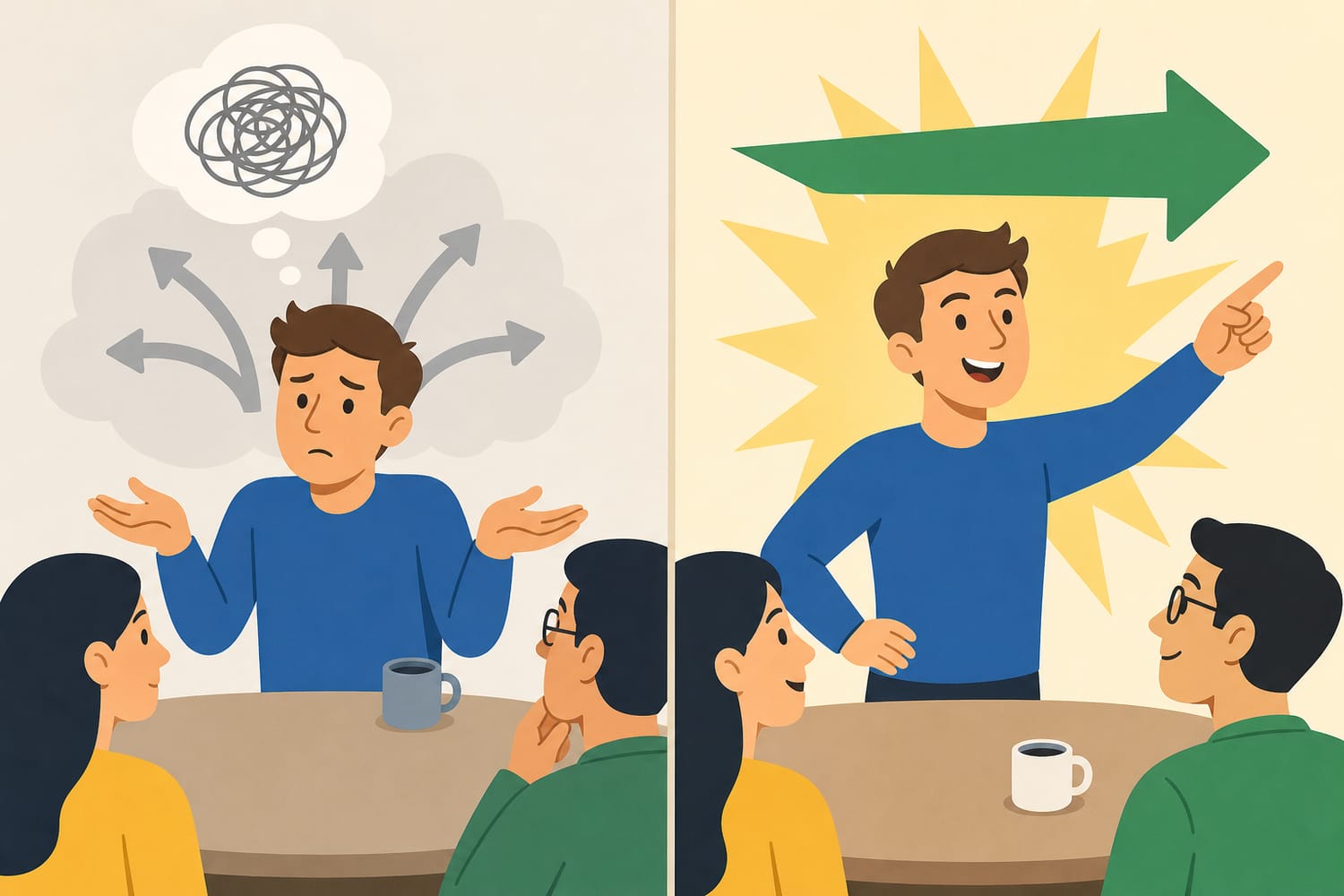
The Tiny Phrase That Steals Your Confidence
“Kind of” is one of those phrases that sneaks into everyday speech like a cat into an open cardboard box. It feels harmless. Casual, even. You might say:
- “I’m kind of interested in the role.”
- “That’s kind of a problem.”
- “I kind of disagree.”
- “We should kind of rethink the plan.”
The trouble is that “kind of” often weakens what you mean. It can make a clear thought sound foggy, hesitant, or unfinished. Instead of sounding thoughtful, you may sound unsure—even when you are not.
To be fair, “kind of” is not always wrong. Sometimes it’s useful. If something is genuinely partial, approximate, or difficult to define, “kind of” does its job. A tomato is kind of a fruit in everyday conversation, even though botanically it is a fruit. A movie might be kind of funny if it made you smile twice and check your phone three times.
But many people use “kind of” as a verbal cushion. It softens opinions, blurs decisions, and drains energy from otherwise good ideas. If your goal is to sound smarter, clearer, and more decisive, learning when to replace “kind of” is an easy upgrade.
Think of it as removing bubble wrap from your sentences. The meaning was already there—you’re just letting people see it.
Why “Kind Of” Makes You Sound Less Certain
“Kind of” is a hedge. In language, a hedge is a word or phrase that reduces the force of a statement. Other common hedges include “sort of,” “maybe,” “I guess,” “just,” “a little,” and “probably” when used unnecessarily.
Hedges are not evil. They help us avoid sounding arrogant, leave room for nuance, and soften sensitive messages. Imagine telling a friend, “Your soup is disgusting.” Now imagine saying, “It’s kind of salty for me.” One preserves the friendship. The other may result in a wooden spoon being thrown.
The problem appears when hedges become automatic. In professional settings, presentations, emails, interviews, and serious conversations, too many hedges can make you seem less confident in your own thoughts.
Compare these:
- “I kind of think we should delay the launch.”
- “I think we should delay the launch.”
- “We should delay the launch.”
- “I recommend delaying the launch because the testing results are incomplete.”
Each version grows stronger. The final one is the best because it is decisive and supported by a reason. It does not shout. It does not pretend to know everything. It simply states a position clearly.
That is the goal: not to sound bossy, but to sound intentional.
When “Kind Of” Is Actually Fine
Before we escort “kind of” out of the building, let’s be fair. There are times when it belongs.
Use “kind of” when you mean “somewhat,” “approximately,” or “not exactly.” For example:
- “The sauce is kind of spicy.”
- “He’s kind of like a mentor to me.”
- “It’s kind of a mystery.”
- “The design is kind of retro.”
In these cases, “kind of” communicates uncertainty or partial similarity accurately. You are not weakening the sentence by accident; you are adding useful meaning.
It can also be appropriate in informal conversation. If you are chatting with friends, “kind of” helps create a relaxed tone. Not every sentence needs to walk into the room wearing a blazer.
The key question is: Are you using “kind of” because it improves the meaning, or because you are afraid to say what you mean?
If it improves the meaning, keep it. If it hides the meaning, replace it.
Stronger Words for Opinions
One of the most common places people use “kind of” is before an opinion.
“I kind of liked it.” “I kind of disagree.” “I kind of think this is the best option.”
If you want to sound more decisive, choose a word that matches your actual level of belief.
Instead of “I kind of think,” try:
- “I think”
- “I believe”
- “I suggest”
- “I recommend”
- “In my view”
- “My position is”
- “The strongest option is”
Examples:
- Weak: “I kind of think the second proposal is better.”
- Stronger: “I think the second proposal is better.”
- Strongest: “I recommend the second proposal because it is cheaper and faster to implement.”
Notice that the strongest version does more than delete “kind of.” It adds evidence. Decisiveness is not just about sounding firm; it is about being clear and useful.
For disagreement, replace “I kind of disagree” with:
- “I disagree.”
- “I see it differently.”
- “I have a different view.”
- “I’d challenge that point.”
- “I’m not convinced.”
- “That doesn’t match the data.”
These phrases let you be direct without being rude. “I see it differently” is especially helpful because it sounds calm, confident, and open to discussion.
Stronger Words for Problems
Another classic use: “That’s kind of a problem.”
This can sound oddly casual, especially when the problem is very real. If a project is three weeks late, the budget has vanished, and the office printer has started smoking, “kind of a problem” may be underselling the situation.
Try more specific alternatives:
- “That’s a concern.”
- “That’s an issue.”
- “That’s a significant issue.”
- “That creates a risk.”
- “That needs attention.”
- “That could delay the project.”
- “That changes our timeline.”
- “That requires a decision.”
Examples:
- Weak: “The missing data is kind of a problem.”
- Stronger: “The missing data is a concern.”
- Better: “The missing data creates a risk because we can’t verify the results.”
Specific language makes you sound sharper because it shows you understand the size and nature of the problem. A “concern” is different from a “risk.” An “issue” is different from a “delay.” The more accurate your word, the smarter your sentence sounds.
And no, you do not need to use dramatic words like “catastrophe” unless there is actual catastrophe. If the coffee machine is broken, that may feel catastrophic, but legally and linguistically, it is probably an inconvenience.
Stronger Words for Interest and Enthusiasm
“Kind of” also appears when people are trying not to seem too excited.
“I’m kind of interested.” “I kind of like the idea.” “That sounds kind of exciting.”
This can be a problem in interviews, networking, dating, sales, creative work, or anywhere enthusiasm matters. If you are interested, say so. People generally prefer clarity to mysterious emotional fog.
Instead of “kind of interested,” try:
- “I’m interested.”
- “I’m very interested.”
- “That appeals to me.”
- “That sounds promising.”
- “I’m excited about that.”
- “I’d like to learn more.”
- “That’s exactly the kind of opportunity I’m looking for.”
Examples:
- Weak: “I’m kind of interested in the position.”
- Stronger: “I’m interested in the position.”
- Best: “I’m excited about the position because it combines research, writing, and strategy.”
Again, the best version explains why. Enthusiasm plus reasoning sounds intelligent. Enthusiasm without reasoning can still sound good, but enthusiasm with reasoning sounds credible.
The same applies to ideas:
- Weak: “I kind of like the new design.”
- Stronger: “I like the new design.”
- Better: “I like the new design because it’s cleaner and easier to navigate.”
Decisive does not mean exaggerated. You do not have to say “I am wildly obsessed with this spreadsheet.” Unless you are. In which case, congratulations on finding your passion.
Stronger Words for Decisions
If “kind of” has a favorite hiding place, it is probably near decisions.
“We should kind of move forward.” “I kind of want to choose option A.” “Let’s kind of wait and see.”
These sentences are frustrating because they make action unclear. Are we moving forward or not? Are we choosing option A or merely gazing at it fondly from across the room?
Use decision words instead:
- “Let’s proceed.”
- “Let’s pause.”
- “I recommend option A.”
- “We should choose option B.”
- “The next step is”
- “Our priority should be”
- “Let’s decide by Friday.”
- “We need more information before deciding.”
Examples:
- Weak: “We should kind of wait until next week.”
- Stronger: “We should wait until next week.”
- Better: “We should wait until next week so we can include the updated numbers.”
If you are not ready to decide, say that clearly too. Decisive language does not always mean making an immediate choice. Sometimes the smartest sentence is:
“We do not have enough information to decide yet.”
That sounds far more confident than:
“I kind of don’t know what we should do.”
Uncertainty is not the enemy. Vague uncertainty is.
Use Precision Instead of Padding
Many “kind of” sentences improve when you replace the phrase with a precise adjective or verb.
Instead of saying:
- “The meeting was kind of long.”
You might say:
- “The meeting was long.”
- “The meeting ran 30 minutes over.”
- “The meeting covered too many topics.”
- “The meeting needed a clearer agenda.”
Each version tells us more. “Kind of long” is a shrug. “Ran 30 minutes over” is a fact. “Needed a clearer agenda” is an insight.
Instead of:
- “The instructions are kind of confusing.”
Try:
- “The instructions are unclear.”
- “The instructions are incomplete.”
- “The steps are out of order.”
- “The wording is ambiguous.”
- “The example doesn’t match the task.”
Precision makes you sound smarter because it reduces the listener’s work. They do not have to guess what you mean. You have already done the thinking for them.
A useful trick: when you catch yourself writing “kind of,” ask, “What kind, exactly?”
- Kind of bad? Is it inaccurate, late, expensive, risky, unclear, unfair, boring?
- Kind of good? Is it useful, efficient, original, persuasive, practical, elegant?
- Kind of difficult? Is it complex, time-consuming, technical, unfamiliar, physically demanding?
The exact word is usually waiting nearby, wearing a tiny name tag.
How to Sound Decisive Without Sounding Rude
Some people rely on “kind of” because they do not want to sound harsh. That is understandable. Directness can be clumsy if it is not handled well.
The solution is not to weaken every statement. The solution is to combine clarity with respect.
Try these patterns:
Clear opinion + respectful tone
- “I see your point, but I disagree.”
- “I understand the concern. My recommendation is different.”
- “That’s a fair question. I would approach it this way.”
Direct feedback + specific reason
- “This section is unclear because the main point comes too late.”
- “The proposal is strong, but the budget needs more detail.”
- “The timeline is ambitious, so we should add a backup plan.”
Decision + openness
- “I recommend moving forward, but I’m open to reviewing any risks I missed.”
- “My preference is option A. What concerns do you see?”
- “I think this is the right direction. Let’s test it with users before finalizing.”
These sentences are confident without being arrogant. They show that you can hold a position and still listen. That combination is powerful.
A Simple Editing Trick
Here is an easy exercise: search your emails, documents, or messages for “kind of” and “sort of.” Then test each one.
Ask three questions:
Is it accurate?
If you truly mean “somewhat” or “not exactly,” keep it.Can I delete it?
“I kind of agree” often becomes “I agree” with no loss of meaning.Can I replace it with something more specific?
“Kind of difficult” might become “time-consuming,” “technical,” or “unclear.”
Try it with these:
- “This is kind of important.” → “This is important.”
- “The result is kind of surprising.” → “The result is unexpected.”
- “I’m kind of worried about the deadline.” → “I’m concerned about the deadline.”
- “The plan is kind of working.” → “The plan is improving retention but not reducing costs.”
That last example shows the real magic. Sometimes “kind of” is hiding a more nuanced truth. Once you remove it, you can explain what is actually happening.
The Goal Is Not to Delete Your Personality
You do not need to become a human press release. Natural speech includes softness, hesitation, humor, and approximation. A world without “kind of” would be efficient, yes, but also slightly robotic and probably less fun at brunch.
The goal is awareness.
Use “kind of” when it serves your meaning. Avoid it when it dilutes your meaning. If you are making a recommendation, giving feedback, stating an opinion, or explaining a problem, choose words that show you know what you mean.
Decisive language does not have to be loud. It does not need to dominate the room. Often, it is simply the sentence that arrives without unnecessary fog.
So the next time you hear yourself say, “I kind of think…” pause for half a second. Ask yourself what you really think. Then say that.
Your ideas will sound clearer. Your writing will feel stronger. And you will seem more confident—not because you used fancy words, but because you used the right ones.