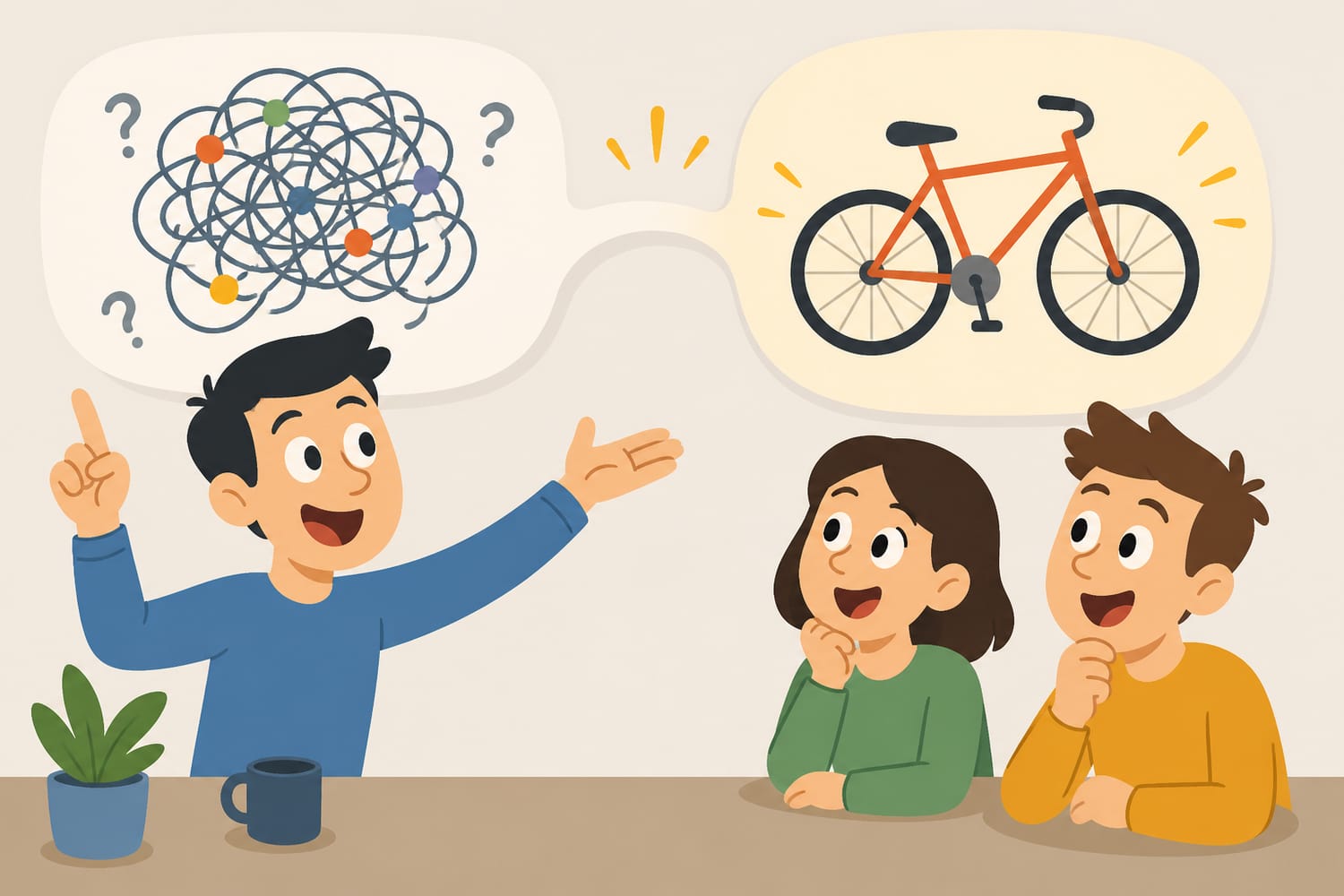
The “it’s like” trick uses an analogy to explain an unfamiliar idea through something your listener already understands. Choose a familiar comparison, show exactly how the important parts match, and point out where the comparison stops working. The goal isn’t to sound more complicated. It’s to make complexity easier to follow.
Imagine someone tells you, “We need to identify the constraint limiting our workflow.”
Now imagine they add: “It’s like a grocery store with six open checkout lanes but only one person bagging everything. Speeding up the cashiers won’t fix that final backup.”
Suddenly, you have something to picture—and a reason the proposed solution might not work.
That’s the useful part of “it’s like.” Two ordinary words can introduce an explanation that does more work than a paragraph of jargon.
Why a Familiar Comparison Helps
An analogy connects two situations through a shared relationship or pattern. The things themselves don’t need to look alike; what matters is how their relevant parts work together.
Northwestern University’s explanation of structure-mapping theory describes analogy as transferring a system of relationships from one area to another. In everyday terms, you borrow an arrangement someone understands to explain one they don’t.
A checkout line and an office approval process are physically different. But both can involve work arriving faster than one stage can handle it.
The useful match is that relationship—not the shopping carts.
This gives you a practical rule: compare how things work, not merely how they look or feel.
“Our project is like a circus” expresses a mood. “Our project is like a relay race: each person needs a clear handoff before the next stage can begin” explains a dependency.
Both are colorful. Only the second tells you what to pay attention to.
Build Your Analogy in Four Simple Steps
You don’t need to wait for a dazzling comparison to arrive while you’re shampooing. Start with the idea, then build outward.
1. Decide What You’re Actually Explaining
Finish this sentence first:
“The one thing I want them to understand is…”
Suppose your topic is project planning. That could include deadlines, staffing, budgets, priorities, and roughly eleven varieties of spreadsheet.
Narrow it down:
“Adding people won’t help if everyone is waiting for the same approval.”
Now you have a specific relationship to explain. You’re looking for a comparison involving a shared waiting point—not an analogy for the entire working world.
2. Choose Something Familiar to Your Listener
Try everyday activities: cooking, shopping, traveling, organizing a closet, or waiting in line.
But don’t assume your favorite hobby is universal. An elaborate football comparison isn’t helpful if the listener needs football explained first.
The University of Southern California’s guidance on teaching with analogies emphasizes considering what learners already know and discussing the comparison’s limitations. Familiarity belongs to the audience, not just the speaker.
Ask yourself: “Will they understand this example without a second explanation?”
If not, choose another.
3. Explain the Match
Don’t stop at “it’s like a restaurant.” Explain which part of the restaurant matters.
“It’s like a restaurant where every order must pass through one oven. Hiring more servers won’t increase the oven’s capacity.”
Then connect it back:
“Our final approval step is that oven. More people preparing work won’t help unless we also address the approval delay.”
The comparison has now earned its place. It explains both the problem and why one tempting fix might disappoint.
4. Mark the Boundary
Add a short limit when there’s a realistic risk of misunderstanding:
“The comparison is about capacity, not about people being interchangeable equipment.”
You don’t need a disclaimer longer than the explanation. Just identify the difference that could lead someone astray.
Research published in CBE—Life Sciences Education discusses both the usefulness of analogies and the risk of misconceptions when their limits go unexamined. A good comparison highlights selected similarities; it doesn’t make two things identical.
Three “It’s Like…” Examples You Can Adapt
The easiest way to understand the trick is to watch it work. Here are three examples, each aimed at one specific idea.
Explaining Dependencies: The Dinner Problem
The idea: Some tasks cannot begin until another task is complete.
“It’s like making toast with jam. You can put the plate out early, but you can’t spread jam on the toast until the toast exists. Our design work is the toast; the final page layout has to wait for it.”
Why this comparison fits: It separates preparation that can happen now from work that genuinely depends on an earlier step.
Where it stops: Real projects may allow partial drafts and overlapping stages. The example explains a dependency, not a rule that everyone must sit motionless until the toaster dings.
Explaining Useful Detail: The Map Problem
The idea: An explanation should include the details needed for its purpose, not every available detail.
“It’s like drawing someone a map to your house. Include the turn they’re likely to miss. You probably don’t need to label every shrub.”
Why this comparison fits: It makes relevance the deciding factor. You aren’t removing detail because detail is bad; you’re choosing what helps someone reach the destination.
This is also a useful way to approach clarifying without overexplaining: ask what the listener needs next, rather than unloading everything you know.
Explaining Trade-Offs: The Suitcase Problem
The idea: With fixed capacity, adding one thing may require giving up another.
“It’s like packing a full suitcase. If the new boots have to come, something else may have to stay home. With our current team and deadline, adding this feature means reconsidering another task.”
Why this comparison fits: It makes the constraint explicit instead of treating the new request as magically weightless.
Where it stops: Project capacity can sometimes change. A team might extend the deadline or adjust its resources. State the assumption: with the current capacity.
Avoid the Comparisons That Create More Work
An analogy should help explain the idea—not become a second puzzle.
The Unfamiliar Comparison
“Think of it as a Kubernetes orchestration layer” may be perfectly helpful to the right audience.
For everyone else, you’ve introduced a new mystery wearing a tiny technical hat.
Choose the simplest familiar situation that preserves the relationship you need.
The Comparison That Keeps Changing
“Our strategy is a roadmap, but also a garden, and the engine needs fuel.”
Pick a world and stay in it long enough to make your point. Otherwise, your listener has to keep figuring out which parts belong together.
The Comparison That Pretends to Be Proof
An analogy can illustrate your reasoning. It cannot establish a claim just because the comparison sounds convincing.
“This policy is like locking the front door” doesn’t, by itself, demonstrate that the policy is effective or proportionate. You still need relevant evidence.
Try separating the jobs:
“Here’s the comparison that explains the proposal. Here’s the evidence we need to evaluate it.”
The Unnecessary Analogy
Sometimes the plain sentence wins.
“Please send the revised file by Thursday” does not need a supporting story about trains leaving stations.
Use “it’s like” when it resolves a genuine difficulty—not as decorative seasoning on every instruction.
Check Whether the Idea Actually Clicked
After explaining, ask a question that brings the listener back to the real situation:
“Given that, which step should we examine first?”
Or:
“What would that mean for the extra feature?”
You’re looking for understanding of the original idea, not applause for your restaurant impression.
If you’re the listener, you can also test the comparison: “So the approval stage is the oven in this example?” These polished ways to ask for clarification offer useful language when you need the connection made more explicit.
Try This Before Your Next Explanation
Choose one idea you often struggle to explain. Write three sentences:
- The idea: “The key point is…”
- The comparison: “It’s like… because…”
- The limit: “The comparison works for… but not…”
Then remove anything that doesn’t help the listener understand the key point.
You don’t need the cleverest analogy in the room. You need one that makes the right relationship visible.
Sounding smarter doesn’t have to mean making people marvel at your vocabulary. Aim for the better response:
“Oh. Now I get it.”