Why Baby Talk Sounds Different Around the World
The Short Answer: Babies Hear Language Through a Cultural Filter
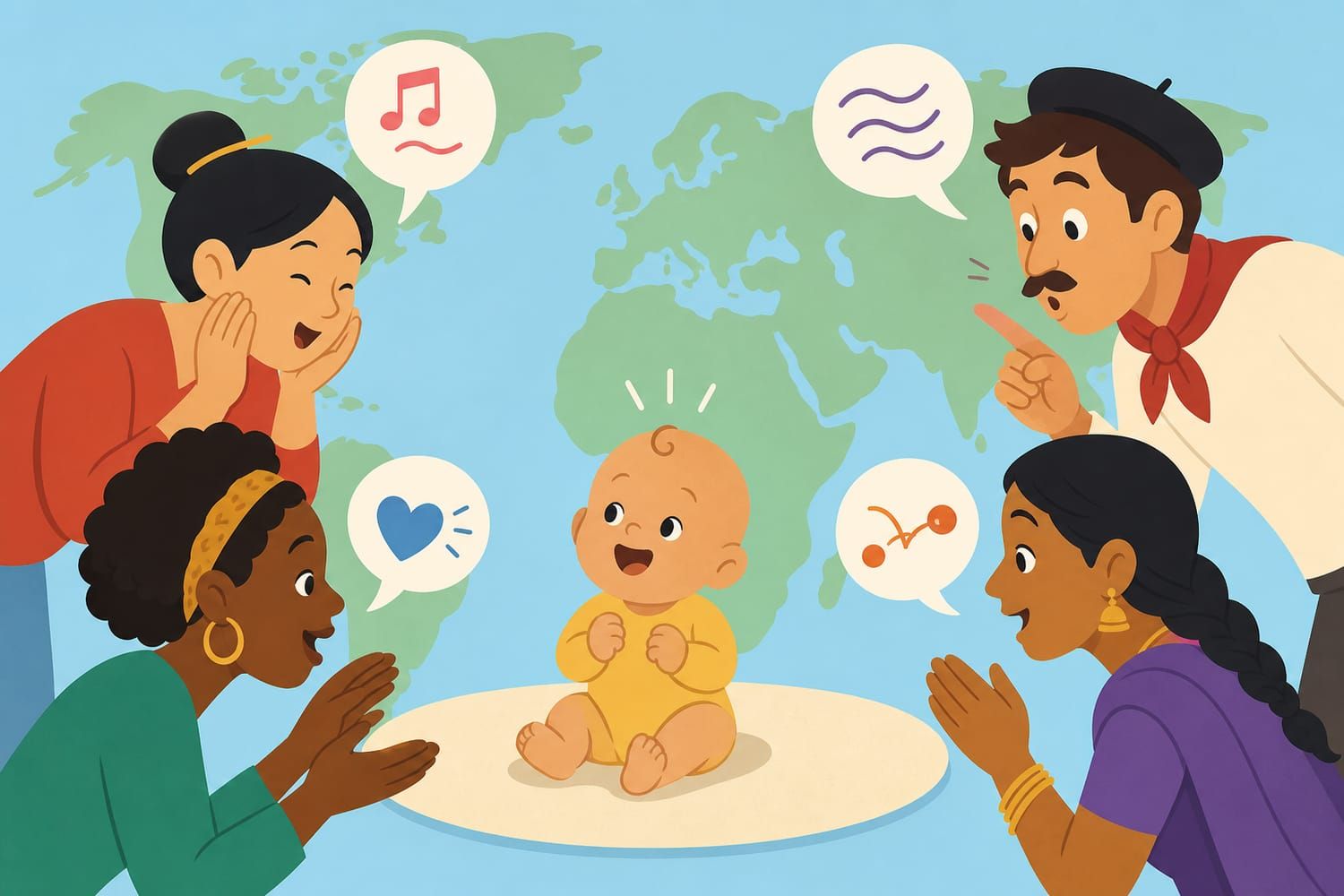
Baby talk sounds different around the world because caregivers adapt the sounds, rhythms, vocabulary, and grammar of their own languages when speaking to infants. The warm, repetitive style is widespread, but its exact form depends on everything from local speech patterns to cultural ideas about how—and how often—adults should address babies.
Baby Talk Is Not Just Adorable Nonsense
Mention “baby talk,” and you may picture an adult announcing, “Who’s a widdle cutie?” in a voice normally reserved for cartoon squirrels. Linguists, however, are usually interested in something broader and more useful: infant-directed speech.
Infant-directed speech is the special register people often use around babies. Compared with ordinary adult conversation, it commonly includes:
- A higher or more varied pitch
- Slower speech
- Shorter sentences
- Clearer pauses
- Repeated words and phrases
- Exaggerated facial expressions
- Plenty of questions, even when the listener cannot answer
In other words, baby talk is often less about replacing dog with doggy-woggy and more about changing how language is delivered. As this UNICEF guide to baby talk explains, caregivers generally use real language while making it slower, simpler, more repetitive, and more expressive.
This is an example of a linguistic register: a version of language suited to a particular audience or situation. Adults make similar adjustments all day long, as anyone who has noticed how language changes when talking to Grandma versus Google will recognize. Babies simply inspire one of our most dramatic register changes.
The Global Baby-Talk Toolkit
Although baby talk varies, it is not completely different in every society. Research across languages and cultures has found recurring acoustic patterns in the ways people speak and sing to infants.
Caregivers frequently make their voices warmer, more melodic, and easier to follow. Babies tend to prefer infant-directed speech over ordinary adult speech, perhaps because its exaggerated rhythm and positive emotion signal, “This message is for you.” Studies also suggest that its pauses, repetitions, and vocal contrasts can help infants notice speech sounds and locate individual words within the stream of language.
Think of it as a shared musical framework. People around the world may use some of the same instruments—pitch, rhythm, repetition, facial movement—but every language plays a different tune.
Every Language Supplies Different Building Blocks
Sound Systems Shape the Melody
Languages do not all use sound in the same way. English speakers can raise their pitch dramatically without changing the dictionary meaning of a word. In a tone language such as Mandarin, however, pitch patterns help distinguish one word from another.
Mandarin-speaking caregivers still use exaggerated intonation with babies, but they must preserve the important pitch information carried by lexical tones. Research indicates that speakers can raise and expand their pitch while maintaining the contrasts babies need to hear.
The result is infant-directed speech that may sound less wildly sing-song than some varieties of English baby talk—not because Mandarin-speaking caregivers are less affectionate, but because pitch already has an important linguistic job.
Even varieties of the same language can differ. American English infant-directed speech has sometimes been found to use more exaggerated prosody than British English. There is no single “English baby voice,” just as there is no single adult English accent.
Grammar Joins the Cuteness Parade
Baby talk also borrows from the grammatical habits of its language. Languages with productive diminutive endings can turn an ordinary noun into something smaller, sweeter, or more affectionate.
English does this to a limited degree with words such as doggy and kitty. Spanish can use endings such as -ito and -ita, while Italian frequently uses its own diminutive forms. These endings are not exclusively for babies, but they fit naturally into affectionate speech.
Some languages also repeat syllables or entire words. Linguists call this reduplication, and baby-directed vocabulary is full of it: English has choo-choo, night-night, and bye-bye. Italian examples include nanna for sleep and bau-bau for a dog or its bark.
Research on early vocabulary suggests that diminutives and reduplicated forms may be especially noticeable within continuous speech. Their predictable rhythms can make them easier for young listeners to identify and remember.
Animals Apparently Speak Many Languages
One of the most entertaining differences involves animal noises. An English-speaking dog says woof-woof or bow-wow. An Italian dog may say bau-bau. The dogs are not changing accents at the border; people are interpreting the same messy natural sound through different linguistic systems.
These words are examples of onomatopoeia, but they are not perfect recordings of reality. Each language selects familiar sounds and syllable patterns to represent what listeners hear.
That is why roosters, frogs, ducks, and cats appear to become multilingual as humans travel. Animal noises reveal something also seen in languages that organize familiar ideas in unexpectedly different ways: languages do not merely label the world. They package it according to their own patterns.
Culture Determines Who Talks to Babies—and How
The biggest worldwide difference may not be the sound of baby talk but the amount of it.
In many Western, urban, middle-class households, adults frequently hold face-to-face “conversations” with infants. A caregiver may narrate a diaper change, ask which sock the baby prefers, and wait politely for an answer consisting mainly of drool.
That practice is not universal. In some communities, babies spend more time listening to conversations among older children and adults. Caregivers may speak directly to them less often, or mainly when feeding, comforting, carrying, or guiding their actions.
Researchers studying a rural Tseltal Mayan community in Mexico found that young children heard relatively little speech addressed specifically to them but abundant conversation directed to other people. The children in that study still began producing words and short sentences at broadly expected ages. The findings do not show that interaction is unimportant; rather, they demonstrate that children may have multiple routes into language, including participation, observation, routines, and overheard speech. The Max Planck Institute’s summary of the Tseltal research offers a useful look at this cultural variation.
Cultural differences should therefore not be ranked as “more caring” or “less caring.” Affection can be expressed through speech, touch, shared activity, eye contact, carrying, singing, or simply including a baby in the social world.
Why the Back-and-Forth Matters
Infant-directed speech can attract attention, highlight emotion, and make certain language patterns easier to detect. Yet the most valuable feature may be its responsiveness.
A baby coos. An adult answers. The baby kicks, squeals, or studies the ceiling fan with enormous seriousness. The adult reacts again. This creates a tiny conversation long before the child knows any conventional words.
The Center on the Developing Child at Harvard calls these responsive exchanges “serve and return” interactions. They support early communication and social development because the baby’s sounds, looks, and gestures receive meaningful responses.
The precise wording matters less than the connection. A caregiver does not need to perform a flawless high-pitched monologue or turn breakfast into a vocabulary seminar. Responding, taking turns, naming nearby objects, and following the baby’s attention can all contribute to a rich interaction.
What About Babies Growing Up With Several Languages?
Multilingual households do not need to choose one approved form of baby talk. Caregivers can naturally use infant-directed speech in each language they know well.
A baby may hear different melodies, sound patterns, affectionate endings, and animal noises from different relatives. Grandma may use one language, a parent another, and siblings a lively mixture. That variety is not inherently confusing; it is information the developing brain can gradually organize.
The result may be a child whose linguistic world is linked to particular people and settings—much like the shifting patterns explored in what language bilinguals dream in. What matters most is meaningful, responsive exposure rather than forcing every caregiver to speak in the same way.
One Human Instinct, Thousands of Local Accents
Baby talk is both remarkably familiar and wonderfully diverse. Around the world, people soften their voices, repeat themselves, stretch vowels, use affectionate words, sing, gesture, and respond to sounds that are not quite words yet.
But they do so through the phonology, grammar, vocabulary, and social customs available to them. English offers choo-choo. Italian offers bau-bau. Mandarin carefully balances expressive intonation with meaningful tones. Some communities produce long face-to-face exchanges, while others welcome babies into a bustling world of speech they can observe.
So baby talk is not one universal mini-language. It is something more interesting: the world’s languages bending down, smiling broadly, and introducing themselves to their newest speakers.