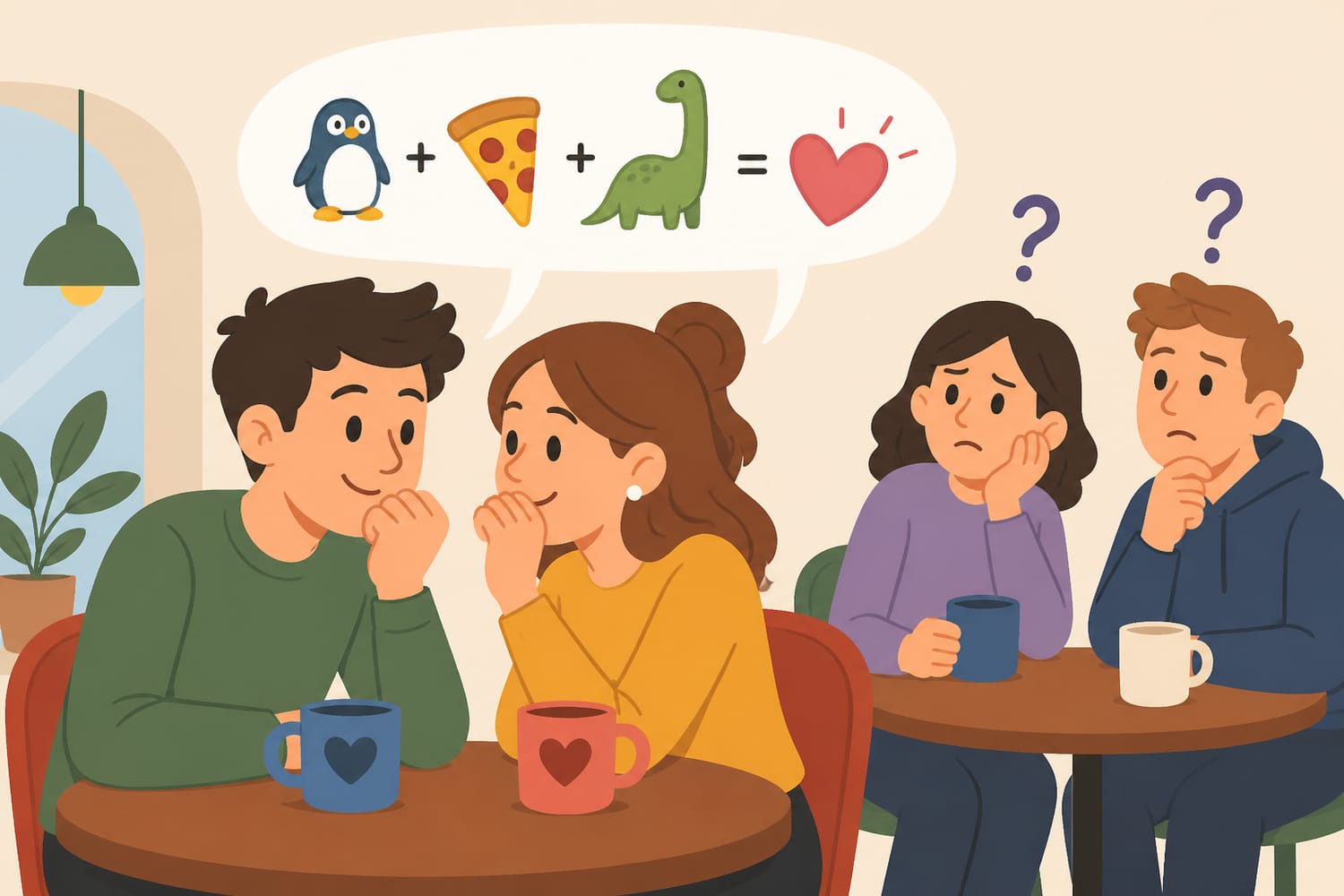
Couples develop private expressions because shared experiences give ordinary words extra meanings. Nicknames, recycled jokes, and familiar signals become shortcuts for affection, requests, and memories. They sound strange to outsiders because outsiders hear the words without knowing the history that makes them meaningful. Researchers call these expressions personal idioms.
Imagine hearing someone ask their partner, “Is the potato accepting visitors?” Their partner immediately lifts the blanket.
You have questions. They apparently do not.
For this hypothetical couple, the potato means a person curled up on the couch, and accepting visitors means being available for a cuddle. To everyone else, it sounds like an unusually bureaucratic vegetable.
Welcome to language built for an audience of one.
A Private Language Usually Isn’t a Whole New Language
Despite the nickname, a couple’s “private language” need not involve a new grammar or an extensive invented vocabulary. Researchers have studied much smaller units: expressions and signals whose special meanings belong to a particular relationship. A 1987 study collected 647 such idioms, including nicknames, expressions of affection, requests, and teasing insults. Some were verbal; others were nonverbal.
That distinction matters. You do not need to speak fluent Snugglewegian to participate.
Consider these invented examples:
- A repurposed word: “Penguin?” means “Would you walk with me?”
- A miniature quotation: “Excellent navigation” recalls the vacation when both partners confidently walked in the wrong direction.
- A household label: “The museum” means the chair displaying clothes that are neither clean nor quite ready for the laundry.
- A silent signal: Two taps on the wrist mean “Ready to leave?”
The words themselves may be ordinary. What makes them private is the additional meaning the partners have established.
Researchers also distinguish between idioms used only when a couple is alone and those used around other people. “Private” meaning does not necessarily require private delivery—which explains how the potato conversation can escape into a dinner party.
How an Ordinary Moment Becomes a Dictionary Entry
To understand the process, start with common ground: the knowledge, beliefs, and assumptions people understand themselves to share. Psycholinguist Herbert H. Clark’s account of common ground in conversation explains why communication depends on more than dictionary definitions. Speakers also rely on what they believe their listener already knows.
Here is how that might look in a relationship.
On a rainy vacation, one partner announces, “Perfect picnic weather,” while water pours off their nose. Both laugh. Later, the phrase returns during another minor disaster. Eventually, “Picnic weather?” becomes a compact way to ask, “Are we going to laugh about this?”
Nobody held a vocabulary meeting. Nobody submitted a definition for approval.
In this example, the expression develops through a simple sequence: a memorable moment, a shared reaction, repetition, and an agreed—or at least mutually understood—meaning.
The crucial ingredient is not originality. It is recognition. “Perfect picnic weather” could mean something entirely different to the couple next door.
Why Such Tiny Expressions Can Carry So Much
A useful way to think about personal idioms is as shortcuts with emotional footnotes.
Imagine that “Emergency toast” begins as the name for a late-night snack after an awful day. With repeated use, it might become an offer: “You seem overwhelmed. Shall I make something comforting and sit with you?”
Two words now stand in for an entire little scene.
Research on couples’ idiomatic communication supports this broader view: these expressions serve multiple purposes, from conveying affection to making requests and handling confrontation. They are not merely decorative alternatives to someone’s first name. The 1987 study of young lovers’ personal idioms documented that range of functions.
Thinking of a relationship as a tiny culture helps make sense of this. It can have its own recurring stories, familiar characters, and expressions that need no explanation inside the group.
That does not make every household joke profound. Sometimes “the ceremonial spoon” is simply a spoon somebody once waved dramatically. Its charm may lie precisely in how little explanation it needs between those two people.
Why Everyone Else Hears Nonsense
The outsider’s problem is missing context.
They hear “Excellent navigation” and interpret a compliment. The couple hears a reference to getting lost beside a very clearly marked sign. Understanding the ordinary words is not enough to recover the intended message. That gap follows directly from the role of common ground in communication.
This resembles the problem explored in Uncover Words’ guide to why humor lands differently across cultures: an audience can understand the vocabulary while missing the reference that makes it funny.
Now add an exaggerated voice.
Imagine someone delivering “The potato requires tea” in a squeak normally reserved for a cartoon mouse. The intended recipient might hear affection and a familiar joke. A visitor might reasonably wonder whether to leave them alone with the kettle.
The useful distinction is between a message’s literal content and its meaning within the relationship. An outsider’s bafflement does not establish that the expression is pointless. It establishes that the outsider needs subtitles.
What About the Baby Voice?
Not every couple’s private vocabulary sounds cute. The examples could just as easily involve deadpan announcements, mock-formal titles, or elaborate impressions.
But when the delivery is conspicuously childish, it helps to separate three questions:
- What does the expression mean to these partners?
- Do both partners enjoy it?
- Is this an appropriate setting for it?
“Would Captain Biscuit like a sandwich?” might be welcome at home and mortifying during a work call. The same words do not have to suit every audience.
That question of audience connects with how language changes depending on whom we’re addressing. A relationship-specific style need not be someone’s all-purpose speaking voice.
There is also no need to assume that a silly expression reveals a hidden psychological problem—or proves exceptional intimacy. Before interpreting Captain Biscuit, it is worth asking whether the sandwich request is simply a mutually enjoyable joke.
Does Having Private Words Mean a Happier Relationship?
There is evidence of an association, but not a magic formula.
In a 1993 study of 154 married couples, Carol J. S. Bruess and Judy C. Pearson found that more satisfied spouses reported more personal idioms than less satisfied spouses. Participants ranged from newlyweds to couples married for more than 50 years.
However, this was an association based on recalled language use—not proof that inventing nicknames causes marital satisfaction. The study also found that couples in later life-cycle stages recalled fewer idioms than those in earlier stages. More years together did not simply produce an ever-expanding glossary.
The sensible takeaway is modest: private expressions can be part of a satisfying relationship. They are not a relationship scorecard.
Please do not greet your partner tonight with, “We need six additional pet names to remain competitive.”
Keep the Joke Shared, Not Imposed
For anyone wondering whether to embrace this kind of talk, a practical rule is to judge it by how it is received—not how adorable its inventor considers it.
A few useful checks:
- Keep it mutual. Retire a nickname if your partner dislikes it.
- Translate when necessary. Give other people enough context to join the conversation.
- Respect the setting. A cherished private expression does not need a public debut.
- Use plain language for important matters. A playful hint is no substitute for a clear request, apology, or boundary.
“Emergency toast” can be a lovely offer. It should not be the only available way to say, “I need support.”
The Weirdness Is Easier to Understand From the Inside
Try a small experiment: choose one expression you share with someone close and trace its history. What happened the first time? What does it mean now? How much explaining would a stranger need?
You may discover that a very silly phrase contains a surprisingly detailed story.
That is the appeal of a couple’s private language. It makes room for communication that does not have to work for everyone—only for the people who built its meaning together.
To an outsider, it may sound like nonsense.
To the person lifting the blanket, the potato has been perfectly clear.