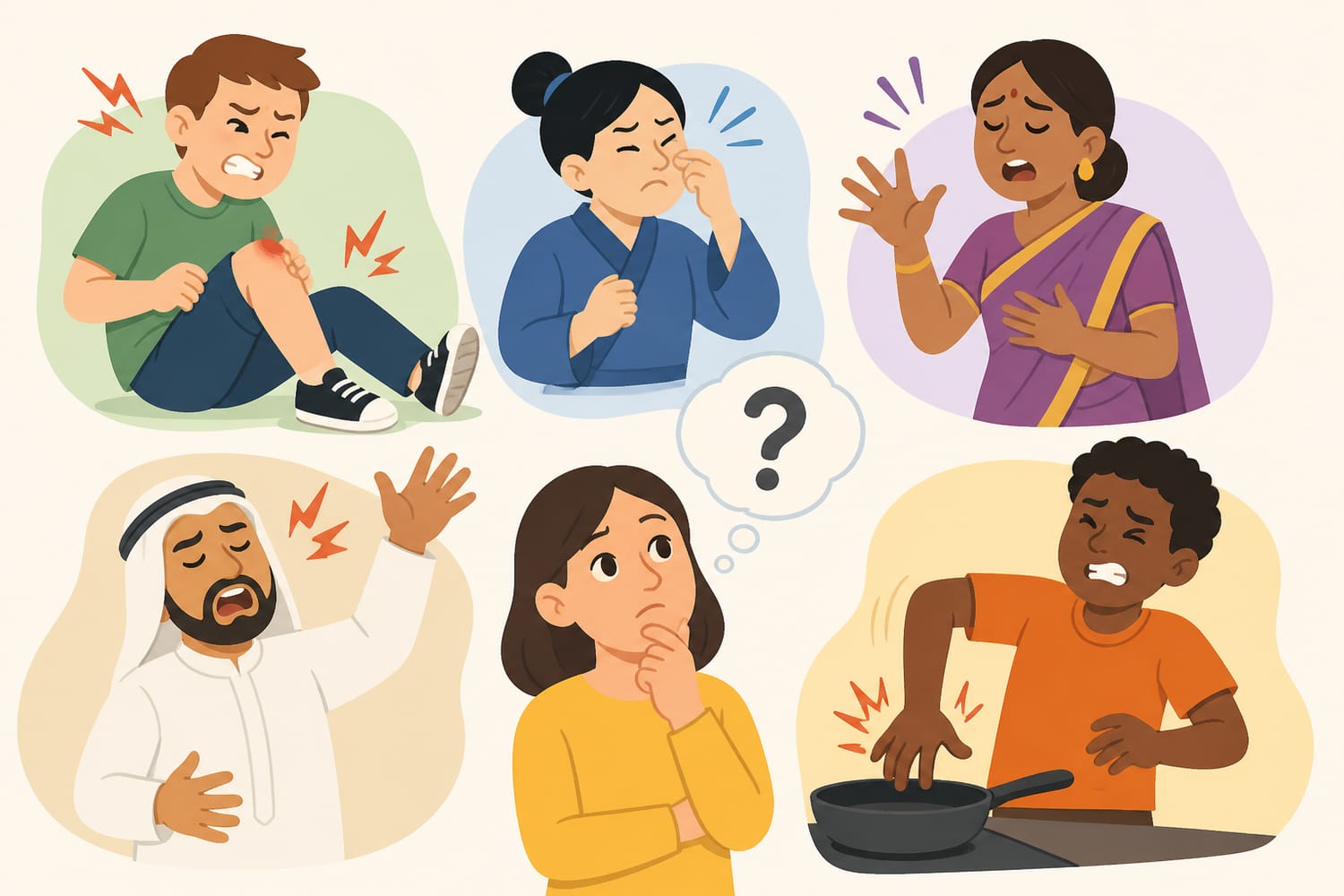
We don’t all say “ouch” because a pain cry and a pain word aren’t quite the same thing. Humans share biological responses to pain, but languages give those responses conventional forms. Still, expressions such as English “ow,” Spanish “ay,” and French “aïe” have more in common than their spellings suggest.
Imagine an international gathering interrupted by someone stepping barefoot on a toy brick. The resulting vocabulary might vary, but the situation probably wouldn’t require an interpreter.
That tiny moment raises a surprisingly big question: where does an instinctive noise end and language begin?
A Cry Is Natural. “Ouch” Is Also a Word.
A scream doesn’t require a vocabulary lesson. But “ouch” belongs to English, just as other familiar expressions of pain belong to other languages. Linguist Mark Dingemanse, writing for the Max Planck Institute for Psycholinguistics, explains that people have instinctive cries as well as learned linguistic ways of representing them.
“Ouch” is an interjection: an expression that can stand on its own, without needing a complete sentence around it. “Wow,” “oops,” and “ugh” are other examples. They may be small, but they do real communicative work.
Consider the difference between these imagined situations:
- You bump your elbow and make an involuntary cry.
- You say “ouch” to tell someone their grip is too tight.
- You describe the incident later: “I said ‘ouch,’ but they didn’t hear me.”
The same experience can involve both a bodily reaction and a recognizable word. As the Max Planck Institute’s explanation of pain cries points out, having a word such as “ouch” also lets us discuss a cry without having to reproduce the original noise.
Convenient, really. Otherwise, telling someone about yesterday’s stubbed toe could become an unexpectedly theatrical performance.
How Do You Say “Ouch” Around the World?
There isn’t a neat one-language, one-exclamation rule. English already offers “ow” and “ouch,” while other languages also have alternatives. Nevertheless, dictionaries provide some useful starting points.
| Language | A common expression of pain | |---|---| | English | Ow! / Ouch! | | Spanish | ¡Ay! | | French | Aïe ! | | Italian | Ahi! | | Portuguese | Ai! | | Japanese | 痛い! — Itai! | | Korean | 아야! — Aya! |
These are conventional equivalents, not promises about what every speaker will shout in every painful situation. The examples are documented in Cambridge’s multilingual dictionary entries and cross-linguistic research.
Some apparent differences are differences in writing rather than completely different sounds. Italian ahi, for instance, is pronounced /ai/: the written h doesn’t add an English-style “h” sound. Cambridge’s entry for Italian ahi includes both its pronunciation and its use as an equivalent of “ouch” or “ow.”
Looking at the table, you might already notice a family resemblance: lots of open, “ah”-like beginnings, sometimes followed by a glide toward another vowel.
That isn’t just a coincidence someone spotted while collecting amusing foreign words. Researchers have investigated it systematically.
The Surprising Similarity Hiding Inside Pain Words
A 2024 study published in the Journal of the Acoustical Society of America examined interjections expressing pain, disgust, and joy in dictionaries covering 131 languages. The researchers also analyzed nearly 500 vowel sounds from recordings of deliberately produced, nonverbal emotional vocalizations.
Pain stood out. Across languages, pain interjections favored “a”-like vowels and broad vowel movements such as those heard in “ai” and the “ow” portion of “ouch.” Comparable worldwide patterns did not emerge for the disgust and joy interjections they examined.
A vowel movement within one syllable is called a diphthong. Say English “ow” slowly and notice that your mouth doesn’t stay in one position: the vowel changes as you say it.
The researchers also found that nonverbal pain vocalizations favored open “a”-like vowels. That overlap supports the possibility that conventional pain words have been shaped partly by the cries people make without words.
But there are two important cautions. This was a statistical tendency, not a rule for every language. And the recordings involved people intentionally expressing emotions, rather than researchers capturing every kind of spontaneous, real-world injury response.
In other words, the study of vowel patterns in pain expressions found evidence of shared features—not a single universal password for standing on something sharp.
Why Shared Bodies Don’t Produce Identical Words
If pain expressions share a biological foundation, why aren’t they identical?
Because a natural cry and a community’s conventional word for that cry operate at different levels. Languages have their own sound inventories and established expressions. Shared human vocal behavior can therefore produce recognizable similarities without producing exactly the same word everywhere.
Think of the distinction as a shared starting point rather than a finished script. Biology may help explain why open vowels recur; linguistic convention helps explain why English settles on “ouch” in places where Spanish offers “ay.” That is a useful way to interpret the research, rather than a claim that scientists have reconstructed the history of every pain word.
This relates to iconicity: a connection between an expression’s form and what it means. Pain interjections may retain something of the sound of the experience they express, rather than being entirely arbitrary labels.
The interesting answer, then, is neither “pain noises are purely instinctive” nor “we learn every detail from scratch.” The evidence points toward an interaction between bodily vocal responses and language-specific conventions.
Japanese Adds a Twist: “Painful!”
Japanese itai makes the boundary between reaction and description especially interesting. It is an adjective meaning “painful,” but it can also function as the immediate expression English speakers might translate as “ouch!”
That means a pain response needn’t be a special-purpose exclamation. It can also be a word describing the sensation.
A questionnaire study comparing Japanese and American English speakers found that Japanese participants frequently reported descriptive expressions such as itai for pain. American participants showed a different balance, including primary interjections and expressions such as swear words. Importantly, the study asked what people would say in described situations; it wasn’t a recording of everyone’s spontaneous reactions to injuries.
Imagine the contrast as “Ow!” versus “Painful!” Both can be immediate reactions, even though one looks more like a description when translated.
This is a useful reminder for language learners: the natural equivalent of an expression doesn’t always belong to the same grammatical category.
Sometimes the Injury Is to Your Feelings
Pain expressions also wander beyond physical pain. Cambridge documents English “ouch” as a response to an unkind remark, not just a sudden bodily hurt.
Consider this fictional exchange:
“Your presentation was memorable.”
“Thanks!”
“Mostly because the projector caught fire.”
“Ouch.”
No injured elbow required.
Cross-linguistic research likewise shows that an interjection can cover several related experiences. A 2025 study of 523 interjections across 144 languages examined these shared meanings, including overlaps between pain and grief, or pain and surprise. Linguists call this colexification: one expression covering more than one meaning.
This emotional territory also connects with why swearing sounds different in every language. A painful moment may prompt an ordinary interjection, a description, or something you would rather not put in a children’s phrasebook. The Japanese–English comparison illustrates why we shouldn’t assume all communities choose among those options in the same way.
Listen for the Small Words
If you’re learning a language, ask a speaker, “What would you naturally say if you bumped your elbow?” Then ask whether that expression is ordinary, playful, rude, or regional. A dictionary translation is a useful beginning; a conversation can supply the context.
You can also listen for these expressions in dialogue without conducting any painful experiments. Notice whether a character cries out, describes the sensation, repeats a syllable, or reaches for a stronger word.
So why don’t we all say “ouch”? Because even our smallest expressions sit where shared human bodies meet particular languages. The words differ, but the recurring sounds suggest that our reactions are not quite as far apart as they first appear.
The furniture, unfortunately, remains equally unforgiving.