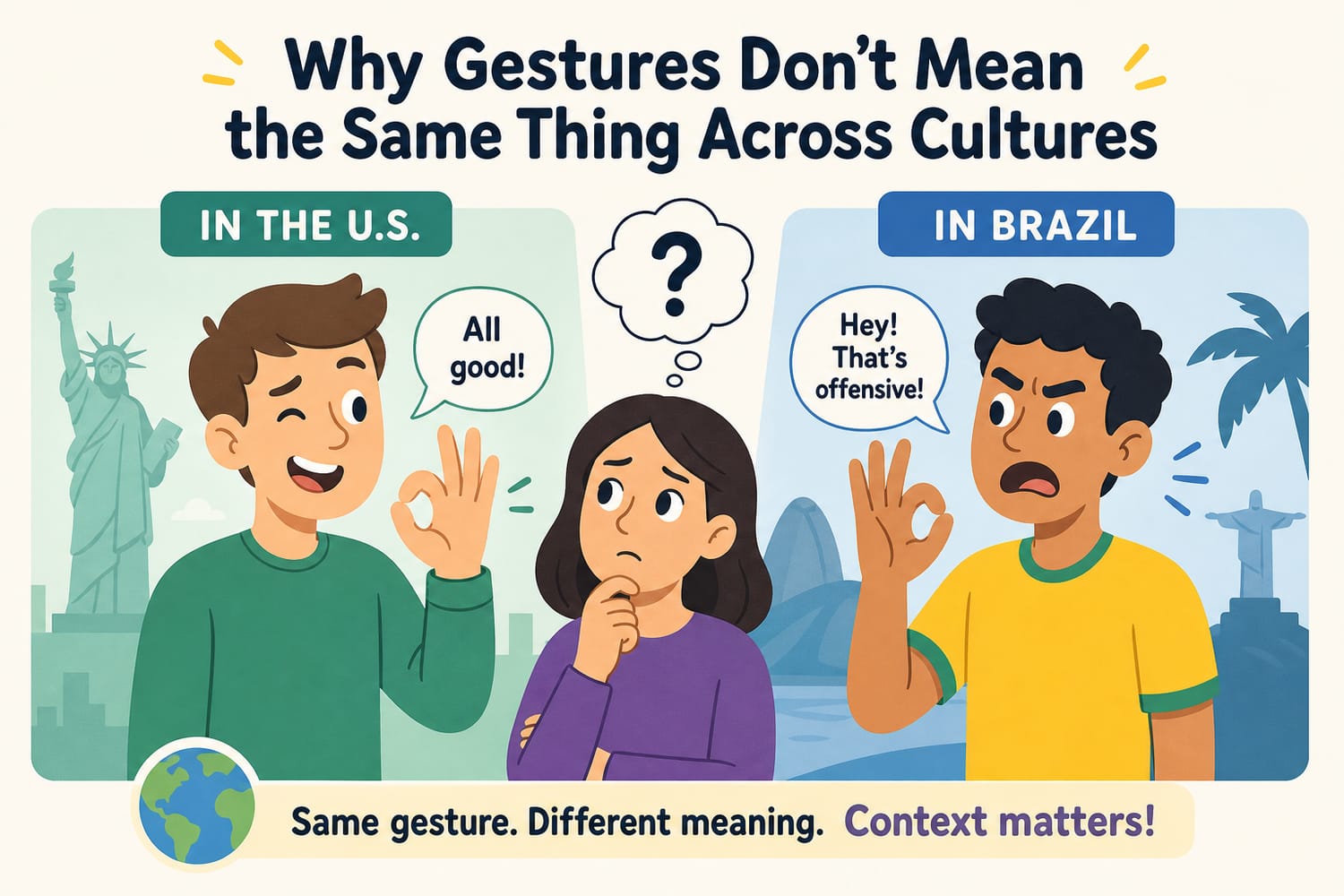
The Same Hands, Very Different Messages
Imagine landing in a new country, stepping out of the airport, and proudly giving someone a thumbs-up to say, “All good!” Only to discover that your cheerful hand signal may not have landed quite the way you intended.
Welcome to the wonderfully complicated world of gestures.
Gestures feel natural because we use them constantly. We point, wave, nod, shrug, clap, beckon, and raise eyebrows without thinking much about it. They help us communicate when words fail, when the room is noisy, or when we’re trying to tell a friend across the café that yes, we did save them a seat.
But gestures are not a universal language. Some are widely understood, but many are deeply cultural. A movement that means “great job” in one place might mean “go away,” “I’m angry,” “good luck,” “money,” or something much ruder somewhere else.
This is because gestures are part of culture, just like food, greetings, humor, manners, and language itself. They are learned, shared, and passed along. And just like words, their meanings can shift over time.
So before you assume your hands are speaking fluent international, let’s take a closer look at why gestures don’t mean the same thing across cultures.
Gestures Are Like Words Without Sound
Linguists and psychologists often distinguish between different kinds of body movements. Some gestures simply support speech. For example, if you say, “The fish was this big,” while stretching your hands apart, your gesture is illustrating your words.
Other gestures can stand alone. These are sometimes called “emblems.” A peace sign, a thumbs-up, a military salute, or a “come here” motion can communicate meaning without speech.
The tricky part is that emblematic gestures behave a lot like vocabulary. They must be learned. If you grow up in a culture where a certain gesture means “OK,” you may assume that meaning is obvious. But to someone from another culture, it may mean nothing at all—or something completely different.
Think of it this way: the English word “gift” means a present. In German, “Gift” means poison. Same letters, very different birthday party.
Gestures work in a similar way. Same shape, different meaning.
The Famous Thumbs-Up Problem
The thumbs-up is one of the most recognizable gestures in the world today. In many countries, especially across North America and much of Europe, it usually means “good,” “yes,” “well done,” or “everything is fine.” Social media has helped spread that meaning even further through the familiar “like” icon.
But the thumbs-up has not always been interpreted so positively everywhere. In some places and contexts, including parts of the Middle East and West Africa, it has been considered rude or insulting. Its meaning can depend on age, setting, and exposure to global media.
This is an important point: gesture meanings are not frozen in time. Younger people in many countries may understand the thumbs-up through movies, tourism, and the internet, even if older generations remember different associations.
So is the thumbs-up safe everywhere? Often, yes. Always? Not quite.
As with many gestures, context is king. A friendly smile and a relaxed situation can soften misunderstandings. But if you’re unsure, a verbal “thank you” or a simple nod may be safer.
When “OK” Is Not OK
In many English-speaking countries, touching your thumb and index finger together to form a circle means “OK,” “perfect,” or “all correct.” Divers also use a version of this sign underwater because a thumbs-up can mean “go up,” not “everything is fine.”
But travel with that gesture and things get interesting.
In Japan, the circle shape may be associated with money, because it resembles a coin. In parts of Europe and Latin America, the gesture has at times been interpreted as vulgar or offensive. In France, it can sometimes mean “zero” or “worthless,” depending on context.
More recently, the “OK” sign has gained additional controversy in some online and political contexts because it has been deliberately used by extremist groups or trolls. That does not mean everyone using it has that intention, but it shows how gestures can acquire new meanings through social events.
A tiny circle made with two fingers can carry a surprising amount of cultural baggage.
The V Sign: Peace, Victory, or Insult?
The V sign is another classic example of gesture confusion. Hold up your index and middle fingers with the palm facing outward, and in many places it means “peace” or “victory.” It became strongly associated with Winston Churchill during World War II and later with peace movements in the 1960s.
But turn the hand around so the palm faces inward, and things change dramatically in the United Kingdom, Ireland, Australia, and New Zealand. There, the reversed V sign is a well-known insult, roughly comparable to giving someone the middle finger.
To outsiders, the difference may seem tiny. Palm out: peace. Palm in: not peace at all.
This is why gestures can be so easy to misread. Small details matter. Finger position, palm direction, facial expression, and social setting all contribute to meaning.
It’s not just what you do with your hands. It’s how you do it.
Nodding, Shaking, and the Surprise of “Yes” and “No”
Surely nodding means yes and shaking your head means no, right?
Mostly. But not everywhere.
In many cultures, an up-and-down head nod signals agreement, while a side-to-side shake signals disagreement. However, in Bulgaria and some neighboring regions, these meanings may be reversed or used differently. In parts of Greece and Turkey, a backward head tilt or upward nod can indicate “no,” sometimes accompanied by raised eyebrows or a clicking sound.
To visitors, this can be deeply confusing. You ask, “Is the bus going to the city center?” The person makes a motion that your brain reads as yes, but actually means no. Suddenly you are enjoying an unexpected tour of the suburbs.
Head movements are among the gestures we tend to assume are universal because they feel so basic. But even “yes” and “no” can have local grammar.
Pointing: Helpful or Rude?
Pointing seems practical. There’s the museum. There’s your bag. There’s the person who stole your taxi. But pointing with the index finger is not equally acceptable everywhere.
In many cultures, pointing directly at people is considered rude, aggressive, or childish. Some communities prefer pointing with the whole hand, an open palm, the chin, or even the lips. In parts of Southeast Asia, for example, using the lips or chin to indicate direction can be common in casual contexts.
In many Indigenous cultures and communities around the world, direct finger-pointing may also be avoided, especially toward people, places with spiritual significance, or elders.
The issue is not that people dislike directions. It’s that the manner of giving them carries social meaning. A sharp index finger can feel accusatory, as if you are scolding someone.
If in doubt, use an open hand. It’s the gesture equivalent of wearing comfortable shoes: practical, neutral, and unlikely to cause drama.
Beckoning: Come Here… or Don’t You Dare
The “come here” gesture also varies widely. In the United States and much of Europe, people often beckon with the palm facing up and the index finger curling toward the body.
But in parts of Asia, including the Philippines, that gesture can be considered disrespectful when used toward people. It may be associated with calling animals rather than humans. A more polite beckoning gesture in several Asian cultures involves the palm facing downward, with the fingers moving toward the body.
This difference can produce awkward moments. Someone thinks they are being friendly and casual; the other person feels belittled.
Gestures do not just transfer information. They also express relationships: respect, equality, authority, affection, distance. That is why the “same” gesture may feel polite in one culture and insulting in another.
Hands, Feet, and the Geography of Respect
Some gesture differences are tied to broader cultural ideas about the body.
In many parts of the Middle East, South Asia, and Africa, the left hand has traditionally been associated with personal hygiene, so using it to eat, give, receive, or pass objects can be considered impolite. This does not mean every person in these regions reacts the same way, but the custom is significant enough that travelers are often advised to use the right hand in formal or traditional settings.
Feet can also carry strong meanings. In Thailand and several other cultures influenced by Buddhist traditions, the feet are considered the lowest and least clean part of the body, while the head is considered especially important or sacred. Pointing the soles of your feet at someone, stepping over a person, or touching someone’s head can be seen as disrespectful.
Meanwhile, in some Middle Eastern cultures, showing the sole of your shoe can also be insulting. This became widely discussed after the 2008 incident in which an Iraqi journalist threw his shoes at U.S. President George W. Bush—a gesture loaded with contempt in that cultural context.
A body is never just a body. Cultures map values onto it.
Greetings: From Handshakes to Bows to Cheek Kisses
Even saying hello can be a cultural maze.
A handshake may be standard in one country, too formal in another, and inappropriate in some situations elsewhere. In Japan, bowing is an important greeting and sign of respect, with depth and duration depending on social context. In Thailand, the “wai,” made by pressing the palms together near the chest or face with a slight bow, communicates greeting, thanks, or respect.
In parts of Europe, Latin America, and the Middle East, cheek kissing may be common among friends, relatives, or even new acquaintances, though the number of kisses varies by region. One cheek? Two? Three? Start left or right? The choreography can feel like trying to solve a puzzle while someone’s face is approaching yours.
The COVID-19 pandemic also changed greeting habits around the world, at least temporarily. Handshakes, hugs, and cheek kisses were replaced in many places by waves, elbow bumps, or distant nods. This reminded us that gestures are flexible. They respond to history, health, fashion, technology, and social change.
Why Cultures Create Different Gesture Meanings
So why don’t gestures mean the same thing everywhere?
One reason is simple: communities develop their own habits. Over generations, certain movements become associated with certain ideas. Just as languages evolve differently, body language does too.
Another reason is symbolism. A gesture may resemble an object, action, or social relationship within one culture but not another. The “money” meaning of the OK-like circle in Japan makes sense if the circle suggests a coin. A hand-over-heart gesture often conveys sincerity or respect because many cultures associate the heart with emotion and truth.
History also matters. Some gestures become famous through wars, religions, political movements, films, or celebrities. The V sign’s association with victory and peace did not appear magically; it spread through specific historical moments.
Power and identity matter too. Gestures can signal belonging. A handshake, salute, gang sign, religious gesture, or sports celebration may mark someone as part of a group. Outsiders may not understand it—or may use it incorrectly.
And finally, gestures change because people meet each other. Migration, tourism, media, and the internet constantly reshape nonverbal communication. A gesture once considered local can become global. A once-harmless sign can become controversial. Human communication is always under construction.
How to Avoid Accidental Gesture Disasters
The good news is that most gesture misunderstandings are not catastrophic. People are often forgiving, especially if they sense goodwill. Still, a little awareness goes a long way.
If you are traveling, working internationally, or meeting people from different backgrounds, here are a few safe habits:
- Use fewer dramatic gestures until you understand local norms.
- Choose open-hand gestures instead of pointing with one finger.
- Watch how local people greet, beckon, and show respect.
- Avoid touching people’s heads or using your feet to point.
- Be cautious with gestures that have strong emotional meanings, such as the middle finger, horns, or reversed V sign.
- When unsure, smile, ask politely, or use words.
Curiosity is better than panic. If you make a mistake, a sincere apology usually works better than an elaborate explanation involving “But in my country…”
The Beauty of Not Being Universal
It might seem inconvenient that gestures vary so much. Wouldn’t life be easier if every nod, wave, and finger movement meant the same thing everywhere?
Maybe. But it would also be less interesting.
Gesture differences show us that culture is not only spoken. It is performed through tiny everyday movements: how people greet elders, call children, show gratitude, refuse food, celebrate victory, or signal respect. Our bodies tell cultural stories long before our words catch up.
Learning about gestures reminds us to slow down and pay attention. It teaches humility. It also adds a little comedy to human life, because sometimes the path to cross-cultural understanding begins with an awkward wave and a confused smile.
So the next time you travel, meet someone new, or watch a film from another country, notice the hands, heads, eyes, and posture. There is a whole language happening in plain sight.
Just don’t assume your thumbs-up has a passport.