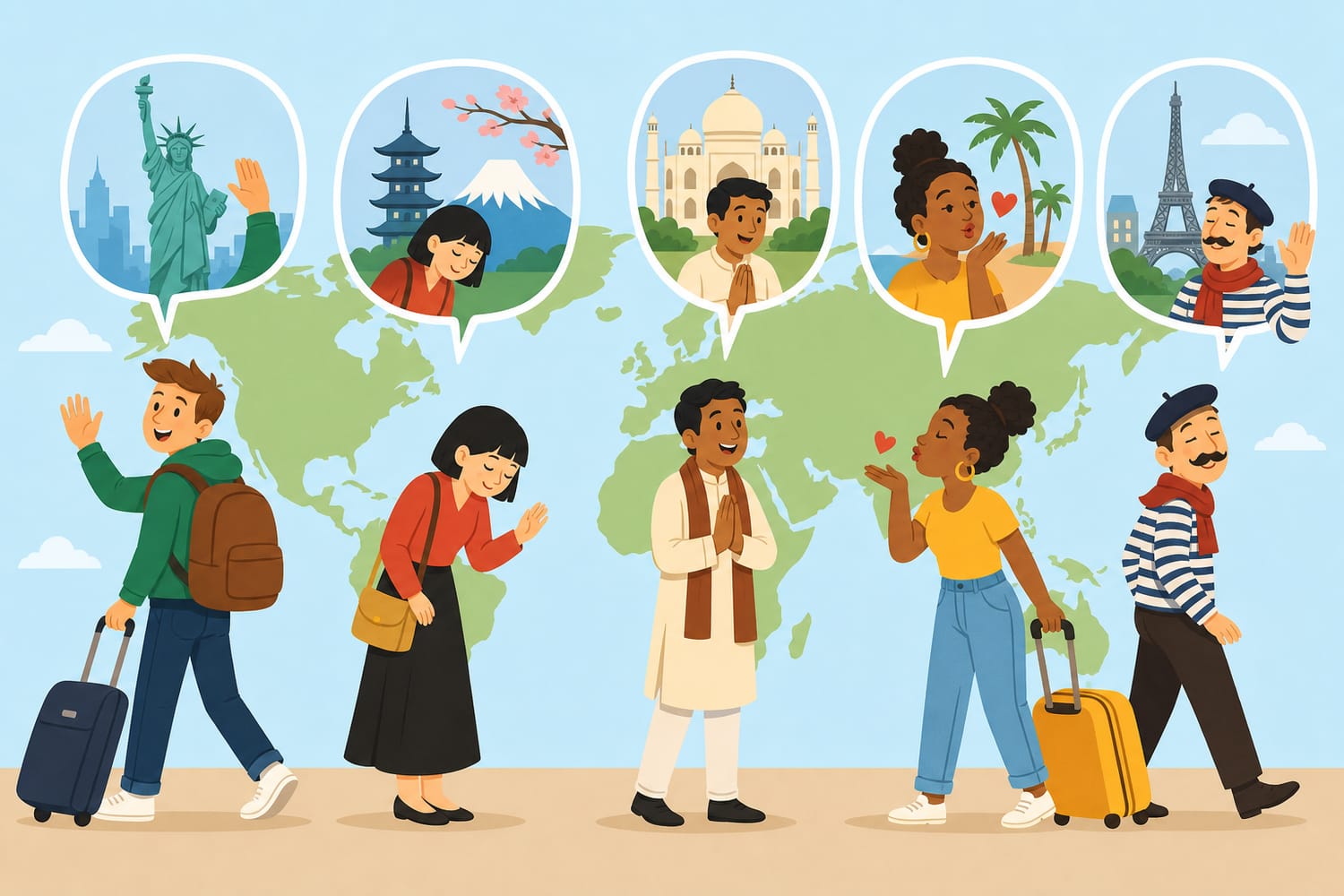
A Tiny Word With a Big Cultural Job
Goodbyes are small words with an enormous assignment. In just a second or two, they can say: “I’ll see you soon,” “Travel safely,” “I love you,” “This meeting is officially over,” “Please don’t leave yet,” or “We may never meet again, but let’s not make it awkward.”
Every language has ways to part, but those ways are not interchangeable little labels. They carry history, religion, social rules, ideas about time, and even local habits of politeness. Some goodbyes are blessings. Some are promises to meet again. Some are instructions: go safely, stay well, be at peace. Others are borrowed from neighbors, softened by slang, or shortened into cheerful little sounds.
In other words, “bye” is never just “bye.” It is a tiny cultural suitcase.
Let’s unpack it.
The English “Goodbye” Began as a Blessing
English speakers toss around “goodbye” so casually that it can feel like a plain, practical word. But it began as something more spiritual.
“Goodbye” developed from the phrase “God be with ye,” meaning “God be with you.” Over time, as people said it faster and more often, it changed shape: “God be with ye” became something like “godbwye,” then eventually “goodbye.” The “good” part was likely influenced by greetings such as “good morning” and “good night.”
So when you tell someone “goodbye,” you are using a word descended from a blessing. You may not intend anything religious by it today, but the history is still hiding inside the sound.
English also has an unusually large wardrobe of farewells. “Bye” is everyday and neutral. “See you later” is optimistic. “Take care” is warm. “Cheers” works in British English and other varieties. “Catch you later” is casual. “Farewell” is dramatic enough to require a cloak, a windswept hill, or at least a very serious email.
The variety reflects a key feature of English-speaking cultures: people often choose a goodbye based on mood and relationship rather than a strict social formula.
Many Goodbyes Send You Off With God
English is not alone in hiding religion in farewell language. Many European goodbyes have roots in religious expressions.
Spanish “adiós,” French “adieu,” Italian “addio,” and Portuguese “adeus” all come from phrases meaning roughly “to God” or “I commend you to God.” They are cousins in both sound and meaning. Historically, saying one of these was a way of placing someone in God’s care as they departed.
But modern usage varies. In Spanish, “adiós” is common, though in some contexts it may feel more final than “hasta luego” — “until later.” In French, “adieu” can sound quite final or literary today, while “au revoir,” meaning “until seeing again,” is the everyday choice. In Italian, “addio” often suggests a serious or permanent farewell, while “arrivederci” — “until we see each other again” — is much more common.
This shows an important point: the origin of a word does not always match its current feeling. A goodbye may begin as a prayer and later become casual, formal, old-fashioned, or emotionally intense.
Language never sits still. It packs up and moves along with the people using it.
Some Goodbyes Promise Another Meeting
A very popular goodbye strategy around the world is not to say “we are parting,” but “we will meet again.”
French “au revoir” literally points toward seeing again. German “auf Wiedersehen” means “until seeing again.” Russian “do svidaniya” has a similar meaning: “until the meeting.” Mandarin Chinese “zài jiàn” means “again see.” Japanese “mata ne” means something like “see you again,” and “ja, mata” works like “well then, later.”
These phrases soften the separation. They turn an ending into a pause. Rather than closing a door, they leave it politely ajar.
English does this too with “see you,” “see you later,” and “until next time.” Even if we do not have a specific next meeting planned, the phrase creates a friendly fiction: of course we’ll meet again. Why make things gloomy?
This is one reason farewells can be emotionally comforting. They help humans manage the uncertainty of separation. The other person is going away, yes, but the language says: not forever, not really, not if we can help it.
Others Focus on Safety, Peace, and Well-Being
In many languages, the central idea of a goodbye is not “see you again,” but “be safe” or “go in peace.”
Arabic offers several examples. “Ma‘a as-salāma” means “with safety” and is a common farewell in many Arabic-speaking regions. “Ilā al-liqā’” means “until the meeting,” a more formal equivalent of “see you.” The word “salām,” meaning peace, is also central to greetings and farewells in Arabic and related cultural contexts.
Hebrew “shalom” is famously rich: it can mean hello, goodbye, and peace. It carries a sense of completeness and well-being, not merely the absence of conflict. One word does the work of both arrival and departure, as if to say: may peace cover the whole visit, from start to finish.
Irish “slán” means “safe” or “healthy,” and is used in farewells such as “slán leat” — “safety with you” — said to someone leaving. This is a farewell with a protective instinct.
In Swahili, “kwa heri” means something like “with happiness” or “with good fortune.” In isiZulu, one may say “hamba kahle” to someone leaving — “go well” — and “sala kahle” to someone staying — “stay well.” That distinction is wonderfully practical. After all, not everyone in a goodbye is doing the same thing.
These expressions remind us that, for much of human history, departures could be risky. Travel meant uncertain roads, weather, distance, and delay. A farewell was not just polite. It was a verbal charm against danger.
In Some Cultures, Who Leaves Matters
One fascinating difference among languages is that some goodbyes change depending on whether you are leaving or staying.
Korean is a classic example. If you are leaving and someone else is staying, you can say “annyeonghi gyeseyo,” meaning roughly “stay in peace.” If you are staying and the other person is leaving, you say “annyeonghi gaseyo,” meaning “go in peace.” The words reflect the actual situation.
Japanese has many parting expressions, and their use depends heavily on relationship, setting, and emotional tone. “Sayōnara” is well known internationally, but it is not always the everyday equivalent of “bye.” It can sound formal or final, especially in casual situations. Friends are more likely to say “ja ne,” “mata ne,” or “bye-bye.” In a workplace, people leaving before others often say “osaki ni shitsurei shimasu,” meaning “excuse me for leaving before you,” while those remaining may respond “otsukaresama desu,” an expression recognizing someone’s effort.
These formulas reveal something important: goodbyes are social choreography. They help people exit without seeming rude, cold, or careless. The right phrase says, “I understand our roles here.”
Goodbye Can Be Formal, Casual, or Dangerously Dramatic
Not all farewells are equal. Some are everyday slippers; others are polished shoes.
In English, “bye” is casual, “goodbye” is neutral or slightly more serious, and “farewell” can sound grand, old-fashioned, or permanent. If your coworker says “farewell” before going to lunch, you may reasonably wonder whether they know something you don’t.
Spanish has similar layers. “Chao” or “chau,” borrowed from Italian “ciao,” is casual in many places. “Hasta luego” means “until later,” while “hasta mañana” means “until tomorrow.” “Adiós” may be ordinary in some regions and more final in others, depending on context and tone.
Italian “ciao” is especially interesting. It comes from a Venetian expression meaning “I am your servant” or “your slave,” used as a polite formula of humility. Over time it transformed into one of the friendliest, breeziest words in Europe, meaning both “hi” and “bye.” A word that once bowed deeply now waves from a scooter.
Thai also shows the importance of politeness. “Sawatdee” can mean hello or goodbye, but speakers often add polite particles: “khrap” for many male speakers and “kha” for many female speakers. The farewell is not just the main word; the social tone comes partly from the ending.
Goodbyes are often less about dictionary meaning and more about choosing the right level of warmth, respect, and distance.
Some Words Mean Both Hello and Goodbye
Several languages use the same word for greeting and parting. This may seem confusing until you remember that English does it too, at least sometimes: “good day” can greet or dismiss, and “aloha” is familiar to many English speakers as both hello and goodbye.
Hawaiian “aloha” is much more than a simple greeting. It is associated with love, affection, compassion, and a spirit of connection. Reducing it to “hi/bye” misses much of its cultural depth. Still, it beautifully shows how one word can frame both meeting and parting with warmth.
Hebrew “shalom,” as mentioned earlier, also covers both hello and goodbye. Italian “ciao” does the same in informal settings. Mandarin Chinese “nǐ hǎo” is a greeting and “zài jiàn” is a farewell, so it separates the two more clearly. English generally separates “hello” and “goodbye,” though informal speech gives us flexible options like “hey” on arrival and “see ya” on departure.
When one word does both jobs, it can suggest that greeting and leaving are part of the same social circle. You are acknowledging a relationship at both ends.
Gestures Speak Alongside Words
Goodbyes are not only spoken. They are waved, bowed, kissed, hugged, saluted, nodded, and sometimes stretched out in doorways for twenty minutes.
In many parts of Europe and Latin America, cheek kissing may accompany greetings and farewells, though the number of kisses and the situations where it is appropriate vary widely. In Japan, bowing can mark both hello and goodbye, with depth and duration reflecting respect and context. In the United States, a casual wave may be enough; among close friends or family, hugs are common.
New Zealand’s Māori hongi, in which people press noses and foreheads, is a traditional greeting that may also appear in ceremonies of welcome and connection. It is not simply a casual “bye,” but it reminds us that cultures often use physical gestures to express relationship and respect in ways words alone cannot.
Even the timing of a goodbye differs. Some cultures value quick, efficient departures. Others treat leaving as a process: announce you are leaving, stand up, continue talking, move toward the door, remember one more story, say goodbye again, and finally depart. The “long goodbye” is practically an international art form.
Technology Is Changing Farewells Too
Modern life has created new kinds of goodbyes. Phone calls end with “talk soon.” Text messages fade without any farewell at all. Emails close with “best,” “regards,” “cheers,” or the mysterious corporate “warmly.” Video calls produce the chaotic modern ritual of everyone saying “bye” at once while trying to find the leave button.
Digital communication also spreads farewells across languages. “Bye-bye” is recognized in many places. “Ciao” travels well. “Adios” appears in English for flair. Japanese “mata ne” and Korean “annyeong” circulate through pop culture and language learning communities.
But technology has not made goodbyes less meaningful. If anything, it has made them more flexible. A heart emoji, a waving hand, or “ttyl” can carry the same human message as an ancient blessing: I acknowledge our parting, and I want the connection to continue.
What Goodbyes Reveal About Us
Goodbyes sound different around the world because people imagine parting in different ways. Is it a blessing? A promise? A wish for safety? A sign of respect? A casual wave? A small emotional negotiation at the edge of leaving?
The answer is yes.
Every farewell contains a culture’s ideas about relationships, distance, politeness, religion, time, and care. Some languages say, “God be with you.” Others say, “until we meet again,” “go well,” “stay in peace,” or “be safe.” Some keep it short and cheerful. Others carefully mark who is leaving, who is staying, and how respectful the situation needs to be.
So the next time you say “bye,” “see you,” “ciao,” “shalom,” or “adiós,” remember: you are doing something very old and very human. You are turning separation into language.
And with that — until next time.