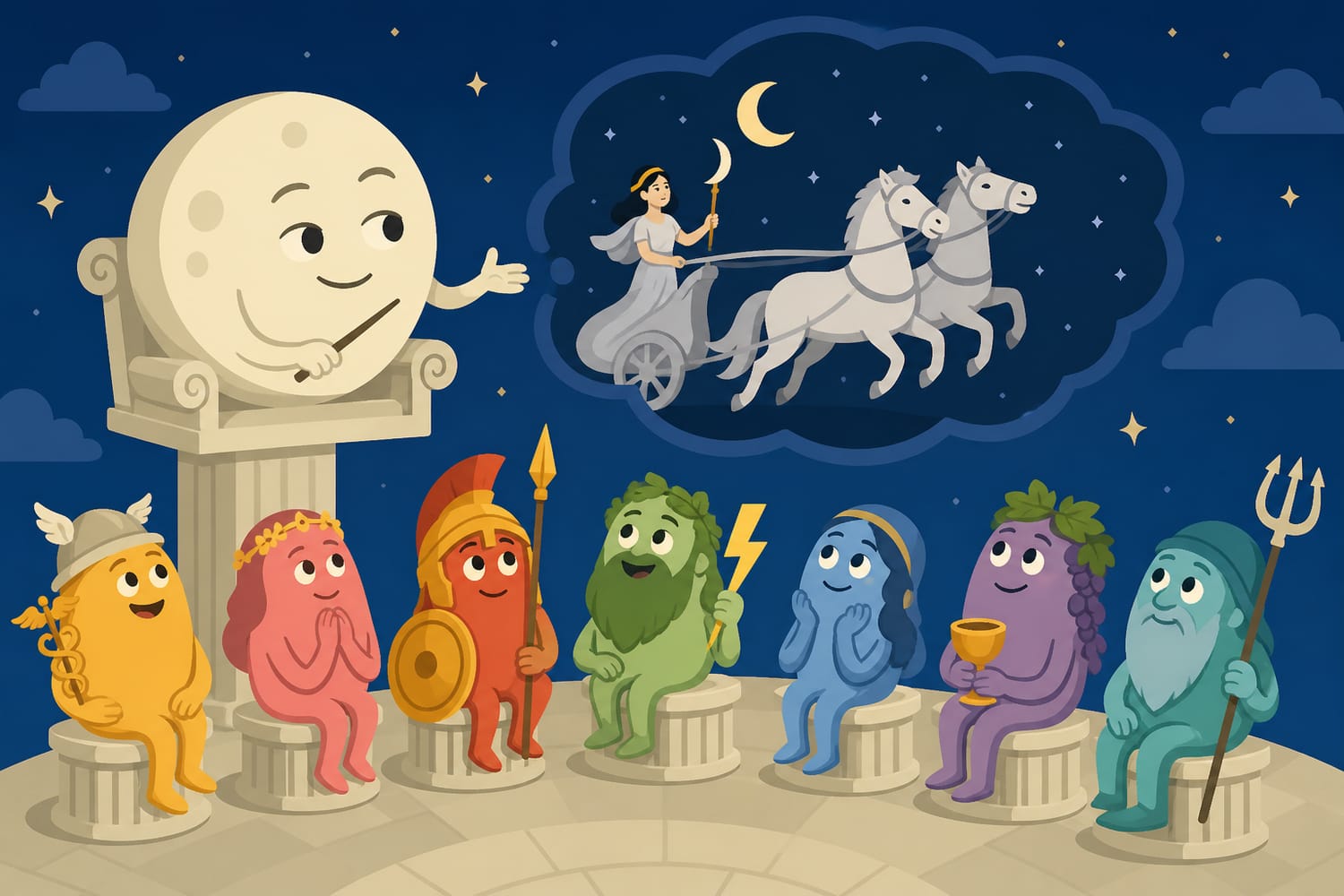
Why Monday Belongs to the Moon
Monday is named after the Moon. The name comes from Old English Mōnandæg, meaning “Moon’s day,” and follows the pattern of Latin diēs Lūnae, also meaning “day of the Moon.” The rest of the English week has a similarly surprising cast: the Sun, several Germanic gods, and one Roman god who kept his place.
It is a lot of history to find hiding in a calendar reminder. Once you know what to look for, though, the names become easier to spot. Monday still sounds a little like Moon-day. Sunday barely bothers to hide its connection to the Sun. The days between them take more detective work.
How the Sky Got Into the Calendar
The story begins with seven heavenly bodies that ancient observers could see without a telescope: the Sun, the Moon, and the planets Mars, Mercury, Jupiter, Venus, and Saturn. In the Roman world, each acquired a day name. Mars, for example, gave Latin diēs Martis—“day of Mars”—to the day we call Tuesday.
The Sun and Moon were called “planets” in the ancient system, although modern astronomy does not classify them that way. That is why descriptions of the old seven planetary days include two objects we would not call planets today.
The seven-day week has a history beyond these names; the names did not create the idea of a week all by themselves. What the Roman naming tradition gave later speakers was a set of labels tied to the visible sky. As the pattern moved between languages, people did not always keep the same gods in charge. Sometimes they translated a name. Sometimes they found a local deity to take a Roman one’s place.
Monday and Sunday: The Calendar’s Brightest Clues
The Latin name for Monday was diēs Lūnae: “day of the Moon.” Old English rendered the idea with its own word for the Moon, producing Mōnandæg. Over centuries of speech and spelling change, that became Monday. The name points to the Moon, not to a prediction that the Moon will be visible on Monday—or that Monday will feel particularly peaceful.
Sunday took a parallel route. Latin diēs Sōlis, “day of the Sun,” corresponds to Old English Sunnandæg. These two names make a helpful pair: English speakers kept the celestial meaning but expressed it in their own language.
Compare Monday with French lundi or Spanish lunes. Those names preserve the connection to Latin luna much more visibly, while English uses its Germanic word moon. Three languages, one heavenly body, and very different-looking calendar squares. The Old Farmer’s Almanac comparison of weekday names lays the forms out side by side.
Tuesday Through Friday: Meet the Substitutes
When Germanic-speaking peoples adopted the Roman weekday pattern, they matched several Roman deities with gods from their own traditions. The result was not a fresh set of days, but a new way to name familiar positions in the week. English still carries those substitutions.
- Tuesday comes from Tiw, a Germanic god associated with war. He took the naming role that Mars held in Latin diēs Martis. This is why Spanish martes and English Tuesday look unrelated even though they label the same day.
- Wednesday is Woden’s day. Woden is the Old English name related to Odin, while the corresponding Roman day belonged to Mercury. Old English Wōdnesdæg also offers a clue to Wednesday’s famously awkward spelling: there really was a d in the older name.
- Thursday comes from Old English Þunresdæg, the day of Thunor, the Germanic thunder god closely related to the Norse Thor. In the Roman pattern, this was Jupiter’s day; Jupiter, too, was associated with the sky and thunder.
- Friday comes from Frige, the Old English goddess corresponding to Frigg, in the position held by Venus in the Roman week. You may hear that Friday is “Freyja’s day.” Freyja is relevant to discussions of related traditions, but the Old English form Frīgedæg points specifically to Frige. The Online Etymology Dictionary’s Friday entry unpacks the distinction.
These were rough cultural correspondences, not claims that two traditions had identical gods. Jupiter and Thunor share thunder; Mars and Tiw share a connection with war. The match between Mercury and Woden may feel less obvious at first glance, but the naming history is well established. A calendar is not a tidy mythology textbook.
Saturday: The Roman Who Stayed
After all those substitutions, Saturday breaks the pattern. Its Old English ancestor, Sæternesdæg, means Saturn’s day. English retained the Roman name rather than replacing Saturn with a Germanic god, making Saturday the odd one out among the four god-named days from Tuesday through Friday.
Not every neighboring language made the same choice. Spanish sábado and Italian sabato have names connected with the Sabbath. Danish lørdag takes an altogether different direction: it is traditionally understood as a washing or bathing day. The Viking Ship Museum’s guide to weekday names makes for a delightful comparison. Saturn may have kept Saturday in English, but he does not hold every calendar.
Why Are the Days in That Order?
The names have another puzzle tucked inside them. Why does Moon-day follow Sun-day, only to be followed by days associated with Mars and Mercury? That is not the order of the planets by distance from Earth—or a ranking of anyone’s favorite gods.
One ancient astrological explanation assigned the seven heavenly bodies to successive hours, cycling through a fixed order. Each day took the name of the body assigned to its first hour. Because there are 24 hours in a day but seven bodies in the cycle, the next day’s first hour landed on a different body. Repeating that process produced the familiar sequence: Sun, Moon, Mars, Mercury, Jupiter, Venus, Saturn. It explains the traditional ordering of the names, not why every culture uses a seven-day week.
Fortunately, nobody has to calculate planetary hours to arrange a lunch date. But it is fun to know that the apparent jumble of names once followed a system.
A Week Is a Little Map of Cultural Encounters
English weekday names are not simply “Roman names” or “Norse names.” They are a mixture: Sun and Moon translated into Old English, four Roman gods’ days recast with Germanic counterparts, and Saturn left in place. Calling all seven “days named after Norse gods” misses both the heavenly bodies and Saturday.
That mixture is part of a much bigger story about what happens when languages meet. Sometimes a word travels largely intact; sometimes speakers translate its parts or reshape its meaning to fit a new setting. For more examples beyond the calendar, explore the words English borrowed from other languages.
The names are historical clues, not instructions for how to live today. Calling a meeting on Thursday tells us nothing about the attendees’ beliefs concerning Thor. It does show how an ordinary word can outlast the world that first gave it meaning. That is one reason the language we use for time is worth a closer look, whether in weekday names or in the different ways languages talk about time.
The Next Time Monday Rolls Around
The next time you sigh at the sight of Monday on your calendar, you can at least give its name a warmer reception. It is Moon’s day: an Old English expression shaped by an older Latin naming pattern, still in everyday use.
Then look across the week. There is Woden tucked into Wednesday, a thunder god rumbling through Thursday, and Saturn stubbornly holding on to Saturday. The calendar on your wall may look ordinary, but its labels are a small, wonderfully mismatched record of the people who named the days before us.