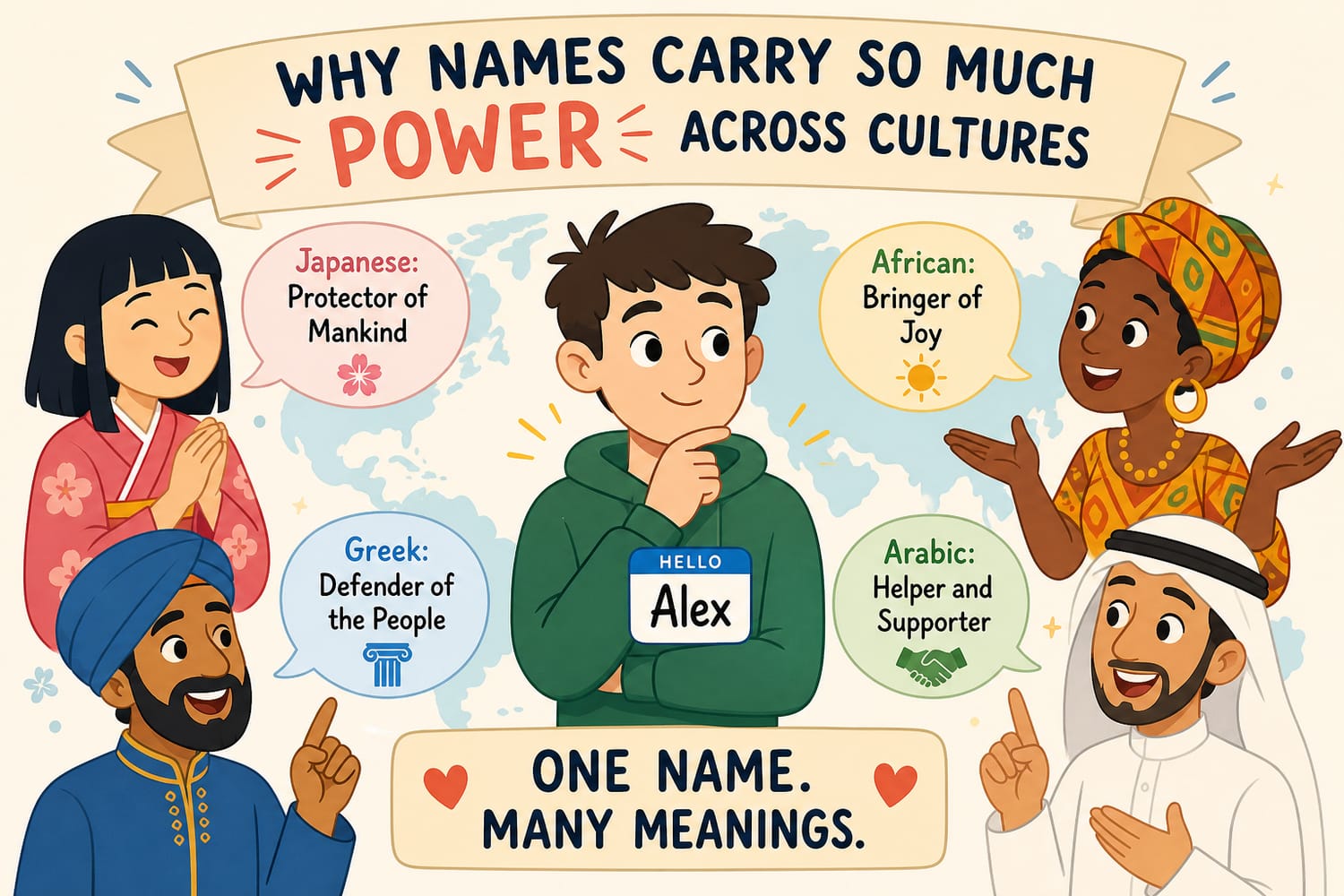
A Name Is Never “Just a Name”
At first glance, a name looks like a label. A neat little word attached to a person so we can tell one human from another at school, at work, or when yelling across a crowded room: “Sam, your coffee is ready!”
But across cultures and throughout history, names have carried far more weight than that. They can signal family, religion, social status, gender, ancestry, geography, hopes, blessings, political history, and even spiritual protection. A name can honor the dead, welcome a newborn, mark a rite of passage, or announce a completely new identity.
Names are tiny containers packed with meaning. They are personal, but they are also cultural. They belong to individuals, but they are shaped by families, communities, laws, languages, beliefs, and sometimes empires.
In other words: names are small words with big jobs.
Names Tell Stories Before We Do
Many names carry stories long before the person has a chance to create their own.
In Yoruba culture, for example, names often reflect the circumstances of a child’s birth, family hopes, or gratitude. A name such as Ayodele can mean “joy has come home,” while Yetunde may be given to a girl believed to represent the return of a female ancestor, meaning something like “mother has returned.” These names are not random sounds; they are miniature family histories.
In many Arabic-speaking and Muslim communities, names may reflect religious devotion or admired qualities. Names such as Abdullah (“servant of God”) or Amina (“trustworthy” or “faithful”) carry meanings that connect the individual to values, faith, and tradition.
In Chinese naming traditions, names often combine beauty of sound, written character, family identity, and aspiration. A given name may include characters associated with brightness, strength, elegance, learning, or virtue. In some families, siblings or cousins of the same generation may share a character in their names, creating a visible link across the family tree.
A name can be a wish. A memory. A prayer. A poem that fits on a form.
Of course, not every name has a dramatic origin story. Sometimes parents simply like the sound. Sometimes a name comes from a favorite actor, athlete, grandparent, saint, ancestor, or even a baby-name website consulted at 2 a.m. Still, even those choices reveal something about the time and culture in which the naming happens.
Names Connect Us to Family and Community
One major reason names are powerful is that they locate us within a network of relationships.
Surnames, for instance, often tell us about ancestry, occupation, geography, or family structure. English surnames such as Smith, Baker, or Carpenter point to occupations. Names like Hill, Wood, or Brook may come from landscapes. In many European languages, surnames developed from a parent’s given name: Johnson means “son of John,” while MacDonald means “son of Donald” in Gaelic.
This pattern appears in many parts of the world. Traditional Icelandic names commonly use patronymics or matronymics rather than fixed family surnames. Someone named Jónsdóttir is “daughter of Jón,” while Jónsson is “son of Jón.” This system emphasizes immediate family connection rather than a surname passed unchanged across generations.
In Spanish-speaking naming customs, people often have two surnames: traditionally the first from the father and the second from the mother, though legal practices and ordering can vary by country and family choice. This system keeps both parental lines visible in a person’s official name.
Names can also mark membership in a clan, caste, tribe, lineage, or religious community. In many cultures, knowing someone’s name is not only knowing what to call them. It is knowing who their people are.
That can be comforting. It can also be complicated. Names may carry pride, but they may also carry expectations: “Remember who you are,” families often say, and names are one way of saying it before a child can even walk.
Sacred Names, Secret Names, and Naming Taboos
In many traditions, names are not only social tools but spiritual ones.
In Judaism, the divine name represented by the Hebrew letters YHWH is traditionally treated with deep reverence and not pronounced casually. Instead, substitutes such as Adonai (“Lord”) or HaShem (“the Name”) are used in religious contexts or everyday speech. Here, the power of a name is tied to holiness and respect.
In ancient Egyptian belief, a person’s name, or ren, was considered an essential part of the self. Preserving someone’s name helped preserve their existence in the afterlife. This is one reason inscriptions, monuments, and tombs mattered so much. To erase a name was not merely vandalism; it could be understood as an attack on memory and being.
Some cultures have also practiced naming taboos around the dead. Among various Aboriginal Australian communities, for instance, it may be customary to avoid saying the name of someone who has died, though practices differ widely among groups and regions. The purpose is often connected to respect, mourning, and spiritual beliefs. Similar avoidance practices appear in other parts of the world as well.
Secret names are another fascinating example. In some societies, a public name may be used in daily life while another name is reserved for ritual, spiritual, or intimate contexts. The idea is simple but powerful: if a name gives access to a person, then controlling who knows it can offer protection.
This may sound mystical, but even in modern life we understand the instinct. We protect passwords, legal names, usernames, and identity documents. Maybe the magic has changed outfits, but the concern is still familiar.
Naming as a Rite of Passage
A new name can mark a new stage of life.
Many cultures hold naming ceremonies for infants. These ceremonies formally welcome a child into the family and community. In some Christian traditions, names may be given or confirmed at baptism. In Islam, it is common for a child to be named soon after birth, often accompanied by practices such as the aqiqah, a ceremony that may include sacrifice, charity, and the shaving of the baby’s hair, depending on community tradition.
Names can also change at marriage, religious initiation, migration, adoption, or adulthood. Catholic popes choose a papal name upon election. Many Buddhist monks and nuns receive Dharma names. Some people take confirmation names, stage names, pen names, or regnal names as rulers.
A name change says, “Something important has happened.” The person is still themselves, but their social or spiritual role has shifted.
This is also why chosen names matter so deeply to many transgender and nonbinary people. A chosen name can be an act of truth, dignity, and self-recognition. Using it is not simply “being polite”; it is acknowledging who someone is.
Names are among the first gifts society gives us, but sometimes they are also among the first gifts we give ourselves.
The Politics of Names
Because names are tied to identity, they often become political.
Colonialism, slavery, forced assimilation, and migration have all changed people’s names—sometimes by choice, often by pressure or force. Enslaved Africans in the Americas were frequently stripped of their original names and given European names by enslavers. Indigenous children in boarding and residential schools in countries such as the United States, Canada, and Australia were often renamed as part of broader efforts to suppress their languages and cultures.
Place names tell similar stories. Cities, mountains, rivers, and countries often carry the marks of conquest, colonization, independence, and resistance. When a place is renamed, the change may be celebrated by some and contested by others. Think of Bombay becoming Mumbai, Swaziland becoming Eswatini, or Mount McKinley officially returning to Denali in the United States. These are not merely changes on maps; they are debates over history, authority, and belonging.
Personal names can face politics too. Immigrants have often shortened, translated, or altered their names to avoid discrimination or make pronunciation easier in a new country. Sometimes this is practical. Sometimes it is painful. Sometimes it is both.
A name can open doors. Unfortunately, research has shown that it can also close them. Studies in several countries have found that job applicants with names perceived as belonging to racial or ethnic minorities may receive fewer callbacks than identical applicants with majority-associated names. The name on the résumé becomes a site where bias quietly operates.
This is one reason learning to pronounce someone’s name correctly is more than a nice gesture. It is a small act of respect in a world that has often asked people to make their names more “convenient.”
Names Shape First Impressions
Names influence how people imagine us before they meet us. They may suggest age, gender, class, ethnicity, religion, or nationality—even when those assumptions are wrong.
For example, some names rise and fall in popularity so clearly that they become linked to particular generations. In English-speaking countries, names like Mildred or Ethel may sound old-fashioned to many ears, while Ava, Liam, or Noah may feel more contemporary. But trends change constantly. Today’s fashionable baby name is tomorrow’s “that was my grandpa’s name,” and the cycle continues.
Names can also carry stereotypes. A name may be judged as “professional,” “traditional,” “foreign,” “creative,” or “difficult,” depending on the listener’s background and biases. But those judgments often reveal more about the listener than the name.
The funny thing is that nearly all names were unfamiliar to someone at some point. Every “classic” name had to start somewhere. Even Jessica, often thought of as a familiar English name, was popularized by Shakespeare’s The Merchant of Venice. Imagine someone in the 1500s saying, “Jessica? That sounds made up.” Technically, they would not have been entirely wrong.
The Digital Age: Usernames, Handles, and New Selves
Today, names have expanded into digital territory.
We have legal names, nicknames, usernames, gamer tags, email addresses, display names, and social media handles. Some people use the same name everywhere. Others maintain different identities for work, family, hobbies, activism, or privacy.
Online names can be playful, anonymous, protective, or deeply meaningful. A username might reveal a fandom, a joke, a political stance, or a version of the self that feels more authentic than a legal name ever did.
At the same time, digital naming brings new problems. Names become searchable. They can be copied, stolen, mocked, or misused. Questions of identity, privacy, and authenticity are now tied to what we call ourselves online.
In a way, this is an ancient issue wearing modern sneakers. Humans have always understood that names give access. The internet simply made that access global.
Why We Should Treat Names with Care
Names matter because people matter. A name may carry centuries of history, a parent’s hope, a community’s memory, a sacred tradition, or one person’s hard-won sense of self.
That does not mean we must know the full background of every name we encounter. No one expects you to become a walking encyclopedia of global naming customs before introducing yourself at a party. But we can be curious. We can ask respectfully. We can make the effort to pronounce names correctly. We can avoid turning unfamiliar names into jokes. We can understand that changing, reclaiming, or protecting a name may be deeply significant.
A name is one of the first words attached to a life. It is spoken in celebration, written on documents, whispered in love, called across kitchens, printed on diplomas, remembered after death.
So yes, a name is a label.
But it is also a story, a bridge, a blessing, a boundary, a memory, and sometimes a revolution in miniature.
Not bad for a few syllables.