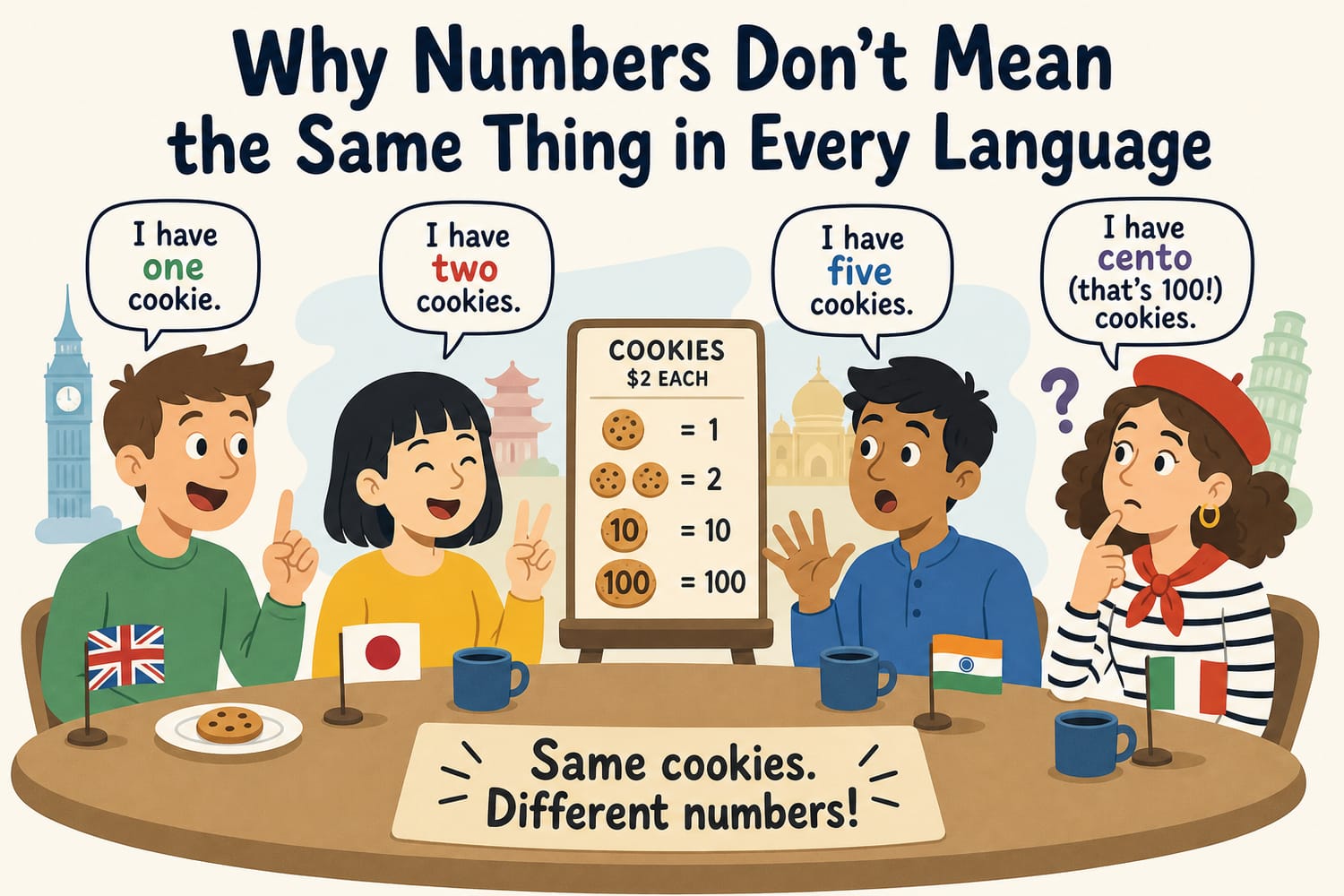
Counting Is Universal—But Not Uniform
Numbers feel like the most straightforward part of language. One apple is one apple. Two socks are two socks. Ten fingers are, conveniently, ten fingers. Surely numbers are the same everywhere, just wearing different accents?
Not quite.
While the quantity “three” may be the same in Tokyo, Nairobi, Paris, and Lima, the way people talk about numbers can vary dramatically. Some languages build number words like neat little equations. Others preserve ancient counting systems based on twenties, body parts, or even pairs. Some require special words depending on what you are counting. And beyond grammar, numbers can carry cultural meanings: luck, danger, holiness, humor, or taboo.
In other words, numbers may be mathematical, but number words are deeply human. They reflect history, culture, trade, religion, the body, and the wonderfully odd habits of language.
Let’s count the ways.
Ten Fingers, Many Systems
Most of the world’s counting systems are decimal, or base-10. That probably isn’t a coincidence. Humans generally have ten fingers, and fingers make excellent portable calculators, especially if you’ve misplaced your abacus.
In a base-10 system, numbers are organized around tens: ten, twenty, thirty, and so on. English works this way most of the time, though it has a few leftovers from older patterns. We say “twenty-one,” “twenty-two,” and “twenty-three,” which is nice and logical. But then there are “eleven” and “twelve,” which do not transparently mean “ten-one” and “ten-two.” They come from older Germanic forms meaning something like “one left” and “two left” after ten.
Many languages are much more transparent. In Mandarin Chinese, for example, eleven is literally “ten-one” (十一, shí yī), twelve is “ten-two,” and twenty is “two-ten.” Japanese and Korean number systems also often show this tidy structure, especially in Sino-derived numbers.
That regularity can make arithmetic easier for children learning to count. If “thirty-seven” is basically “three-ten-seven,” the number system is wearing its place value on its sleeve. English, by contrast, asks children to memorize “eleven,” “twelve,” “thirteen,” and then the strangely reversed “fourteen” before finally behaving itself a bit more.
Numbers may be logical. Languages are not always in the mood.
When Twenty Is the Magic Number
Not every system is built only around ten. Some languages use vigesimal systems, based on twenty. Again, the human body is a likely suspect: ten fingers plus ten toes gives you twenty convenient counting tools, assuming you are willing to remove your shoes.
French famously contains traces of a base-20 system. The word for eighty is quatre-vingts, literally “four twenties.” Ninety is quatre-vingt-dix, “four twenties and ten.” So the French number 97, quatre-vingt-dix-sept, is basically “four twenties, ten, seven.” Elegant? Maybe. A workout? Absolutely.
Traditional Welsh also used a vigesimal system, and although modern decimal forms are common today, older forms survive and are still known. Danish has its own historically complex system involving twenties too. For learners, Danish numbers above fifty can feel like someone hid a math puzzle inside a word.
Base-20 systems are also found in many parts of the world, including Indigenous languages of the Americas. The Maya used a vigesimal numerical system, visible in their mathematics and calendars. Their number system was sophisticated, including a symbol for zero—an impressive achievement in the history of mathematics.
So while base-10 dominates globally, base-20 reminds us that counting does not have to stop at the fingers. Toes deserve recognition too.
Sixty Still Rules Your Clock
If base-20 sounds unusual, consider this: every time you check the time, you are using a base-60 inheritance.
There are 60 seconds in a minute and 60 minutes in an hour. A circle has 360 degrees, which is six times sixty. These conventions come from ancient Mesopotamia, especially the Sumerians and Babylonians, who used sexagesimal, or base-60, systems.
Why sixty? It is a very divisible number. You can divide 60 evenly by 2, 3, 4, 5, 6, 10, 12, 15, 20, and 30. That makes it extremely useful for fractions, astronomy, measurement, and trade.
We no longer speak in base-60 for ordinary counting, but the system is still with us. It ticks on wrists, phones, train stations, microwaves, and calendars. A number system from thousands of years ago is quietly helping you decide whether you are late for lunch.
Spoiler: you might be.
Some Languages Count Things Differently
In English, you can count most things by placing a number before a noun: three books, four dogs, five ideas, six suspiciously expensive coffees.
But many languages require classifiers or counters—special words that come between the number and the noun, often indicating the type or shape of the object.
In Mandarin Chinese, you typically do not just say “three books.” You say something like “three [classifier] books.” The common classifier běn is used for books and bound volumes: 三本书 (sān běn shū), “three books.” For flat objects, long thin objects, people, animals, and many other categories, different classifiers may appear.
Japanese also uses counters. You count people with one set, small animals with another, long cylindrical things with another, flat things with another, and so on. “Two pencils” and “two cats” do not use the same counting word.
This may sound complicated, but English does something similar in limited ways. We say “three pieces of furniture,” not usually “three furnitures.” We say “two cups of coffee,” “a loaf of bread,” “a pair of scissors,” and “three sheets of paper.” Classifier-heavy languages simply make this kind of categorization a normal part of counting.
So numbers do not always attach directly to things. Sometimes language asks, “What kind of thing are we counting, exactly?”
One, Two, Many—and Sometimes Dual
English distinguishes between singular and plural: one cat, two cats. Simple enough.
But other languages have more grammatical number categories. Some have a dual form specifically for two things. Classical Arabic had a dual, and Modern Standard Arabic still uses it. Slovenian also has a dual, so “two hands” is grammatically different from “three hands” or “one hand.”
Some languages have trial forms for three, though these are much rarer. Others have paucal forms, used for “a few” of something. Grammatical number can therefore divide the world into more categories than just “one” and “more than one.”
English has tiny echoes of this. We still say “both” for two, not for three. Words like “pair,” “couple,” and “twin” show that two-ness matters to us culturally, even if our grammar does not give it a special form across the whole language.
A language with a dual treats “two” not merely as plural, but as its own category. That makes sense. After all, two shoes, two eyes, two hands, two sides of an argument—human life is full of pairs.
Not Every Language Counts Infinitely in Everyday Speech
Some communities traditionally have very small sets of exact number words. This does not mean their speakers cannot think, reason, trade, compare quantities, or notice differences. It means their language and cultural practices may not emphasize exact counting in the same way that school-taught arithmetic cultures do.
One famous and much-discussed example is Pirahã, a language spoken in the Brazilian Amazon. Researchers have reported that Pirahã does not have exact number words in the way English does, but instead uses terms more like “small quantity,” “larger quantity,” and “many.” The interpretation of Pirahã number concepts has been debated, and it is important not to reduce any culture to a simplistic claim like “they have no numbers.” Human cognition is far more complex than vocabulary lists.
Other languages may have traditional counting systems suited to local needs: counting yams, fish, pigs, shells, days, or ceremonial goods. In some communities, exact counting may historically have been less central than estimating, matching, sharing, or using one-to-one correspondence.
This reminds us that number words are tools. A fishing net, a spreadsheet, and a wedding guest list all demand different kinds of precision.
Your Body Can Be a Number Line
In some cultures, counting is not based only on spoken number words but also on the body. Body-part tally systems have been documented in parts of Papua New Guinea, among other regions. A speaker might count by touching fingers, wrists, elbows, shoulders, ears, eyes, or other body parts in a fixed sequence.
The Oksapmin people of Papua New Guinea are often cited for a body-part counting system that traditionally used 27 points, moving along one side of the body and across to the other. In such systems, numbers can be embodied in a very literal way. The “number” is not only a word but a place on the body.
This may sound unusual if you grew up with written numerals, but it is perfectly practical. Many of us still use fingers to count, mark numbers with gestures, or point to track steps in a process. Body counting simply extends that habit into a more formal system.
Mathematics often pretends to live in the clouds. Language reminds us it also lives in hands, feet, elbows, and eyebrows.
Lucky, Unlucky, Holy, and Suspicious Numbers
Numbers do not only count. They also mean.
In many cultures influenced by Chinese languages, the number 8 is considered lucky because it sounds similar to words associated with wealth or prosperity, especially in Cantonese and Mandarin contexts. This is why 8s are desirable in phone numbers, addresses, license plates, and business openings.
The number 4, on the other hand, is often considered unlucky in Chinese, Japanese, Korean, and Vietnamese contexts because it sounds like the word for “death” in several of these languages. Some buildings in East Asia avoid labeling a fourth floor, much as some Western buildings skip the thirteenth.
Speaking of 13: in many Western cultures, it has a reputation for bad luck. The origins are tangled, involving Christian symbolism, folklore, and later superstition. Whether or not people truly believe in it, the cultural pattern is real enough that “Friday the 13th” has become a phrase loaded with spooky expectation.
Numbers can also be sacred. In Christianity, 3 is associated with the Trinity. In many traditions, 7 has special symbolic power. In Buddhism, Hinduism, Islam, Judaism, and other religious traditions, particular numbers often appear in prayers, rituals, cosmology, architecture, or scripture.
So when someone says a number, they may be invoking much more than quantity. They may be brushing against history, belief, and superstition.
Even Digits Have Accents
The symbols 0–9 are sometimes called “Arabic numerals” in English, because they reached Europe through Arabic-speaking scholars. Historically, they originated in India and were transmitted and developed through the Islamic world before spreading widely in Europe.
But numerals do not look the same everywhere. Many Arabic-speaking countries use Eastern Arabic numerals, such as ١, ٢, ٣, while Western-style numerals 1, 2, 3 are also widely used in many contexts. South Asian scripts, Thai, Khmer, Burmese, and others have their own numeral forms as well.
Even when the mathematical system is shared, the visual style can differ. A price tag, bus route, classroom worksheet, or temple inscription may show numbers in symbols unfamiliar to outsiders.
There are also differences in punctuation. English often writes one thousand as 1,000 and a decimal as 3.14. Many European languages use a comma for decimals, writing 3,14, and may use spaces or periods for thousands. That means 1,234 can mean “one thousand two hundred thirty-four” in one place, but potentially “one point two three four” in another.
Numbers travel internationally. They still need passports.
Translation Is Not Always as Easy as 1, 2, 3
Because numbers seem objective, we expect them to be easy to translate. Sometimes they are. “Five oranges” is usually not a philosophical crisis.
But trouble appears in the details. Does a language require a classifier? Does it mark dual? Does it use singular after numbers, like some Slavic languages do in certain forms? Are large numbers grouped by thousands, ten-thousands, lakhs, or crores?
In English, we group big numbers by thousands: thousand, million, billion. In many South Asian contexts, large numbers are commonly grouped as lakh (100,000) and crore (10,000,000). In Chinese, large numbers are grouped around ten-thousands: 万 (wàn) means 10,000, and 亿 (yì) means 100,000,000. Translating big figures can therefore require mental regrouping, not just word substitution.
Even the word “billion” has had historical variation. Today, English generally uses the “short scale,” where a billion is one thousand million. But some languages and countries historically used or still reference different large-number naming traditions, so context matters.
A translator’s nightmare is not always poetry. Sometimes it is a financial report.
Numbers Are Facts Wearing Cultural Clothing
At the mathematical level, numbers are abstract. Two is two. Ten is ten. Sixty is sixty.
But as soon as numbers enter language, they pick up local flavor. They may reflect fingers, toes, ancient astronomy, trade routes, religious symbolism, grammar, sound patterns, writing systems, or cultural taboos. They may require classifiers, trigger special plural forms, or live inside body-part sequences. They may be lucky, unlucky, sacred, ordinary, or too expensive to put on a license plate.
That is what makes language so fascinating. Even the parts that seem most universal turn out to be shaped by human history.
So the next time you count to ten, remember: you are not just doing math. You are participating in a cultural tradition—one that may involve ancient farmers, Babylonian astronomers, French twenties, Chinese prosperity, Arabic scholarship, your own fingers, and possibly your toes.
Not bad for a few little numbers.