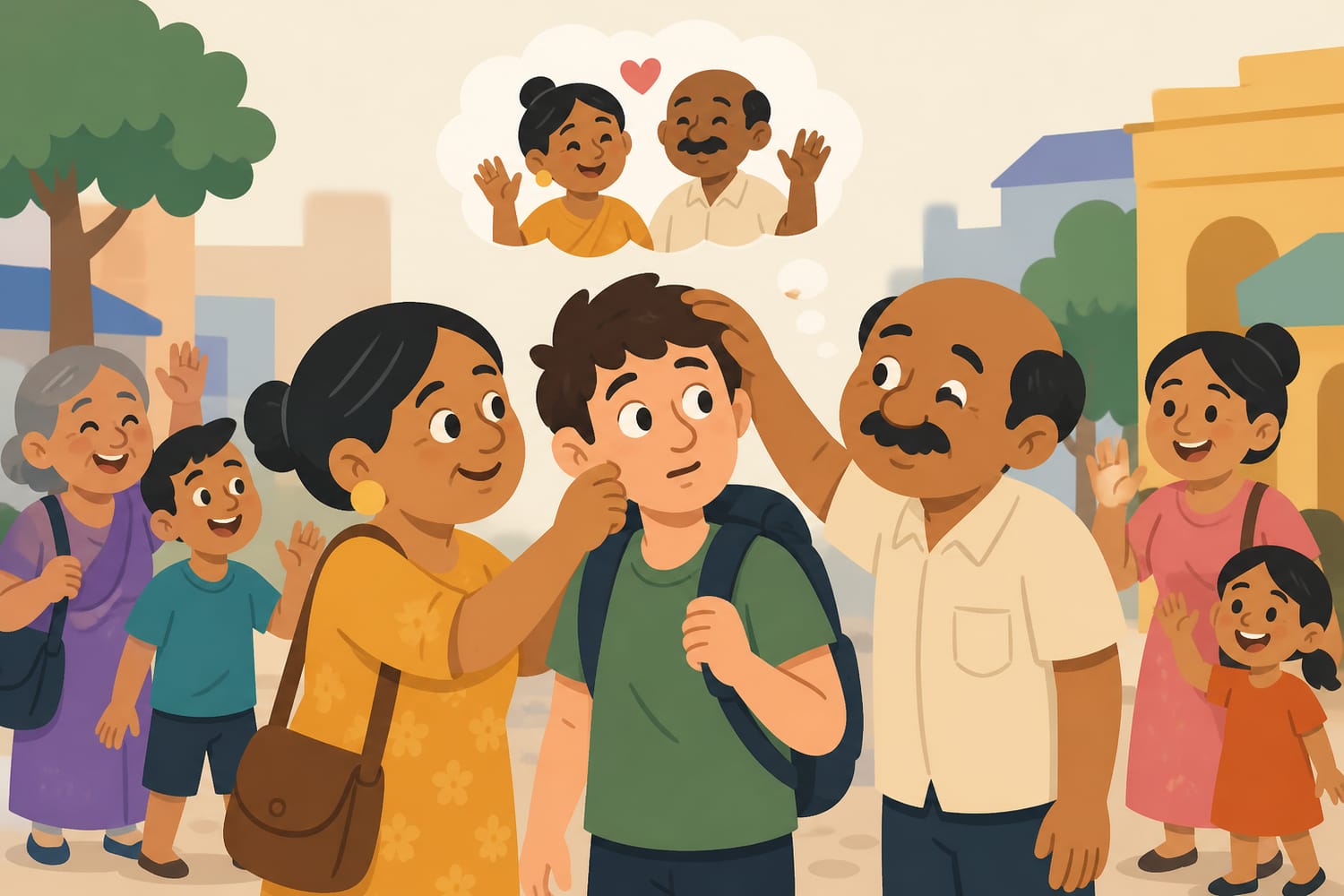
Some cultures call unrelated adults “Auntie” and “Uncle” because family words can do more than describe a family tree. They can signal respect, recognize age or social responsibility, and create a sense of belonging. In other words, the speaker is not confused about their relatives—they are using kinship as a social language.
A Small Word With a Surprisingly Big Job
In everyday English, aunt and uncle usually identify specific relatives: the siblings of a parent or the spouses of those siblings. Yet in many communities, these words—or their local equivalents—stretch far beyond biology.
An auntie might be a neighbor, a shopkeeper, a family friend, a teacher, or an older woman encountered at a community gathering. An uncle might be a respected elder, a friend’s father, or simply an older man whose name the speaker does not know.
To understand why, it helps to remember that kinship is partly cultural. As this introduction to kinship from OpenStax explains, societies differ in how they define relationships and the responsibilities attached to them. Anthropologists also distinguish between terms of reference, which describe someone, and terms of address, which are used when speaking directly to that person.
So “She is my aunt” and “Excuse me, Auntie” may be doing two very different linguistic jobs.
No, Nobody Has Forgotten the Family Tree
The practice is sometimes associated with fictive kinship, an anthropological term for family-like relationships not based on descent or marriage. However, not every stranger called “Uncle” instantly becomes a fully fledged relative with holiday invitations and inheritance expectations.
Often, Auntie or Uncle is better understood as a generalized kinship term: a family word extended into ordinary social life. Depending on the community, it may express affection, politeness, seniority, familiarity, or some combination of all four.
The exact meaning comes from context. Tone matters. Age matters. Who is speaking matters. As with the way language changes when you talk to Grandma rather than Google, people constantly adjust their words to fit a relationship—even when they do not consciously notice themselves doing it.
Why Use “Auntie” Instead of a Name?
It Shows Respect Without Sounding Cold
Calling an older adult by a first name can feel overly casual in communities where age carries social status. On the other hand, a formal title such as Mrs., Madam, or Sir may create too much distance.
Auntie and Uncle occupy a useful middle ground. They are respectful but warm. They acknowledge a difference in age while suggesting that the older person belongs within the speaker’s social world.
Compare the emotional flavor:
- “Excuse me, ma’am” sounds polite and formal.
- “Excuse me, Auntie” can sound polite, familiar, and communal.
- “Hey, Susan” might sound perfectly friendly—or shockingly casual—depending on the setting.
None of these choices is universally correct. Each belongs to a different map of social relationships.
It Places People Within a Generation
Some languages require speakers to pay close attention to relative age and family position. Instead of reaching for one neutral word equivalent to English you, a speaker may select a term meaning older brother, younger sister, aunt, uncle, grandmother, or another relationship.
Vietnamese offers a striking example. Many of its everyday forms of address come from kinship vocabulary, and choosing one often depends on the speakers’ relative ages and generations. A person may address a non-relative with a word whose literal family meaning is “older brother,” “aunt,” or “uncle.” The term simultaneously identifies the other person and positions the speaker in relation to them.
In such a system, family language is not decorative. It helps organize the conversation.
It Turns a Community Into an Extended Family
Kinship words can also communicate a broader idea: adults have social relationships and responsibilities beyond the walls of their own homes.
Calling a neighbor “Auntie” may recognize that she watches out for local children. Calling a family friend “Uncle” may acknowledge his lasting place in the household’s life. The title says, in effect, “You are one of the adults who belongs here.”
That does not mean every community using these terms operates as one enormous, permanently harmonious family. Families themselves are rarely that simple. But the vocabulary encourages people to imagine social life through connection rather than complete separateness.
Aunties and Uncles Around the World
The practice appears in many places, but it does not follow one universal rule.
South Asia
In many South Asian communities, especially among speakers of Indian English, Auntie and Uncle are common ways for younger people to address older neighbors, parents’ friends, acquaintances, and sometimes strangers. Local languages also provide numerous precise kinship terms, including words that distinguish older from younger relatives or the maternal side from the paternal side.
Here, the English words can serve as convenient, flexible titles. They preserve respect for age without requiring the speaker to know a person’s surname or exact family connection. Research on Indian forms of address has described kinship terms as ways of expressing both closeness and respect.
East and Southeast Asia
Chinese speakers may extend kinship terms such as “older brother,” “older sister,” “aunt,” or “uncle” to non-relatives, although customs vary by region, age, and situation. Educational materials for Mandarin learners, for example, describe terms equivalent to uncle and aunt as possible forms of address for strangers of one’s parents’ generation.
In the Philippines, children may call older adults tita and tito, commonly translated as “auntie” and “uncle.” Other terms, including ate and kuya—older sister and older brother—can similarly extend respect beyond a strictly biological relationship.
African Communities
Across a continent containing thousands of communities and languages, no single “African” rule exists. Nevertheless, extended kinship address is found in a variety of settings.
In some Swahili-speaking families, for example, friends of one’s parents may receive honorary aunt or uncle titles. Other family terms can mark age, respect, and a person’s place within the wider social network.
Similar practices occur in parts of southern Africa, where kinship terms may be used for teachers, elders, and authority figures rather than only literal relatives.
Hawaiʻi and the Pacific
In Hawaiʻi, auntie and uncle are widely recognized as respectful terms for adults of an older generation. They connect with an expansive understanding of ʻohana, or family, which can include people beyond immediate biological relatives.
The University of Hawaiʻi describes auntie as a respectful term for a woman of one’s parents’ generation or older, while university materials also note that community members may be honorifically called aunties and uncles.
Aboriginal and Torres Strait Islander Communities
In Aboriginal and Torres Strait Islander contexts in Australia, Aunty and Uncle may be titles of respect for Elders and other senior community members. These titles can recognize cultural knowledge, service, care, and an established relationship—not merely age.
This is also an important example of why outsiders should not copy a cultural practice automatically. Queensland’s Aboriginal and Torres Strait Islander Respectful Language Guide advises people not to assume they may use Aunty or Uncle without an existing relationship or permission. The title can imply mutual connection and obligation, so waiting for an invitation is the respectful approach.
Why It Can Feel Strange to English Speakers
In much of mainstream American and British English, given names have become common even across age differences. Calling an unrelated stranger Auntie may therefore sound unusually intimate—or like an unsolicited announcement that she looks older.
That reaction reveals something important: no form of address is neutral. First names can represent friendliness and equality, but they can also appear disrespectful in cultures that emphasize seniority. Formal titles can represent courtesy, but they may feel stiff or distant elsewhere.
Even auntie carries different associations within English-speaking communities. It might mean a biological relative, a parent’s close friend, a respected elder, or a beloved woman who has been unofficially absorbed into the family. Language rarely checks the genealogy records before becoming affectionate.
Should You Call Someone “Auntie” or “Uncle”?
Cultural appreciation is good. Guessing is riskier. If you are unfamiliar with local expectations:
- Listen first. Notice how people from the community address one another.
- Do not rely on appearance alone. Age, authority, and cultural role cannot always be guessed.
- Follow introductions. If someone is introduced as “Aunty Maria,” that may signal the appropriate title.
- Ask when necessary. A simple “How would you like me to address you?” works beautifully.
- Accept corrections cheerfully. A linguistic mistake need not become an international incident.
- Remember that communities are not monoliths. Preferences vary by generation, region, family, and individual.
Understanding these differences is part of navigating the surprising power of polite words around the world. Good cross-cultural communication is less about memorizing one magical rule and more about paying attention to people.
A Family-Shaped Map of Society
When a stranger becomes “Auntie” or “Uncle,” the word is doing more than replacing a name. It is placing that person on a social map—one shaped by age, respect, warmth, responsibility, and belonging.
To one listener, Uncle means “my mother’s brother.” To another, it can mean “a respected man of my parents’ generation.” To someone else, it identifies a trusted community elder whose title should not be used casually.
The family tree, it turns out, has linguistic branches extending far beyond the household. Sometimes all it takes to climb onto one is a single word.