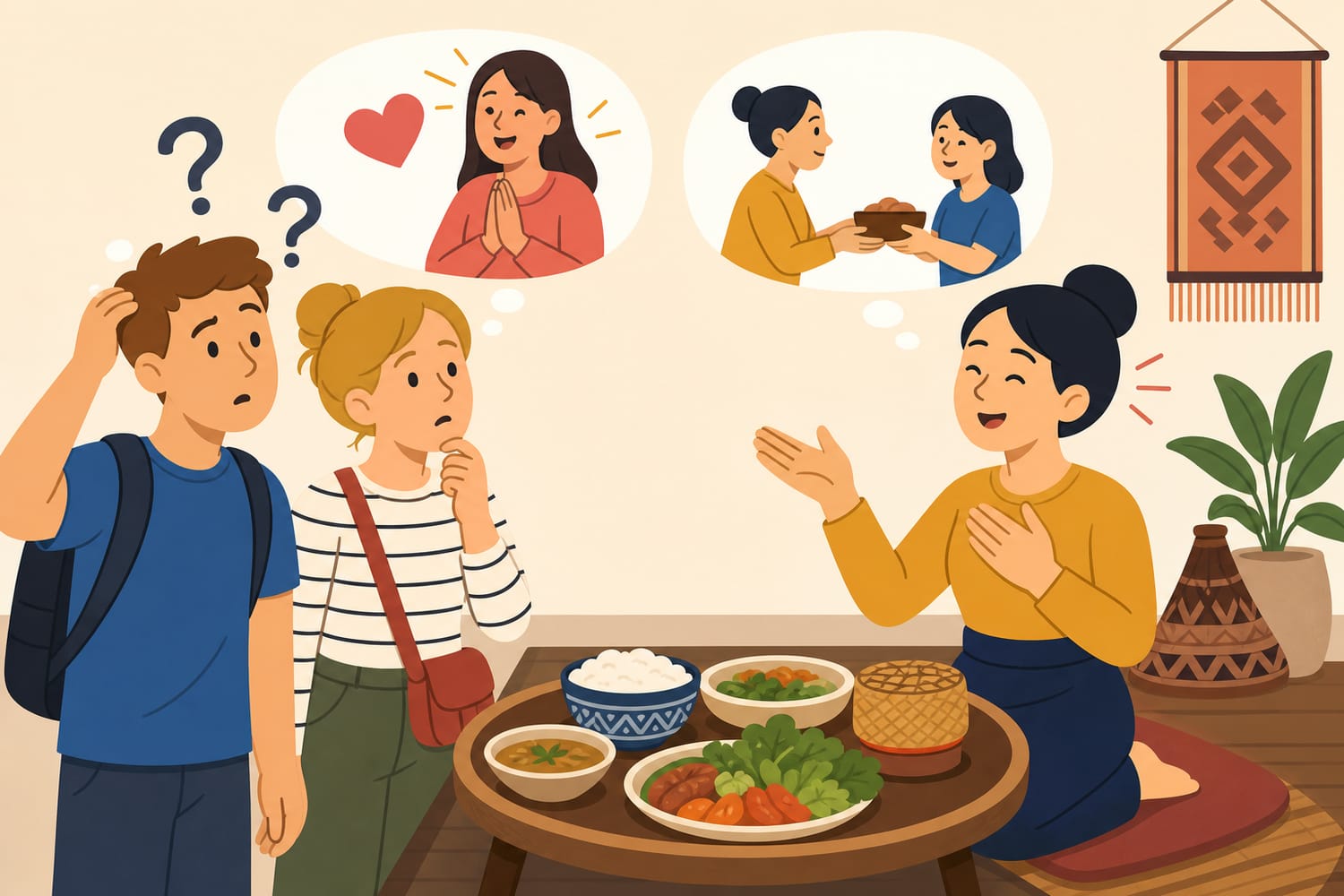
Gratitude Isn’t Missing—It’s Just Wearing Different Clothes
Imagine this: you’re visiting a friend’s family abroad. Their mother spends three hours preparing a meal, refills your plate twice, and sends you home with enough leftovers to feed a small committee. You say “thank you” enthusiastically—possibly too enthusiastically. Everyone smiles politely.
Later, your friend tells you, “You don’t need to keep saying thank you. It sounds a little… formal.”
Wait. What?
For many English speakers, “thank you” is one of the first politeness tools we learn. Someone holds a door? Thank you. Barista hands over coffee? Thank you. Email received? Thanks! Friend listens to your dramatic retelling of a minor inconvenience? Thank you for being there for me during this difficult time.
But not every language or culture uses a direct equivalent of “thank you” in the same way, with the same frequency, or in the same situations. That does not mean people are less grateful. It means gratitude may be shown through different words, actions, expectations, and social rules.
In other words: the feeling is universal, but the script is not.
“Thank You” Is Not as Universal as It Feels
Because phrases like “thank you,” “merci,” “gracias,” or “danke” are so common in many global languages, it is easy to assume that every culture has a similar phrase used in similar ways. But languages are not just word collections. They are social maps. They tell us who we are to each other, what we owe each other, and what should go without saying.
Researchers who study everyday conversation have found that explicit verbal thanks are often less common than many people assume. In a cross-cultural study of informal requests and responses, scholars examined everyday interactions in several languages and communities. They found that people usually help each other when asked—but explicit “thank you” expressions were relatively rare in many settings. English speakers used them more often than some other groups, but even in English, people did not thank each other every single time.
This makes sense if you think about daily life. If you ask your sibling to pass the salt, you may not deliver a heartfelt “thank you” every time. If your partner makes coffee every morning, gratitude might show up as washing the mugs later, remembering their favorite snack, or simply participating in the shared rhythm of life.
Some cultures take that logic further: among close family, friends, or community members, help is expected as part of the relationship. Saying “thank you” too strongly can make the act sound like a transaction between strangers rather than a natural part of belonging.
When Saying “Thank You” Can Create Distance
In many English-speaking contexts, saying “thank you” is warm and polite. But in some cultures, over-thanking can unintentionally create emotional distance.
Why? Because a strong, formal expression of thanks can imply that the favor was unusual, burdensome, or outside the normal relationship. If your grandmother feeds you, she may not want to be treated like a restaurant employee. If a close friend helps you move apartments, thanking them once is lovely; thanking them repeatedly and formally may start to sound like you’re closing a social account.
In some communities, especially those where mutual obligation is central, kindness is not treated as a one-off favor. It is part of an ongoing relationship. Today I help you. Tomorrow you help me. Next month we both help someone else. No one is keeping exact score—or at least no one is supposed to admit they are.
This is not “rudeness.” It is a different idea of politeness.
A simple comparison:
- In a more individualistic setting, “thank you” may acknowledge that another person freely chose to help you.
- In a more relationship-based setting, constant thanks may suggest that help is not naturally expected between people who belong to each other.
The difference is subtle, but important. One culture may say, “I respect your effort by thanking you.” Another may say, “I respect our bond by not making this feel like a favor.”
Japan: Gratitude, Apology, and the Art of “Sumimasen”
Japanese is a wonderful example of how “thank you” does not always fit neatly into one box.
The standard word for “thank you” is arigatō, or more politely, arigatō gozaimasu. Japanese speakers absolutely do say thank you. But another common expression, sumimasen, often enters situations where English speakers might expect only gratitude.
Sumimasen can mean “excuse me,” “I’m sorry,” or even “thank you,” depending on context. If someone goes out of their way to help you, you might say sumimasen not because you have committed a terrible offense, but because you are acknowledging the trouble they took on your behalf.
It is gratitude with a little bow of apology inside it.
This reflects a broader cultural sensitivity to social burden. The phrase recognizes that the other person has been inconvenienced, even slightly. So rather than focusing only on “I appreciate it,” it also carries the meaning “I’m sorry to have troubled you.”
To an English speaker, apologizing when someone helps you may sound overly self-effacing. But in Japanese, it can be a graceful way to show awareness of others.
China: Thanks, Family, and the Closeness Question
Mandarin Chinese has a clear phrase for thank you: xièxie. It is widely used, especially in public, professional, and service settings. If someone gives you directions, serves you tea in a restaurant, or helps you in a shop, xièxie is completely normal.
But among close family members or intimate friends, frequent thanks can sometimes feel overly formal. In some Chinese families, saying xièxie for every small act—your parent serving food, your spouse handing you something, your sibling helping out—may sound distant, as though you are treating loved ones like outsiders.
This varies greatly by generation, region, personality, and exposure to global norms. Younger urban speakers may use xièxie more casually at home than older generations did. Still, the general idea is familiar in many cultures: the closer the relationship, the less need there may be for formal verbal gratitude.
Instead, appreciation might be shown by actions: bringing fruit, pouring tea, helping with errands, offering food, remembering obligations, or simply being present when needed.
In many families, “Have you eaten?” can carry more affection than a speech about gratitude.
South Asia: Gratitude Beyond the Word
Across South Asia, there are many languages and many ways to express thanks: Hindi-Urdu dhanyavaad or shukriya, Bengali dhonnobad, Tamil nandri, and so on. These words exist and are used. But in some contexts, especially within close relationships, a direct “thank you” may feel formal, literary, or even unnecessary.
For example, in Hindi-speaking settings, dhanyavaad can sound quite formal in everyday conversation. Shukriya may feel more conversational to many speakers, though usage varies by region and community. Among family members, people may simply not thank each other for routine care. A mother packing lunch, an uncle arranging transportation, or a cousin hosting you may be participating in expected family duties.
This does not mean gratitude is absent. It may be expressed through respect, gifts, food, deference to elders, or reciprocal help. Touching elders’ feet in some Hindu traditions, offering hospitality, or insisting that guests eat more than physically advisable can all be part of a wider language of appreciation and respect.
Sometimes the “thank you” is not a phrase. It is a mango box, a phone call, or showing up at a wedding three cities away.
“No Thank You” Cultures? Be Careful With That Idea
You may occasionally hear claims like “This culture doesn’t say thank you.” That is almost always too simplistic.
Most languages have some way to express gratitude, appreciation, blessing, indebtedness, or acknowledgment. The real differences are usually about:
- When thanks are expected
- Who you thank
- How formally you say it
- Whether words or actions matter more
- Whether thanks emphasize appreciation, apology, blessing, or reciprocity
For instance, in some Indigenous and small-scale communities, everyday sharing may not require verbal thanks because cooperation is built into survival and social life. In close-knit groups, making every act of sharing into a formal favor can feel odd. But that does not mean people lack gratitude. It means generosity may be understood as normal, necessary, and relational.
The danger is assuming that if people do not use the exact phrase we expect, they are rude. That is like assuming someone is not celebrating because they are not singing the birthday song you know.
English Has Its Own Weird Thank-You Habits
Before English speakers get too comfortable judging anyone else, let’s admit something: English can be a little thank-you obsessed.
In some varieties of English, especially British English, “thanks,” “cheers,” “ta,” “much appreciated,” and “brilliant, thank you” appear constantly in daily interactions. British politeness can produce charming chains like:
“Sorry, could I just squeeze past?”
“Oh, sorry, yes.”
“Thank you.”
“No, sorry, thank you.”
“Cheers.”
“Sorry.”
Nobody is quite sure who has done what to whom, but everyone has apologized and thanked each other, so civilization continues.
American English also uses thanks frequently, especially in customer service and casual exchanges. Emails may include “thanks” before the request has even been fulfilled: “Thanks in advance!”—a phrase that can sound efficient to some and mildly threatening to others.
So if another culture seems to say “thank you” less often, it may not be unusually cold. English may simply say it a lot.
Gratitude Can Be Spoken in Actions
One of the most important lessons from cross-cultural politeness is that words are only one channel.
Gratitude may be expressed by:
- Returning a favor later
- Offering food or drink
- Giving a small gift
- Publicly praising someone
- Showing respect to their family
- Helping without being asked
- Remembering an important date
- Praying for or blessing someone
- Spending time together
- Accepting hospitality graciously
In some cultures, accepting what is offered is itself a sign of appreciation. Refusing food too quickly, even politely, may be more awkward than forgetting to say thanks. In others, writing a thank-you note is deeply meaningful. In still others, a person may downplay your thanks because humility requires them to say, “It was nothing.”
Every culture has ways of managing the delicate emotional math of giving and receiving.
How to Avoid Sounding Rude—or Weirdly Overgrateful
If you are traveling, learning a language, or spending time in a different cultural setting, the best strategy is not to stop saying thank you. Please do not read this article and begin silently accepting sandwiches from strangers.
Instead, pay attention.
Here are a few practical tips:
- Learn the local phrase for thanks. Even if it is not used constantly, knowing it matters.
- Watch how people thank each other. Notice whether thanks are common in shops, homes, workplaces, or among friends.
- Match the level of formality. A formal phrase may be perfect for a teacher or elder but odd with a close friend.
- Use actions too. Offer help, bring something, follow through, and show respect.
- When unsure, be sincere. Most people forgive imperfect etiquette when the intention is kind.
Also, remember that cultures are not machines. Not every Japanese speaker uses sumimasen the same way. Not every Chinese family avoids xièxie at home. Not every English speaker wants to be thanked six times for passing a napkin. Age, class, region, personality, and context all matter.
The Big Lesson: Politeness Is Cultural Poetry
“Thank you” seems simple, but it opens a door into some of the deepest questions in human culture. What do we owe each other? When is help a gift, and when is it expected? Does gratitude create closeness, or can it create distance? Should appreciation be spoken, returned, acted out, or quietly understood?
Some cultures say thank you often. Some say it carefully. Some wrap it in apology. Some save it for formal situations. Some prefer to show gratitude by feeding you until you lose the ability to stand.
The key is not to rank these habits from polite to impolite. The key is to recognize that every language teaches its speakers a different choreography of kindness.
So the next time someone does not say “thank you” the way you expect, pause before judging. They may be saying it in another language entirely—not with a phrasebook expression, but with a gesture, a meal, a favor returned, or a relationship that assumes, “Of course I would help you.”
And honestly, that is something worth being thankful for.