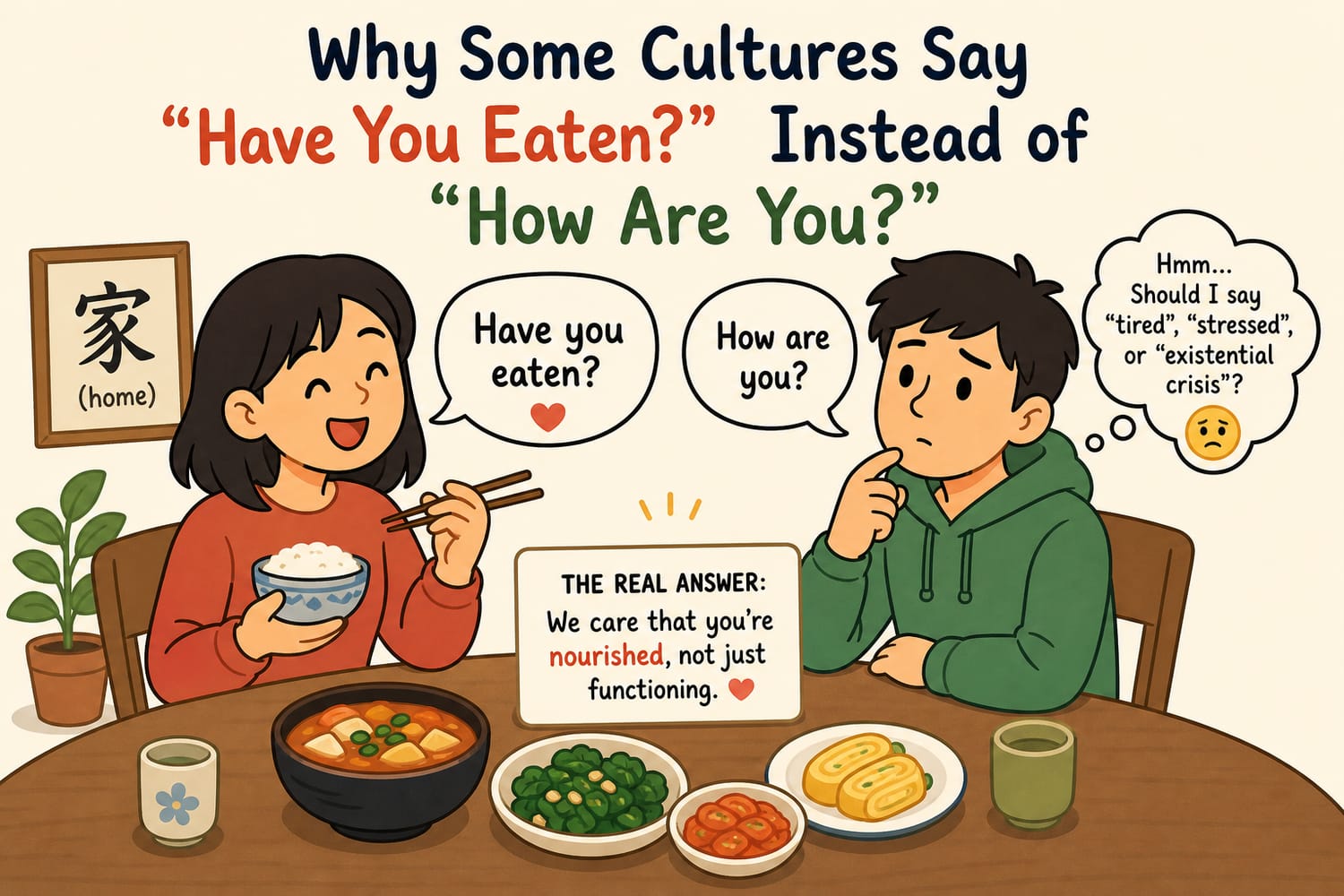
A Greeting That Sounds Like a Dinner Invitation
Imagine you’ve just arrived at a friend’s house, or bumped into an older neighbor on the street, and instead of saying “How are you?” they ask, “Have you eaten?”
If you grew up in an English-speaking culture where greetings usually involve emotional check-ins — “How’s it going?” “You alright?” “How are you?” — this might sound surprisingly specific. Have I eaten? Recently? Is there food coming? Am I supposed to answer honestly?
In many cultures, though, “Have you eaten?” is not mainly about your lunch schedule. It is a greeting, a gesture of care, and sometimes a tiny verbal hug. It can mean “Are you well?” “Are you looked after?” “I’m glad to see you,” or “You matter enough for me to worry about your stomach.”
Versions of this greeting appear across parts of East Asia, Southeast Asia, South Asia, and beyond. In Mandarin Chinese, people may say 你吃了吗? (nǐ chī le ma?) — “Have you eaten?” In Korean, 밥 먹었어요? (bap meogeosseoyo?) means “Have you eaten rice/food?” In Thai, กินข้าวหรือยัง (gin khao rue yang) literally asks “Have you eaten rice yet?” Vietnamese has ăn cơm chưa?, often translated as “Have you eaten rice/a meal yet?”
These phrases are not identical in every language or situation, but they share a common idea: food is not just food. Food is wellbeing, relationship, family, hospitality, history, and care — all tucked into one everyday question.
“How Are You?” Is Not as Literal as It Looks
Before we treat “Have you eaten?” as unusual, it helps to notice something funny about English: “How are you?” often isn’t very literal either.
In many English-speaking settings, if a cashier says “How are you?” the expected answer is not a detailed medical, emotional, or financial report. Usually, “Good, thanks. You?” is enough. The phrase works as what linguists call a phatic expression: language used to create social connection rather than exchange detailed information.
The term “phatic communion” was popularized by anthropologist Bronisław Malinowski in the early 20th century. It describes talk that keeps social bonds warm: “Nice weather,” “Long time no see,” “What’s up?” or “How’s life?” These phrases may look like requests for information, but their real job is often to say, “We are on friendly terms.”
So when someone says “Have you eaten?” as a greeting, they may not be asking for a full dietary summary. Like “How are you?”, the question is doing social work. It opens a conversation. It expresses concern. It acknowledges your presence.
The difference is that different cultures choose different symbols for care. Some ask about your feelings. Some ask about your journey. Some ask whether your family is well. And some ask the most practical question of all: is there food in your body?
Food as a Measure of Wellbeing
To understand why eating becomes a greeting, we need to remember a simple historical fact: for much of human history, having enough food was not guaranteed.
Today, many people still live with food insecurity, but in earlier agrarian societies, hunger was an even more visible part of daily life. Harvests could fail. Weather could ruin crops. War, poverty, migration, taxation, and social upheaval could disrupt food supplies. In such contexts, asking whether someone had eaten was not small talk. It was a real measure of safety.
If you had eaten, you were probably alive, functioning, and cared for. If you had not, someone might offer food.
This is one reason “Have you eaten?” became culturally powerful in places where family and community networks played a central role in survival. The question could communicate concern more concretely than “How are you?” After all, feelings are complex, but hunger is immediate.
In Chinese-speaking communities, 你吃了吗? is often associated with older generations and traditional everyday speech, especially among people who grew up in times when food scarcity was a living memory. It does not mean every Chinese speaker uses it constantly today, nor that it is appropriate in every situation. In modern cities, a simple 你好 (nǐ hǎo, “hello”) or other greetings may be more common, especially among younger people or in formal contexts. But the phrase remains culturally recognizable because it reflects a world where eating was deeply tied to being okay.
Similarly, in Korean, 밥 먹었어요? can function as a caring check-in. The word 밥 (bap) literally means cooked rice, but it also commonly means “meal” or “food” more generally. Asking whether someone has eaten bap can be a way of asking whether they are taking care of themselves.
Why Rice Often Stands for a Whole Meal
One fascinating detail in many “Have you eaten?” greetings is that the word for “rice” often appears where English would say “food” or “a meal.”
In Thai, ข้าว (khao) means rice, but it can also represent food or a meal in everyday expressions. In Vietnamese, cơm refers to cooked rice, but ăn cơm means to eat a meal. In Korean, 밥 works similarly. In many parts of Asia, rice has historically been the staple food: the center of the meal, the crop that shaped agriculture, labor, household routines, and even ideas of comfort.
English has a faintly similar pattern with “bread.” The word appears in expressions like “daily bread,” “breadwinner,” and “breaking bread.” In these phrases, bread is more than a baked item. It stands for food, income, livelihood, and shared life.
So when a Thai speaker asks, “Have you eaten rice yet?” the question does not necessarily mean “Have you consumed rice specifically?” It usually means “Have you eaten a meal?” Rice, like bread in older English expressions, carries cultural weight beyond its literal meaning.
Staple foods become symbols because they are repeated daily. They are there at breakfast tables, in lunch boxes, at festivals, in fields, in childhood memories, and in family kitchens. Over time, the staple becomes shorthand for nourishment itself.
A Question That Can Mean “I Care About You”
One of the warmest things about “Have you eaten?” is that it often carries practical affection.
Not all cultures express care by saying “I love you” frequently. In some families, love is shown through action: cutting fruit, making soup, packing leftovers, telling someone to wear a jacket, or asking if they have eaten. The words may seem ordinary, but the emotional meaning is rich.
This is especially true across generations. A grandparent may not say, “I am emotionally invested in your wellbeing and would like to support your flourishing as a human being.” They may say, “Eat more.” Much shorter. Very effective.
In many families, feeding someone is one of the most basic forms of love. When you ask “Have you eaten?” you are not only gathering information; you are positioning yourself as someone who cares enough to ask. If the answer is no, the next step may be an offer: “Come eat,” “I’ll make something,” or “Take this with you.”
Even when no food is actually offered, the greeting still carries the memory of hospitality. It says, “If you needed something, I would notice.”
But Don’t Always Expect a Feast
For learners of a language, this can be confusing. If someone asks “Have you eaten?” should you answer truthfully? Should you say yes even if you haven’t? Are you being invited to dinner?
The answer depends on the language, relationship, and context.
In many casual situations, a simple answer is fine: “Yes, I have,” or “Not yet.” If you say “Not yet,” a close friend or relative might offer food. A stranger or acquaintance might simply continue the conversation. Tone matters too. A quick “Have you eaten?” while passing in a hallway may function like “Hey, how’s it going?” A more insistent version at someone’s home may be a real invitation to eat.
It is also important not to overgeneralize. Not every Chinese, Korean, Thai, Vietnamese, Filipino, Indian, or other Asian person uses food-based greetings in the same way. Language varies by age, region, class, family style, urban or rural background, and personal habit. Some people may find the phrase old-fashioned; others may use it daily. Some use it only with close family. Some use it humorously. Some may switch between traditional greetings and globalized ones like “Hi” or “Hello.”
Culture is never one sentence. But one sentence can open a door into culture.
The Social Life of Small Talk
Greetings tell us what a society considers worth noticing.
In English, “How are you?” points toward individual condition, mood, or state, even if the answer is usually brief. In many Arabic-speaking contexts, greetings may include questions about health, family, and peace. In some languages and communities, people ask where you are going or where you have come from. To outsiders, that may sound intrusive, but locally it may simply be a normal way to acknowledge someone’s life and movement.
A greeting is like a tiny social ritual. It has rules, but those rules are often invisible to native speakers. You learn when to ask, how much to answer, whether to be literal, and when the phrase is just a polite exchange.
This is why translating greetings word-for-word can be misleading. “Have you eaten?” may sound nosy in one cultural frame and affectionate in another. “How are you?” may sound caring to a learner, only for them to discover that many people don’t expect a deep answer. “Where are you going?” may sound like surveillance in one language and neighborly warmth in another.
The words are only half the message. The social meaning is the rest.
Hunger, History, and Memory
Food-based greetings can also carry historical memory. In societies that experienced famine, war, colonization, poverty, or rapid modernization, food is not just a private matter. It can be connected to collective memory.
For older people who lived through scarcity, asking whether someone has eaten may feel natural because food once marked the boundary between security and danger. For younger generations raised in more prosperous conditions, the phrase may feel traditional, familial, or even quaint. Yet it survives because it remains emotionally understandable.
Everyone knows what hunger feels like. Everyone understands being cared for through food. Even in wealthy societies, a homemade meal can still say what words struggle to express.
That may be why “Have you eaten?” travels so well across time. It is humble, practical, and deeply human. It does not require grand emotion. It simply asks whether your most basic need has been met.
What This Teaches Us About Language
The beauty of “Have you eaten?” is that it reminds us language is never just vocabulary. A phrase carries the life of the people who use it: their crops, homes, hardships, manners, jokes, grandparents, and kitchens.
It also teaches us that no greeting is universal. What feels polite in one culture may feel too direct, too cold, too formal, or too personal in another. Learning another language means learning not only what words mean in a dictionary, but what they do between people.
So the next time someone greets you with “Have you eaten?” don’t be too quick to hear only the literal question. Listen for the care inside it.
They might be saying: “I see you.”
They might be saying: “I hope you’re well.”
They might be saying: “If you’re hungry, you’re not alone.”
And honestly, as greetings go, that’s a pretty beautiful one.