When a Conversation Sounds Like Birdsong
Some languages are whistled because whistles travel farther than ordinary speech, especially across mountains, valleys, and dense forests. Rather than creating an entirely separate language, speakers transform their everyday spoken language into patterns of pitch, rhythm, and interruption that trained listeners can understand—sometimes from several miles away.
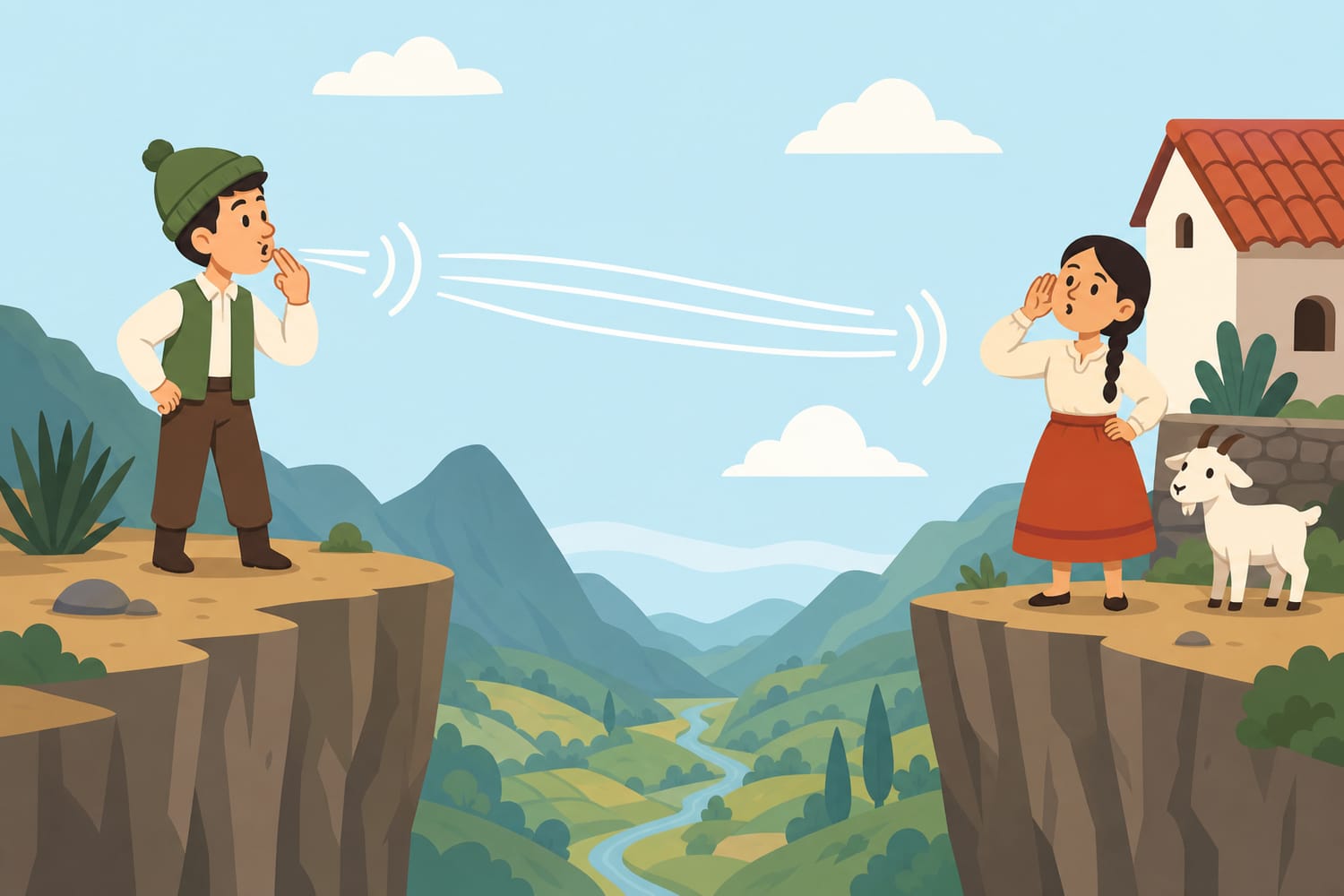
Imagine standing on one side of a steep valley while your neighbor is tending goats on the other. Shouting might produce little more than a muddy echo. A sharp whistle, however, can slice through the landscape with impressive clarity.
That practical problem gave rise to one of humanity’s most remarkable communication systems: whistled speech.
It may sound like birdsong to an outsider, but fluent users can exchange greetings, give instructions, share news, and hold genuine conversations. They are not merely sending a few memorized signals such as “Come home” or “Danger.” They are using the vocabulary and grammar of an ordinary language—just without the ordinary voice.
Are Whistled Languages Really Languages?
The phrase whistled language is convenient, but it can also be slightly misleading. In most cases, people do not speak a language that exists only in whistles. Instead, they use a whistled form, or register, of a language they also speak aloud.
Silbo, for example, is traditionally used on La Gomera in Spain’s Canary Islands. It represents the sounds and structure of the local variety of Spanish. Whistled Turkish does the same with Turkish, while other traditions have developed around languages in Mexico, Greece, parts of Africa, Asia, and South America.
Linguists have documented dozens of such traditions around the world. They occur in unrelated language families, which means humanity has invented this solution more than once. Whistled speech is not one ancient super-language scattered across the globe. It is a clever adaptation created independently by different communities facing similar communication challenges.
The distinction matters. A Spanish speaker who has never learned Silbo will not automatically understand it, just as knowing English does not automatically make someone capable of reading Morse code. The underlying language is familiar, but the method of encoding it must still be learned.
Why Whistles Work So Well Over Long Distances
Ordinary speech contains a complicated mixture of frequencies. As it travels, those acoustic details can be weakened or scattered by wind, vegetation, echoes, and background noise.
A whistle concentrates energy into a much narrower band of sound. It can be loud, piercing, and relatively resistant to the low-frequency rumble of streams, wind, animals, and human activity. Under suitable conditions, a practiced whistle can remain recognizable across several kilometers.
This makes whistled speech especially useful in places with:
- Deep ravines or steep valleys
- Mountainous farmland and grazing areas
- Thick forests that block visibility
- Scattered homes or villages
- Outdoor work that separates people for hours at a time
The landscape does not merely provide a pretty backdrop. It helps explain why the tradition exists at all. Just as some communities develop detailed systems of cardinal directions—explored in our article on languages that do not rely on “left” and “right”—whistling shows how communication can adapt to the physical world.
In effect, whistled speech was long-distance calling before anyone had a phone, a radio, or the irritating ability to start a group chat.
How Do You Squeeze Words Into a Whistle?
Human speech is extraordinarily rich. The tongue, lips, vocal cords, teeth, and mouth work together to produce vowels, consonants, stress, tone, and rhythm. A whistle has fewer ingredients to play with, so whistlers preserve the most useful clues and discard others.
The exact method depends partly on the structure of the spoken language.
Whistling Tonal Languages
In tonal languages, pitch can distinguish one word from another. A syllable spoken with a rising pitch may mean something different from the same syllable spoken with a falling or level pitch.
Whistlers can reproduce these meaningful pitch patterns quite directly. The whistle follows the language’s tones and timing, allowing listeners to reconstruct the message. This approach appears in whistled forms of languages such as Hmong and Chinantec.
Whistling Non-Tonal Languages
Languages such as Spanish, Greek, and Turkish do not generally use pitch to distinguish words in the same way. Their whistled forms therefore rely on a combination of pitch levels, pitch movements, rhythm, duration, and breaks in the sound.
Vowels may be represented by different pitch ranges. Consonants can appear as glides, sudden interruptions, or changes in the shape of the whistle. The result is a simplified acoustic outline of the spoken sentence.
Because some spoken sounds collapse into similar whistles, context is crucial. A whistled sentence may contain more ambiguity than an ordinary spoken one, but fluent listeners use grammar, familiar expressions, and knowledge of the situation to fill in the gaps.
Humans already do this in everyday conversation. If someone mumbles, “Put it over there,” you may understand only half the sounds—but the object in their hands and the direction of their gaze do the rest.
Silbo: The Famous Whistles of La Gomera
The best-known whistled tradition is Silbo, practiced on the rugged island of La Gomera. The island is cut by deep ravines, making a short journey in a straight line considerably less short when attempted on foot.
For generations, islanders used whistles to communicate across this difficult terrain. Messages could concern animals, work, family news, invitations, or public announcements. Silbo was a practical tool, not simply a performance for visitors.
Its use declined during the 20th century as roads, telephones, and changing lifestyles transformed the island. Local efforts eventually brought it into schools in 1999, allowing children to learn a tradition that had once been passed informally between generations.
In 2009, UNESCO added Silbo to its Representative List of the Intangible Cultural Heritage of Humanity. Today it remains both a working form of communication and a powerful symbol of Gomeran identity.
Türkiye’s “Bird Language”
Another celebrated example comes from the mountains near the Black Sea in northeastern Türkiye. Commonly called kuş dili, or “bird language,” it converts Turkish into high, melodic whistles that can travel between slopes and settlements.
The tradition was closely connected to agricultural life. People working far apart outdoors could exchange information without walking down one hillside and climbing another—a journey capable of turning “What time is dinner?” into a major expedition.
Mobile phones have reduced the practical need for the system, while migration and social change have weakened its transmission. In 2017, UNESCO placed Türkiye’s whistled language on its List of Intangible Cultural Heritage in Need of Urgent Safeguarding. Community events, teaching programs, and family instruction now help keep it alive.
Its story is a reminder that communication practices are tied to identity as well as convenience. Changing the way people speak can also change how they express belonging, a theme that appears throughout the relationship between language and identity.
What the Brain Hears in a Whistle
To an untrained listener, whistled speech may sound musical or birdlike. To a fluent whistler, it is language—and the brain treats it accordingly.
Research involving experienced Silbo users found that listening to meaningful whistles activated brain regions associated with language processing. Those regions were not activated in the same way among people who did not understand the system. Studies of whistled Turkish have also suggested that its combination of linguistic information and melody draws on both sides of the brain more evenly than ordinary spoken Turkish.
That flexibility is striking. The brain does not insist that language must arrive as a conventional speaking voice. With experience, it can extract words and grammar from hand movements, writing, touch-based systems—or a piercing whistle floating across a valley.
Why These Traditions Are Disappearing
Whistled speech thrives when it solves an everyday problem. Once mobile phones, improved transportation, and indoor employment change that problem, the incentive to master a demanding skill becomes weaker.
Several pressures contribute to its decline:
- Technology makes distant communication easier.
- Younger people may leave rural communities for cities.
- Traditional farming and herding practices become less common.
- Whistling may be treated as old-fashioned or socially inferior.
- Fewer fluent adults remain available to teach children.
Preservation therefore requires more than recording a few whistles. Communities need opportunities to use the tradition naturally—in schools, festivals, family life, and public events.
Like the cultural meanings of pauses and quiet explored in how different cultures use silence, whistled speech depends on shared knowledge. A sound becomes meaningful because a community agrees on how to interpret it.
Language Will Use Whatever Works
Whistled languages reveal something wonderfully simple about human communication: language is not married to the voice.
Give people a difficult landscape, a need to stay connected, and enough time, and they may turn conversation into melody. The result can carry across forests and ravines, sounding like birdsong to strangers while delivering perfectly ordinary human messages.
Perhaps that is the most charming part. Across a dramatic mountain valley, someone might be producing an astonishing display of linguistic skill—only to ask whether anyone remembered to feed the goats.