English Has a Nose—but Not Always the Words
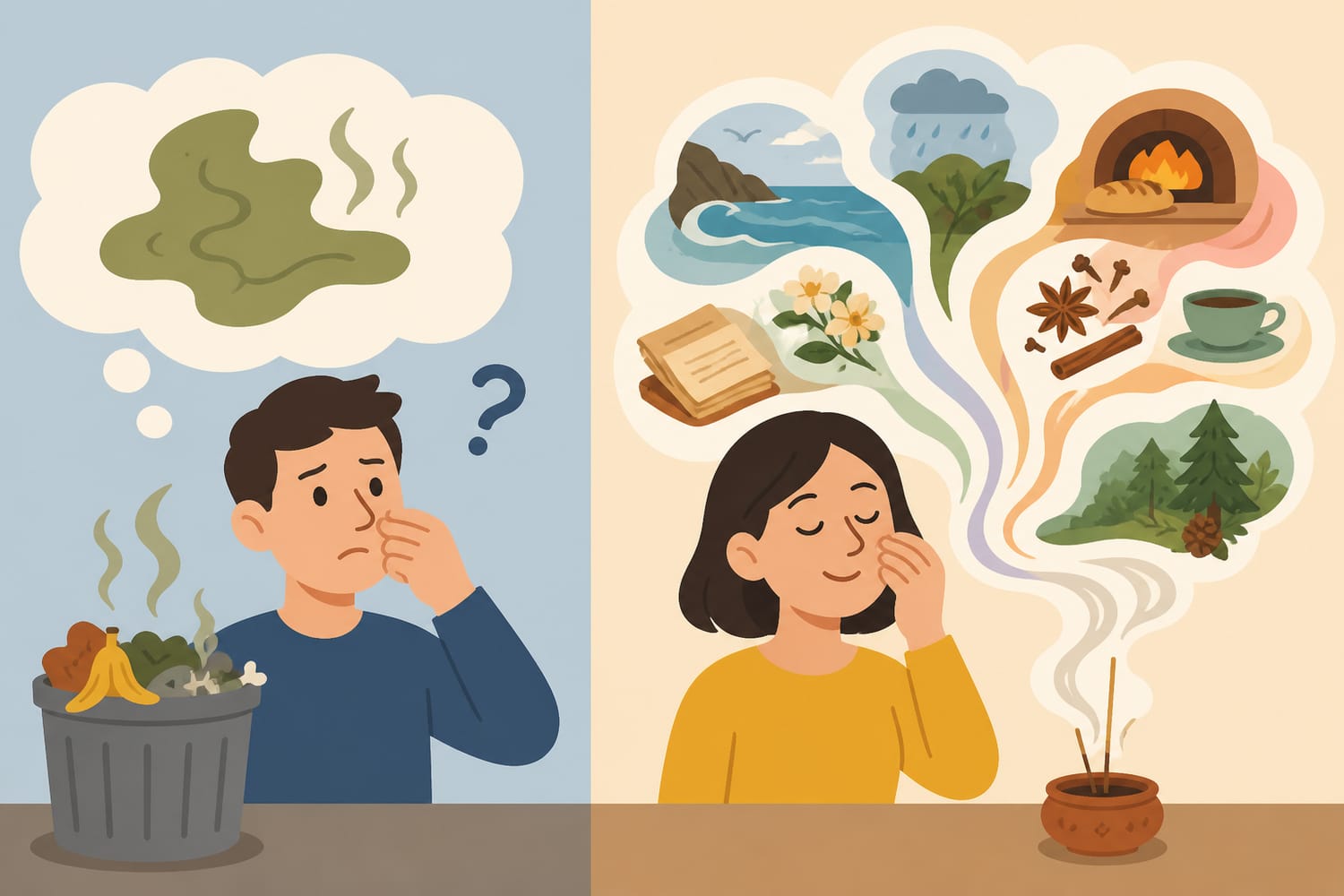
Some languages describe smells better than English because they have conventional, widely understood words for different odor qualities. English speakers usually identify a smell by naming its source—“smoky,” “like coffee,” or “sort of banana-ish.” Speakers of languages such as Jahai and Maniq can instead use basic smell terms much as English speakers use color words.
Try Naming That Smell
Imagine someone hands you an unmarked jar and asks you to sniff it. You recognize the smell immediately. It is familiar, unmistakable and perhaps connected to a vivid memory—but what is it called?
You might say:
- “It’s sweet.”
- “It smells kind of green.”
- “Maybe like cut grass?”
- “Wait, I know this one.”
- “Why are you looking at me like that?”
English speakers are often surprisingly hesitant when asked to name an odor without seeing its source. We may recognize cinnamon instantly when it is sitting in a spice jar, yet struggle when presented with the scent alone.
This does not mean our noses are defective. The difficulty often lies in moving from sensation to language. We can smell something perfectly well without having a convenient, commonly shared label for it.
English certainly has odor-related vocabulary: fragrant, musty, rancid, pungent, acrid, stale, musky and aromatic. It also has delightfully specific terms such as petrichor, the smell associated with rain falling on dry ground. You can explore more examples in “Petrichor” and Other Words That Smell Great.
Yet much of this vocabulary tells us whether a smell is pleasant, intense or connected to a familiar source. It does not divide the entire world of odors into neat, everyday categories.
English Plays the “Smells Like” Game
When English speakers describe colors, they usually use abstract labels. A red apple, a red truck and a red sweater share a quality called red, even though the objects themselves have little else in common.
Smell works differently in everyday English. We commonly borrow the names of things:
- A candle smells like vanilla.
- A room smells smoky.
- A perfume is rosy or citrusy.
- A basement smells like damp socks.
- Something suspicious in the refrigerator smells cheesy, even if cheese is not technically involved.
These source-based descriptions can be useful and wonderfully vivid. The problem is that they depend on shared experience. If you have never smelled cedar, saying that a fragrance is cedar-like will not help much.
They can also create comic disagreements. One person detects “ripe peaches,” another gets “shampoo,” and a third insists the same scent resembles “the inside of a new car.” Everyone may be smelling the same chemical mixture while searching through a different library of memories.
Meet the Languages with Basic Smell Words
The idea that odors are simply impossible to put into words was challenged by research involving languages spoken on the Malay Peninsula.
Jahai, an Aslian language spoken by a community of rainforest hunter-gatherers, has roughly a dozen basic odor terms. These are not technical expressions reserved for perfume makers or ceremonial specialists. They are ordinary words used in everyday life.
Researchers found that Jahai speakers could name odors with a level of ease and agreement comparable to their naming of colors. English speakers, by contrast, were more likely to hesitate, offer several possible answers or describe the object they thought had produced the smell.
Maniq, another Aslian language spoken by hunter-gatherers in southern Thailand, has at least 15 dedicated odor expressions. According to a Max Planck overview of the Maniq odor lexicon, these terms group together smells that may come from very different sources. One category, for example, includes odors associated with an old shelter, mushrooms, rotten wood, dead animal skin and drinking from a bamboo tube.
To an English speaker, that may sound like an eccentric shopping list. To a Maniq speaker, the items share a recognizable odor quality—just as strawberries, stop signs and fire engines all qualify as red despite being otherwise unrelated.
Smell Categories Are More Than Lists of Objects
The important difference is not simply that Maniq or Jahai has “more smell words.” English owns plenty of words related to odor. What matters is how those words organize experience.
A basic color term such as yellow does not mean “the color of a banana.” Bananas are examples of yellow things, but the category exists independently of bananas. In a similar way, a basic Maniq smell term can apply to several unrelated sources because those sources share an odor quality.
Research indicates that the Maniq odor lexicon is structured partly around two dimensions:
- Pleasantness: Is the smell appealing or unpleasant?
- Dangerousness: Does it suggest something safe, useful, spoiled or threatening?
These distinctions make sense in a setting where odors may help people locate food, recognize animals, evaluate medicinal plants or notice potential danger. Smell is not merely decorative atmosphere; it carries practical information.
This resembles the way language can reflect other habits of attention. Some languages emphasize absolute directions rather than body-centered terms, as discussed in why some languages do not rely on “left” and “right”. A language tends to become especially precise where its speakers repeatedly need to notice, discuss and remember distinctions.
Is This About Language, Culture or Lifestyle?
It would be tempting to tell a simple story: rainforest languages have excellent smell vocabularies because rainforests contain many smells. Reality, as usual, refuses to fit into one tidy sentence.
In a 2018 study, researchers compared two communities living in the tropical rainforest of the Malay Peninsula. The Semaq Beri traditionally practiced hunting and gathering, while the Semelai practiced swidden horticulture. Their languages are related, and both communities inhabited broadly similar environments.
The Semaq Beri participants named odors as easily as colors. The Semelai participants found odors substantially harder to name, resembling the pattern commonly seen among Western participants. The results suggested that everyday practices and subsistence could be more important than rainforest ecology alone. The study’s Max Planck summary emphasizes the role that cultural experience may play in odor naming.
However, that does not mean every hunter-gatherer language must possess the same type of vocabulary. Nor does it prove that one lifestyle automatically produces a “better nose.” Language, environment, occupation, history and cultural importance can interact in complicated ways.
Better at Describing Does Not Mean Better at Smelling
There is another important distinction: detecting, recognizing and naming an odor are not identical abilities.
You may detect that a room has a smell without knowing what caused it. You may recognize the scent as familiar without being able to name it. You may also confidently name it and still be wrong—an experience available free of charge to anyone who has attended a wine tasting.
Jahai and Maniq research shows exceptional linguistic skill in categorizing and communicating odors. It does not automatically demonstrate that speakers possess more sensitive noses in every biological sense. Their advantage may lie partly in shared categories, regular attention and frequent practice discussing smells.
Professional experience can make a difference, although its effects are uneven. Research comparing wine experts, coffee experts and novices found that specialists often used more domain-specific descriptions, but expertise did not create a universal advantage across every odor task. In other words, training can sharpen a particular scent vocabulary without magically turning someone into a human bloodhound.
Does Vocabulary Change What We Perceive?
Having a word for something does not give a person an entirely new sensory organ. English speakers can perceive an odor even when they lack a neat label for it.
Vocabulary can, however, guide attention. When a community repeatedly uses the same odor categories, speakers learn which similarities matter. A word offers a mental handle: it helps people compare experiences, remember them and communicate them efficiently.
Colors provide a useful parallel. Languages differ in how they divide the visible spectrum, although all normally sighted humans encounter the same continuous range of light. The boundaries supplied by language can affect how quickly people categorize or discuss particular shades. You can read more about this relationship in how colors shape language and perception.
The safest conclusion is not that language traps us inside a fixed worldview. It is that language and culture can encourage habits of noticing. Words do not build the world from scratch, but they can point our attention toward certain parts of it.
How to Give Your Own Smell Vocabulary a Workout
English may not hand us a complete set of basic odor categories, but we can become more observant. The next time you encounter an interesting scent, try describing it in stages:
- Notice its intensity: Is it faint, strong or overwhelming?
- Describe its effect: Does it feel sharp, warm, dry, cool, heavy or fresh?
- Consider its character: Is it earthy, floral, resinous, smoky, metallic or fermented?
- Separate quality from opinion: “Unpleasant” says whether you like it, not what it smells like.
- Compare several sources: Does the same quality appear in wood, food, soil or fabric?
You may still end up saying, “It smells like my grandmother’s hallway in 1997.” That is not scientifically precise, but it is impressively specific.
The World Is More Fragrant Than English Suggests
Languages do not all divide sensory experience in the same way. Where English often asks, “What does that smell like?” languages such as Jahai and Maniq can offer shared labels for the odor itself.
That difference reveals something larger than a quirky vocabulary gap. Communities develop words around what they regularly need, value and discuss. A smell can be background noise in one culture and essential information in another.
So the next time a mysterious odor leaves you speechless, do not blame your nose. It may know exactly what is happening. English is simply still rummaging through the cupboard for the right word.