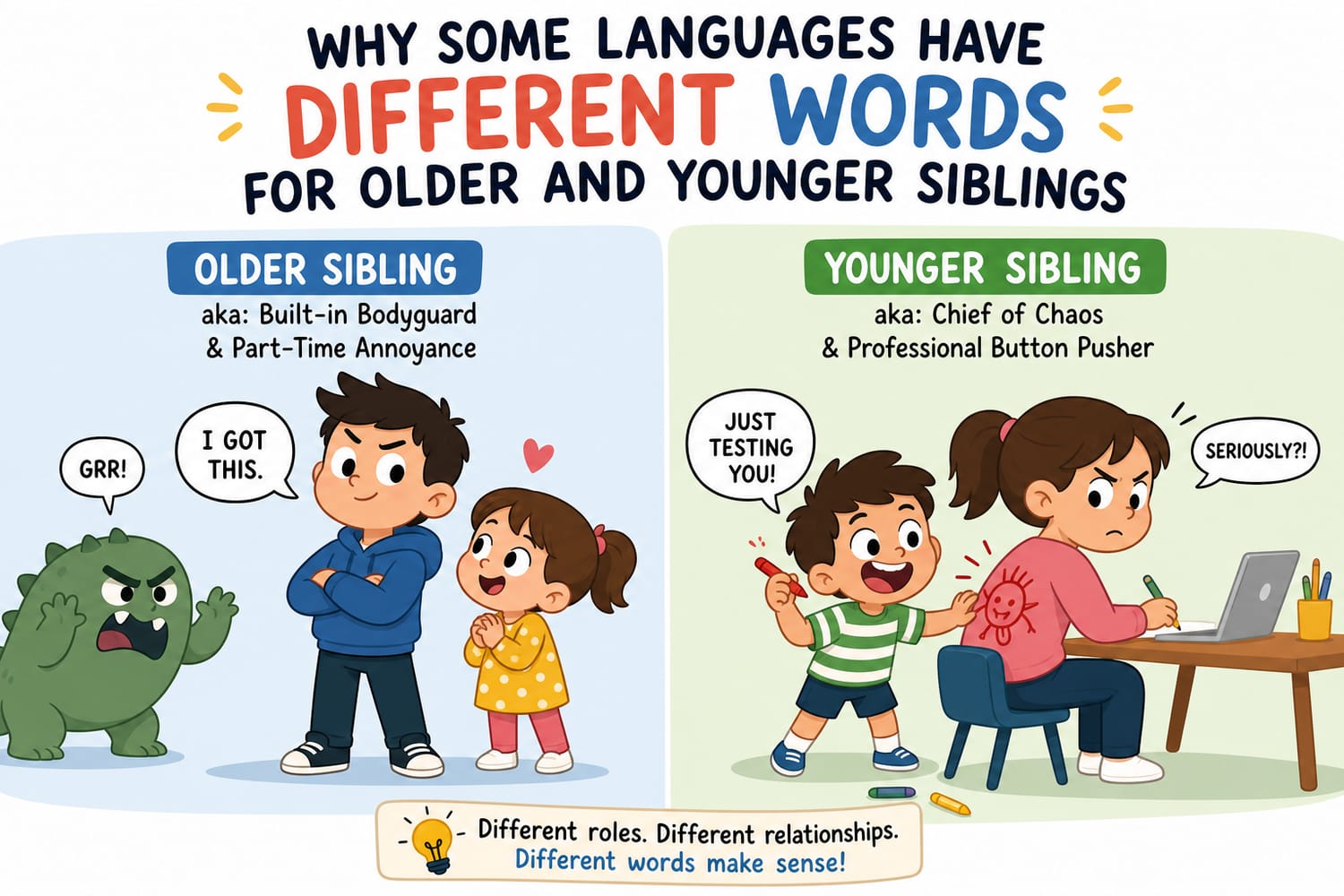
A Tiny Family Tree Hidden in a Word
In English, if you say “my sister,” listeners know you have a female sibling. They do not know whether she is older or younger than you unless you add another word: “older sister” or “younger sister.”
But in many languages, that extra information is built right into the basic word.
In Mandarin Chinese, for example, you don’t usually start with a neutral “brother” or “sister.” You have:
- 哥哥 gēge — older brother
- 弟弟 dìdi — younger brother
- 姐姐 jiějie — older sister
- 妹妹 mèimei — younger sister
So a Chinese speaker often reveals the sibling’s relative age automatically, in the same way English speakers reveal gender when they choose “brother” or “sister.”
This raises a fascinating question: why do some languages care enough about older and younger siblings to give them separate everyday words, while others do not?
The short answer is: because languages tend to make common cultural distinctions easy to say. The longer answer takes us into family structure, respect, hierarchy, social roles, and the wonderfully messy ways humans organize their lives.
English Is Not the Default Setting
For English speakers, “brother” and “sister” may feel like the obvious sibling categories. But from a global point of view, English is just one solution among many.
Some languages divide siblings by gender, as English does. Some divide them by relative age. Some divide them by both. Others have words that depend on the speaker’s gender, the sibling’s gender, or even whether you are speaking to your family or about your family.
For instance, Tamil, a language spoken in southern India and Sri Lanka, has separate common words such as:
- அண்ணன் aṇṇan — older brother
- தம்பி thambi — younger brother
- அக்கா akkā — older sister
- தங்கை thangai — younger sister
Hungarian, unrelated to most European languages around it, also makes these distinctions:
- báty — older brother
- öcs — younger brother
- nővér — older sister
- húg — younger sister
Meanwhile, Indonesian and Malay commonly use:
- kakak — older sibling
- adik — younger sibling
These words can apply regardless of gender, though gender can be specified if needed.
So English is not missing something “natural,” and these other languages are not being unusually fussy. They are simply drawing the family map differently.
Age Matters When Age Means Status
One major reason languages distinguish older and younger siblings is that in many societies, age is closely tied to respect, responsibility, and social rank.
In families, the oldest child may traditionally be expected to help care for younger siblings, assist parents, inherit duties, manage household work, or act as a role model. Younger siblings may be expected to defer to older ones. Even where those expectations are softer today, the vocabulary often remains.
This does not mean every older sibling is treated like royalty. Anyone who has had an older brother steal snacks or an older sister commandeer the television knows reality is more complicated. But in many cultures, birth order has historically mattered enough that it became part of everyday speech.
In Korean, for example, relative age is deeply woven into social interaction. Older-sibling terms are not just about biology. A male speaker calls his older brother 형 hyeong and his older sister 누나 nuna. A female speaker calls her older brother 오빠 oppa and her older sister 언니 eonni. Younger siblings are generally 동생 dongsaeng, with gender added if necessary: 남동생 namdongsaeng for younger brother and 여동생 yeodongsaeng for younger sister.
These words matter because Korean society traditionally places strong emphasis on age and social relationship. Knowing whether someone is older can influence how you speak to them, which honorifics you use, and what level of politeness is appropriate.
In English, you can meet someone and talk for quite a while without knowing who is older. In Korean, Japanese, Vietnamese, Thai, and many other languages, relative age may become socially relevant much sooner.
When Sibling Words Escape the Family
One of the most interesting things about sibling words is that they often do not stay inside the family.
In many languages, words for “older sibling” and “younger sibling” are also used for friends, acquaintances, strangers, or respected community members. They become social labels, not just family labels.
Vietnamese is a beautiful example. Words like anh and chị can mean older brother and older sister, but they are also widely used as pronouns or forms of address for people slightly older than the speaker. Em can mean younger sibling, but it can also refer to someone younger, a student, a junior colleague, or even a romantic partner depending on context.
So a conversation in Vietnamese often requires speakers to place themselves and others on a social map: older, younger, intimate, respectful, familiar, distant. English mostly uses “I” and “you” for everyone, which is convenient but less socially specific.
Thai has a similar pattern with พี่ phîi for an older sibling or older person, and น้อง nɔ́ɔng for a younger sibling or younger person. These terms are common in everyday life, workplaces, schools, and even customer service. A friendly shopkeeper might use sibling-like language with a customer, creating warmth and familiarity.
In these languages, sibling terms help answer a social question English often leaves vague: “How do we relate to each other?”
Not Every Language Sorts Siblings the Same Way
It might be tempting to think languages either “have age-based sibling words” or “don’t,” but the reality is more varied.
Japanese has clear terms for older and younger siblings:
- 兄 ani — older brother
- 弟 otōto — younger brother
- 姉 ane — older sister
- 妹 imōto — younger sister
However, Japanese also changes forms depending on politeness and perspective. You might refer to your own older brother as ani, but address him as お兄さん onii-san or use a more familiar form. When speaking about someone else’s older brother, you would likely use a respectful term. The vocabulary is not just a family label; it interacts with politeness and social distance.
Yoruba, spoken mainly in Nigeria and neighboring regions, makes a different kind of distinction. Ẹ̀gbọ́n refers to an older sibling, while àbúrò refers to a younger sibling. These terms focus primarily on relative age rather than gender. Again, what matters most in the basic sibling term is not “male or female?” but “older or younger?”
Some languages have a general word for sibling but also commonly use more specific age terms. Others technically have age-specific words, but speakers may not use them in every situation. Languages are living habits, not museum labels.
Why English Doesn’t Usually Do This
So why doesn’t English have everyday single words for “older brother” and “younger sister”?
Partly because English-speaking societies have not generally made sibling age a grammatical or social distinction that must be marked constantly. English can express it easily—“big brother,” “little sister,” “older sibling,” “younger sibling”—but it does not require the information in the basic word.
English kinship terms are relatively simple compared with many languages. “Cousin” covers the child of your aunt or uncle regardless of gender, side of the family, or relative age. “Uncle” can refer to your mother’s brother, father’s brother, aunt’s husband, or even a close family friend. Many languages are much more specific.
Mandarin Chinese, for example, has different kinship terms for relatives on the mother’s side versus the father’s side, older versus younger relatives, and different kinds of in-laws. English often bundles these together.
This does not mean English speakers care less about family. It means English does not usually encode those distinctions in basic kinship vocabulary. If the detail matters, English adds it with extra words.
Languages are efficient, but not in the same way. They streamline the things their speakers frequently need to say.
Words Reflect Culture, But They Don’t Trap Us
A word of caution: it is easy to overstate the connection between language and culture.
If a language has separate words for older and younger siblings, that does not mean every speaker lives in a strict age-based hierarchy. If a language lacks such words, that does not mean age is irrelevant. All languages can express all human ideas; they simply package some ideas more conveniently than others.
Think of vocabulary like a set of drawers. Some languages give “older brother” and “younger brother” separate labeled drawers. English puts them in the larger “brother” drawer, with optional sticky notes.
Neither system is automatically better. They just make different information immediately visible.
Still, the words a language chooses to make short and ordinary can tell us a lot. They reveal which distinctions have been socially useful, emotionally important, or historically common.
The Family Tree in Everyday Speech
Sibling words may seem small, but they carry big cultural clues.
A language that distinguishes older and younger siblings may be reflecting a world where age shapes respect, duties, affection, inheritance, politeness, or social identity. In such languages, saying “sister” or “brother” can also say “the one who looks after me,” “the one I look after,” “the one above me in the family order,” or “the one below me.”
English speakers can say all of that too—but usually in more words.
And that is the joy of comparing languages. They remind us that even the most ordinary parts of life can be organized in surprisingly different ways. A sibling is never just a sibling. Depending on the language, they may be older, younger, respected, teased, obeyed, protected, or addressed with a word that carries centuries of family life inside it.
Not bad for something you might shout across the house when someone has taken the last cookie.