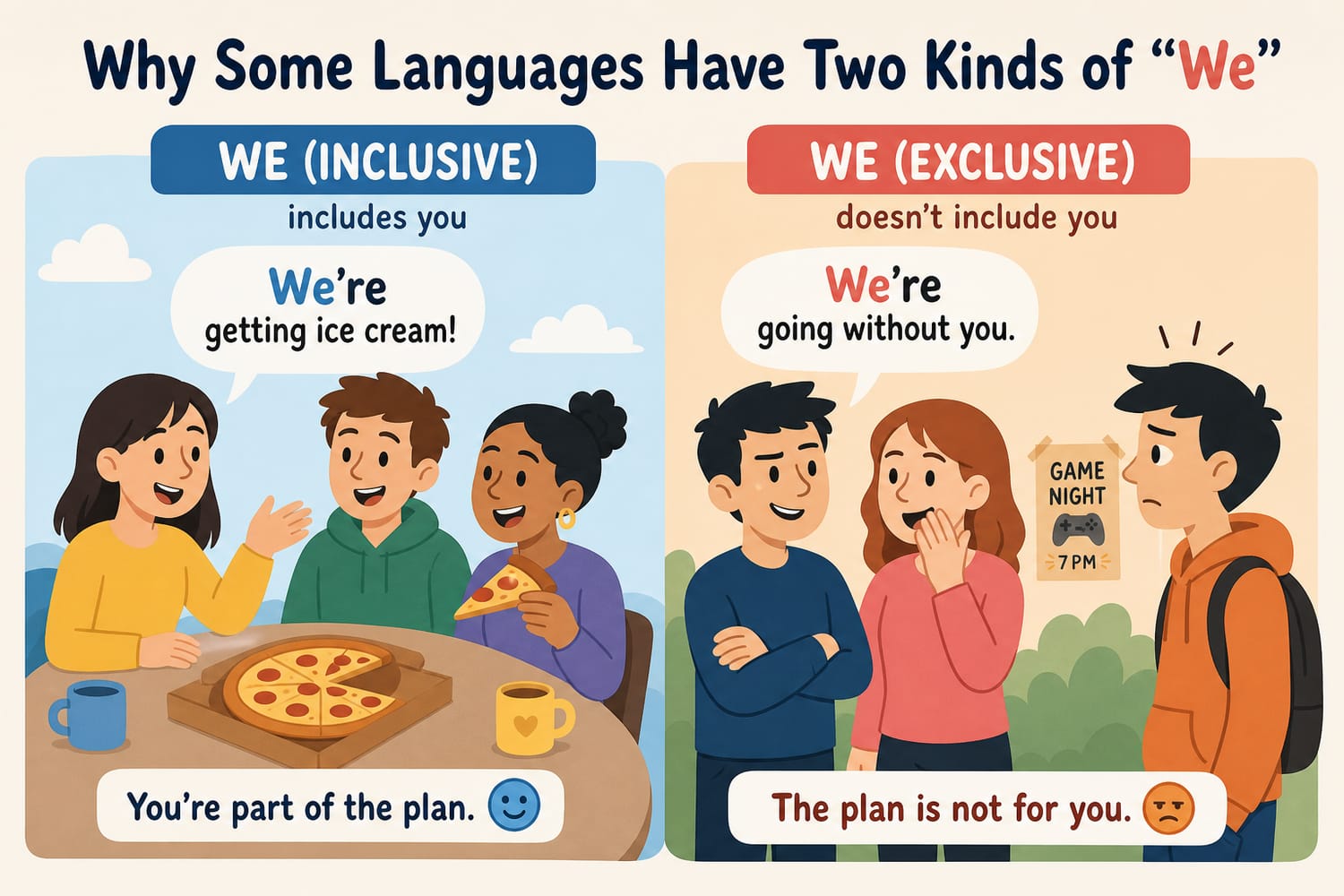
The Tiny Word That Can Cause Big Confusion
English has a wonderfully useful word: we. It is short, friendly, and good at making things sound like a team effort.
“We should clean the kitchen.”
“We won the match.”
“We need to talk.”
But there is a sneaky problem hiding inside this little word. When someone says we, who exactly is included?
Imagine your friend says:
“We’re going to get pizza.”
Do they mean you and I are going to get pizza? Excellent news. Shoes on.
Or do they mean I and some other people are going to get pizza, but not you? Less excellent. Shoes sadly off.
English leaves this to context, tone, and sometimes awkward follow-up questions. But many languages solve the problem directly. They have two different kinds of “we”: one that includes the listener, and one that does not.
Linguists call this distinction clusivity. More specifically, it is the difference between inclusive we and exclusive we.
Once you notice it, English suddenly feels like it has been making us guess all along.
Inclusive “We” vs. Exclusive “We”
The basic idea is simple.
An inclusive we means:
“I/we + you”
It includes the person being spoken to.
An exclusive we means:
“I/we + someone else, but not you”
It excludes the person being spoken to.
So if a language marks this distinction, the sentence “We are leaving” might have two different forms:
- Inclusive: “We are leaving” = you are coming with us.
- Exclusive: “We are leaving” = we are going, but you are not part of this group.
This is not a minor detail. It changes the social meaning of a sentence. It tells the listener whether they are part of the plan, part of the responsibility, part of the celebration, or part of the blame.
English can express the same idea, but it needs extra words:
- “We, including you…”
- “We, but not you…”
- “The rest of us…”
- “You and I…”
- “My group and I…”
Languages with clusivity bake this information right into the pronoun system.
A Pizza Example, Because Grammar Deserves Snacks
Let’s return to the pizza situation.
In English:
“We’re getting pizza.”
This could mean two very different things.
In a language with inclusive and exclusive “we,” the speaker would choose a form that tells you right away whether you are invited.
Inclusive:
“We-including-you are getting pizza.”
Exclusive:
“We-but-not-you are getting pizza.”
That is a powerful grammatical feature. It can save friendships. It can also prevent tragic misunderstandings involving pepperoni.
The same distinction matters in more serious contexts too:
- “We need to make a decision.”
- “We are responsible.”
- “We have finished the work.”
- “We are going home.”
- “We believe this is important.”
In each case, the listener may very much want to know: Am I part of this “we”?
Languages That Have Two Kinds of “We”
The inclusive/exclusive distinction appears in many parts of the world. It is especially common in languages of the Pacific, Australia, South and Southeast Asia, and the Americas.
For example, Tok Pisin, an English-based creole spoken in Papua New Guinea, has a clear distinction:
- yumi = we, including you
- mipela = we, excluding you
So if someone says yumi go, it means something like “you and I/we are going.” If they say mipela go, it means “we are going, but you are not included.”
In Tamil, a Dravidian language spoken mainly in Tamil Nadu and Sri Lanka, there is also a distinction often described as:
- nām = we including the listener
- nāṅkaḷ = we excluding the listener
In many varieties of Quechua, spoken in the Andes, speakers distinguish between inclusive and exclusive first-person plural forms as well. For example, in Southern Quechua descriptions, forms like ñuqanchik are commonly associated with inclusive “we,” while ñuqayku is exclusive.
Some languages go even further. Many Austronesian languages, such as those spoken across the Pacific, do not just ask “Are you included?” They may also distinguish how many people are involved: two of us, three of us, many of us, and so on.
In English, “we” is doing a lot of work with very little detail. In some languages, the pronoun system is more like a seating chart.
English Does Have Little Hints of This
English does not have a full grammatical inclusive/exclusive contrast, but it sometimes gestures in that direction.
Consider the difference between:
- Let’s go.
- Let us go.
In everyday English, let’s almost always includes the listener. If I say “Let’s get coffee,” I am probably inviting you.
But let us can sound different depending on context. In a formal or older style, “Let us pray” includes the audience. But “Let us through!” might mean “allow us to pass,” where “us” refers to the speaker’s group, not necessarily the person being addressed.
English also uses phrases like:
- “you and I”
- “all of us”
- “the two of us”
- “my team and I”
- “we over here”
- “we as a society”
These help clarify who belongs inside the circle of “we.” But they are optional add-ons, not a built-in pronoun distinction.
Interestingly, Mandarin Chinese has a partial comparison. Wǒmen is the general word for “we,” while zánmen often means “we including you,” especially in northern varieties and conversational use. However, the system is not identical to languages where the inclusive/exclusive distinction is fully grammatical across the pronoun system.
The main point: English can clarify clusivity, but many languages require or strongly prefer speakers to mark it.
Why Would a Language Develop This Distinction?
Languages tend to develop features that speakers find useful, though not always in a neat or predictable way. The inclusive/exclusive “we” is useful because human beings are extremely interested in group membership.
Are you with us? Are we doing this together? Is this our problem or just your problem? Are you invited to the meeting? Are you being blamed for the broken vase?
A two-way “we” answers those questions instantly.
The distinction may arise historically from phrases like “I and you” versus “I and they,” which over time become shorter, more common, and eventually grammaticalized into pronouns. This kind of development is common in language change: everyday expressions get worn down into smaller, fixed forms.
Importantly, having inclusive and exclusive “we” does not mean that speakers of those languages are automatically more group-oriented, more polite, or more precise in every area of life. That would be too simplistic. Grammar and culture interact, but they do not map onto each other in easy one-to-one ways.
Still, pronouns are social tools. They help people position themselves in relation to others. A language that marks clusivity gives speakers a built-in way to manage belonging and boundaries.
The Social Power of “We”
The word we is never just about grammar. It can be warm, persuasive, diplomatic, evasive, or manipulative.
A politician saying:
“We must make sacrifices”
may or may not be part of the group actually making them.
A teacher saying:
“We need to be quieter”
probably means the students need to be quieter, though the teacher may be softening the instruction.
A parent saying:
“We don’t put crayons in the dog’s water bowl”
usually means “you, small child, should stop doing that immediately.”
English speakers use “we” in flexible and sometimes slippery ways. It can create solidarity, but it can also blur responsibility. The inclusive/exclusive distinction does not remove all ambiguity, but it does make one thing clearer: whether the listener is inside or outside the “we.”
That can matter a lot.
Imagine a leader addressing a community after a disaster. An inclusive “we” can signal unity: “We are facing this together.” An exclusive “we” can signal action by a smaller group: “We, the council, have made a decision.” Both are useful, but they do different social work.
What This Teaches Us About Language
The inclusive/exclusive “we” is a perfect example of how languages divide the world in different ways.
English makes speakers specify tense: “I walk,” “I walked,” “I will walk.” Some languages mark tense less heavily, but may require other kinds of information, such as whether the speaker witnessed an event directly or heard about it from someone else.
Similarly, English does not require speakers to say whether “we” includes the listener. But many languages do.
This does not make one language better or more logical than another. Every language is precise in some areas and flexible in others. English has a large vocabulary and a fairly simple pronoun system compared with many languages. Other languages may have highly detailed pronouns but handle other grammar differently.
Languages are not checklists of features. They are living systems shaped by history, use, contact, and change.
“We” Is a Tiny Map of Belonging
The inclusive/exclusive distinction shows that even the smallest words can carry big social meaning.
To English speakers, having two kinds of “we” may sound unusual at first. But after thinking about it for a while, it starts to feel surprisingly practical. How many conversations would be clearer if English had one word for “we including you” and another for “we but not you”?
No more mysterious pizza plans. No more guessing whether you are part of the committee, the road trip, or the apology.
At its heart, clusivity is about something deeply human: figuring out who is together with whom. Language gives us many ways to draw circles around people. Some circles include the listener. Some do not.
And in many languages, the pronoun tells you exactly where you stand.