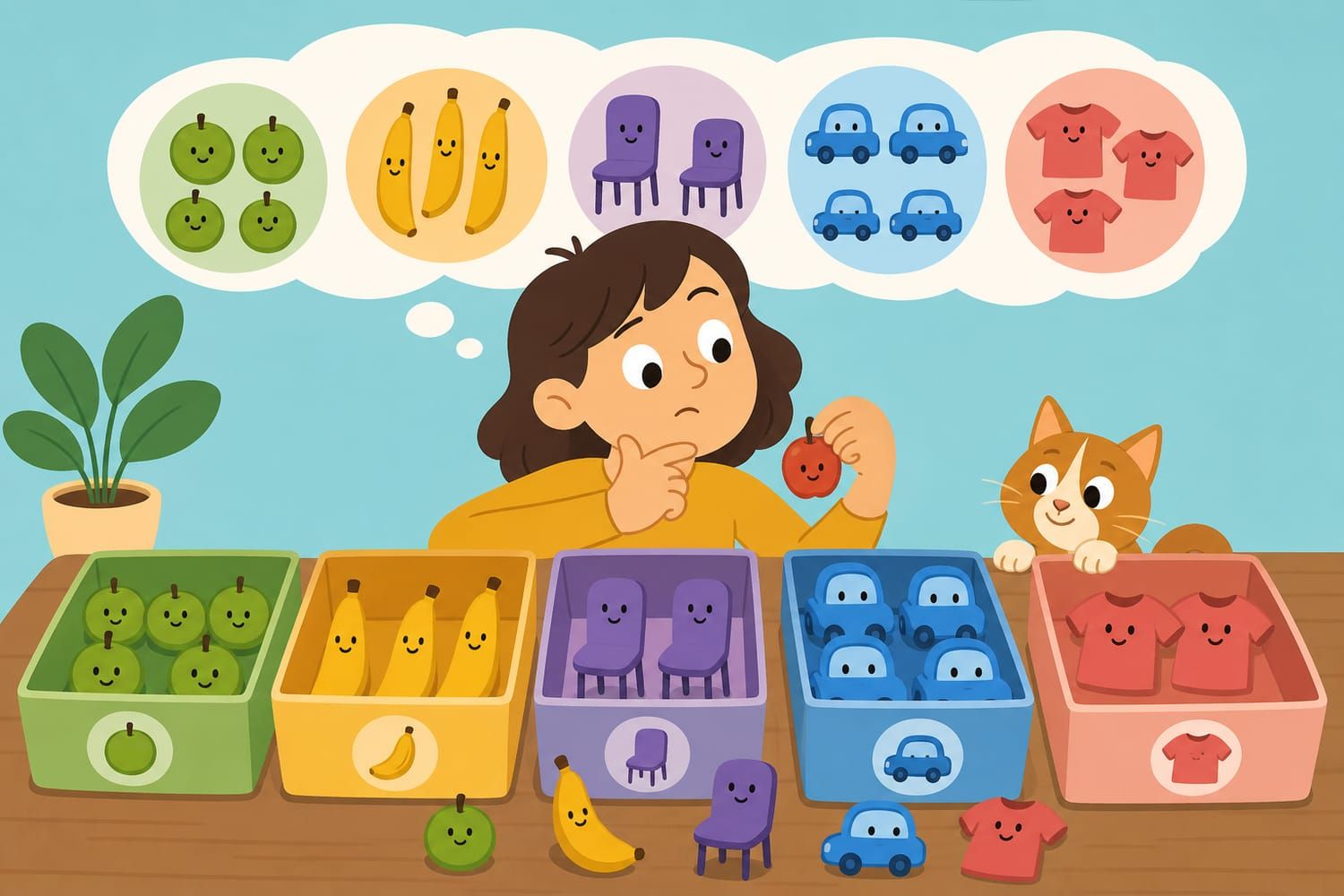
Counting Is Not Always Just Numbers
In English, “three books” is enough. In Mandarin Chinese, Japanese, Vietnamese, Thai, and many other languages, a number often needs help from a special word called a numeral classifier. These classifiers identify what kind of thing is being counted—perhaps a person, animal, flat object, long object, or bound volume.
In other words, some languages do not let you casually toss a number at a noun and walk away. Grammar wants a category too.
A rough English-style translation might look like this:
- three volume books
- four flat-item tickets
- five long-object pencils
- six animal cats
These phrases sound peculiar in English, but the underlying idea is not entirely foreign. English speakers already say “two sheets of paper,” “three head of cattle,” “four pairs of shoes,” and “five grains of rice.” Classifier languages simply use this kind of grammatical packaging much more widely.
Meet the Numeral Classifier
A numeral classifier is a word or grammatical element that appears with a number and a noun. It places the noun into a category, usually according to characteristics such as:
- shape
- size
- animacy
- function
- arrangement
- social status
- conventional usage
Linguists often distinguish sortal classifiers from ordinary measure words. A measure word tells you how much or what portion you have: a cup of tea, a slice of bread, or a liter of milk. A sortal classifier identifies the kind of countable object involved.
According to the World Atlas of Language Structures’ overview of numeral classifiers, these systems may contain only a handful of classifiers or several dozen. Their use may be optional in one language and grammatically required in another.
That means “classifier language” is not a single, tidy grammatical type. Languages have developed many versions of the basic idea.
How Mandarin Chinese Sorts the Shopping List
Mandarin Chinese provides some of the best-known examples. Its usual pattern is:
number + classifier + noun
To say “three books,” for example, a speaker normally says:
三本书 — sān běn shū
Literally, this can be glossed as “three volume-classifier book.” The classifier 本 (běn) is associated with bound volumes.
Other common classifiers include:
- 个 (gè): a widely used general classifier
- 张 (zhāng): commonly used for flat objects, such as sheets, tickets, and tables
- 条 (tiáo): used with various long or flexible things, including ropes, rivers, and some animals
- 只 (zhī): used with many animals and certain paired body parts
- 位 (wèi): a respectful classifier for people
The categories are not always scientifically neat. A fish and a river may share a classifier because both can be conceptualized as long, extending forms. Meanwhile, years of convention can make some noun-classifier pairings feel natural even when their original logic is no longer obvious.
Mandarin also demonstrates that classifiers can offer more than grammatical housekeeping. Different classifiers may present the same object from different angles. One choice might emphasize a flower as a long object with a stalk, while another focuses on the blossom itself. The speaker is not changing the flower—only the linguistic frame around it.
Japanese Counters: Where Books Are Not “Long Objects”
Japanese commonly calls its classifiers counters, and it has plenty of them. A few familiar examples are:
- 人 (nin): people
- 匹 (hiki): small or medium-sized animals
- 頭 (tō): large animals
- 枚 (mai): flat objects
- 本 (hon): long, cylindrical, or string-like objects
- 冊 (satsu): books and other bound publications
This creates a delightful trap for beginners. The Japanese word written 本 can mean “book,” but as a counter, the same character is used for long objects. Two pens can therefore be counted with 二本 (nihon), while two books require 二冊 (nisatsu).
Fortunately, Japanese also has more general options, including つ (tsu) and 個 (ko), so forgetting a highly specific counter does not necessarily bring conversation to a dramatic halt. The detailed guide to Japanese numbers and counters from Tofugu shows how speakers balance specific counters with these useful alternatives.
Japanese adds another complication: pronunciations can change when numbers and counters meet. Counting is not merely classification—it occasionally comes with a small sound puzzle as a complimentary gift.
This Is Not Just an East Asian Feature
Numeral classifiers are strongly associated with East and Southeast Asia because they appear in languages such as Mandarin, Cantonese, Japanese, Korean, Vietnamese, Thai, Burmese, and Hmong. However, they are not exclusive to that region or to languages influenced by Chinese.
Classifier systems also occur in parts of:
- South Asia
- the Indonesian archipelago
- Micronesia and Polynesia
- West Africa
- Mesoamerica
- the Amazon basin
- the Pacific Northwest of North America
They can even appear optionally in languages as geographically separated as Hungarian, Tongan, Haida, and Persian. The global distribution tells us that classifiers are not the invention of one culture or writing system. Similar grammatical solutions can emerge, spread through contact, or develop independently in very different communities.
Why Would a Language Develop Classifiers?
There is no universally accepted one-sentence explanation. Languages are built through centuries of ordinary use, sound change, metaphor, borrowing, and grammatical reshuffling—not by a committee asking, “How can we make counting more exciting?”
Many classifiers began as ordinary nouns. Words meaning things like person, piece, sheet, bundle, or body can gradually become routine counting expressions. If generations of speakers use them often enough, they may lose some of their original independence and become part of the grammar.
Classifiers can also be useful when nouns do not regularly display singular and plural forms. A bare noun may be interpretable as one item, several items, or a substance depending on context. Adding a number and classifier makes the intended unit explicit.
However, classifiers should not be treated as grammatical measuring cups required because speakers otherwise cannot understand what an object is. Linguists have pointed out that many nouns in classifier languages already refer perfectly clearly to individual objects. Classifiers are best understood as one of several grammatical strategies languages use to connect numbers with nouns—not as a repair kit for an incomplete concept.
English Classifies More Than It Admits
English is not usually considered a numeral-classifier language, but it enjoys classification whenever direct counting becomes awkward.
Consider:
- a strand of hair
- a blade of grass
- a clove of garlic
- a loaf of bread
- a speck of dust
- a bolt of fabric
- a head of lettuce
These expressions determine what counts as one unit. A “bread” is not normally countable, but a loaf, slice, or piece of bread is. Each choice creates a different object for counting.
English also classifies groups through expressions such as a flock of birds, a deck of cards, and a pair of scissors. The difference is that most ordinary English count nouns—dogs, chairs, books, ideas—can stand directly beside a number.
So English speakers should resist calling classifiers bizarre. We already use their cousins. We simply invite them over less often.
Do Classifiers Change How People Think?
Classifier systems are irresistible to anyone interested in linguistic relativity: the idea that language can influence habitual attention and thought. If your grammar repeatedly asks whether something is flat, elongated, animate, bound, or machine-like, might you become more sensitive to those properties?
Research suggests classifiers can affect processing during language use. In one eye-tracking study, Chinese-speaking participants used classifier information to direct their attention toward likely objects before the noun itself arrived. More semantically informative classifiers guided attention faster than a general classifier did. The classifier was effectively offering the brain an early clue: “Start looking for something of this type.” The published study on classifiers and visual attention explores this effect in detail.
That does not mean speakers are imprisoned inside grammatical boxes. A Mandarin speaker can recognize similarities between objects that use different classifiers, just as an English speaker can understand a color without knowing its precise name.
A more reasonable conclusion is that language can direct attention, strengthen habits, and make certain distinctions easier to access in particular tasks. It nudges rather than dictates. This is the same careful distinction that matters when asking whether languages shape worldviews or exploring how color categories interact with language and perception.
Categories Are Useful—and Wonderfully Messy
Classifier categories may begin with clear ideas such as “human,” “flat,” or “long.” Real language soon makes them messier.
Objects can belong to different categories depending on how speakers view them. New inventions must be fitted into old grammatical systems. General classifiers may expand, while once-common specialized classifiers become rare. Regional preferences and levels of formality can also influence what sounds natural.
This messiness is not a flaw. It reveals how people reuse familiar categories to make sense of new things. Grammar preserves old metaphors, historical associations, and countless choices made by speakers who never imagined they were creating material for future linguists.
That is part of what makes classifiers so fascinating. They turn counting into a miniature act of description.
Every Number Carries a Point of View
Numeral classifiers remind us that even a basic activity like counting is not linguistically neutral. One language may simply present three objects. Another may present three flat things, three animals, three volumes, or three respectful human beings.
Neither system is more logical. Each has made different grammatical information routine.
The next time you count two books, three cats, or four pencils, notice how little English asks you to say. Then imagine a language gently tapping you on the shoulder and asking one more question:
“Yes, there are four—but four what kind of things, exactly?”