The Tiny Grammar Feature That Acts Like a Fact-Checker
Imagine walking into the office on Monday and saying, “The boss bought a llama.”
In English, your coworkers might ask follow-up questions: “Did you see it?” “Who told you?” “Is this another one of your dreams?” But grammatically, your sentence is complete. English lets you state things without revealing whether you witnessed them, heard them from Dave in accounting, inferred them from hoofprints, or read them in a suspiciously formatted email.
Some languages are less relaxed.
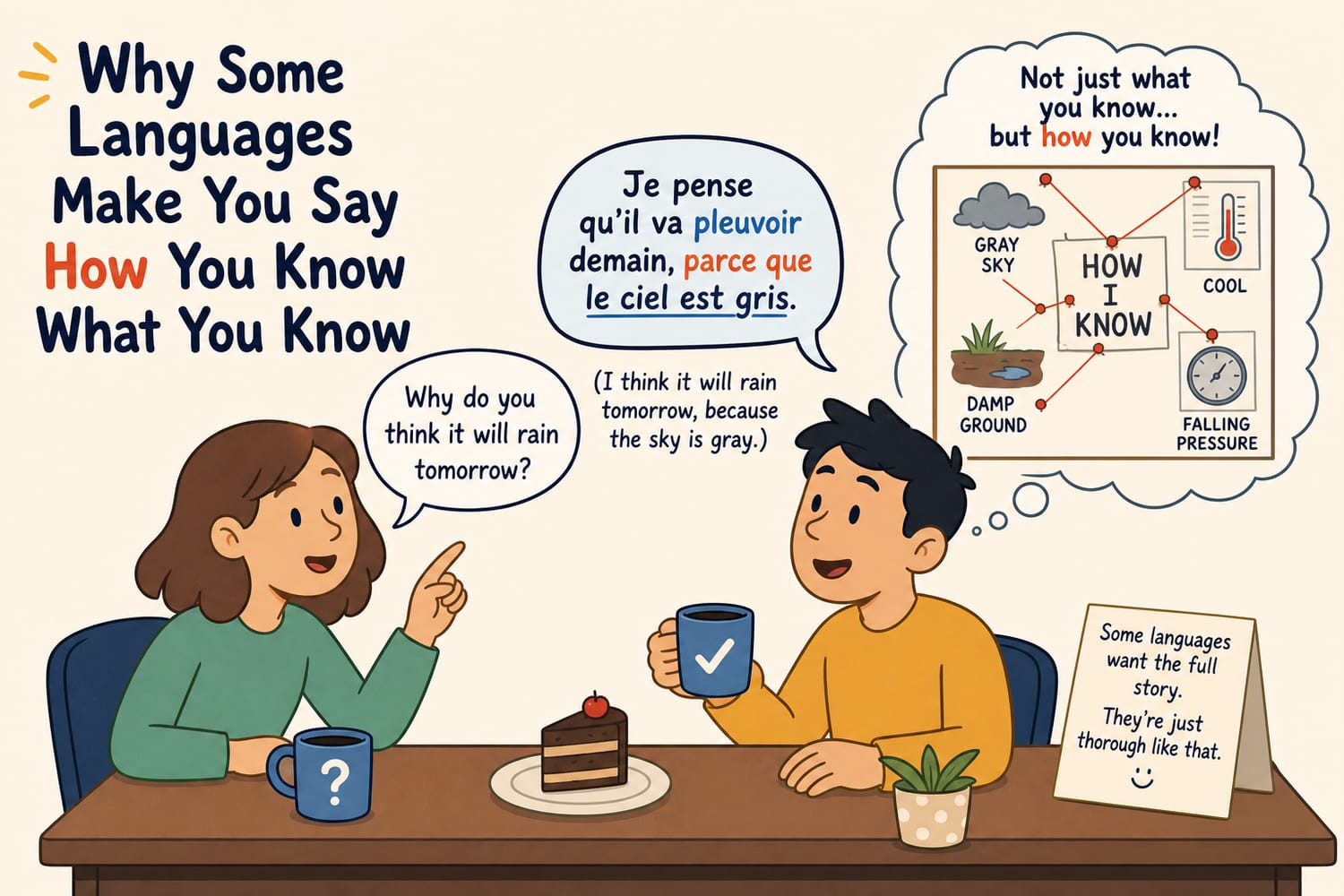
In many languages around the world, you can’t simply say what happened. You also have to say how you know it happened. Did you see it yourself? Did someone tell you? Are you guessing from evidence? Is it common knowledge? This grammatical feature is called evidentiality.
Evidentiality is one of those linguistic ideas that feels oddly futuristic, like a built-in “source needed” button. But it’s not rare, and it’s not exotic in the sense of being strange or primitive. It’s a normal part of grammar in many languages, just as tense is in English.
English makes us care about when something happened: “walk,” “walked,” “will walk.” Evidential languages may also make speakers care about how they know something: “I saw it happen,” “I heard it,” “apparently,” “they say,” or “it must have happened.”
The result is a fascinating window into how languages can package knowledge itself.
What Is Evidentiality?
Evidentiality is the grammatical marking of information source.
That sounds academic, so let’s translate it into everyday terms. An evidential marker tells the listener whether the speaker’s statement is based on things like:
- Direct visual evidence: “I saw it.”
- Direct non-visual evidence: “I heard it,” “I smelled it,” “I felt it.”
- Inference from evidence: “The ground is wet, so it must have rained.”
- Report or hearsay: “Someone told me.”
- General knowledge or assumption: “That’s how things usually are.”
English can express all of these, but usually with extra words: “apparently,” “I heard that,” “it seems,” “reportedly,” “I guess,” “must have.” In languages with grammatical evidentiality, these meanings may be built into the verb or sentence structure and may be required in ordinary speech.
So in English, saying “The dog ate the cake” is enough. In an evidential language, you might need to choose a form meaning something like:
- “The dog ate the cake — I saw it.”
- “The dog ate the cake — I heard it happen.”
- “The dog ate the cake — I infer this from the frosting on its face.”
- “The dog ate the cake — someone told me.”
This does not mean speakers of those languages are more honest, more suspicious, or constantly cross-examining one another like courtroom attorneys. It simply means their grammar tracks a category that English mostly leaves optional.
A Turkish Example: The Famous “Apparently” Past
Turkish is often used to introduce evidentiality because it has a clear and memorable contrast in the past tense.
Turkish has a past tense form often used for events the speaker directly knows about, commonly written as -di. It also has a form -miş, which can indicate that the speaker learned about the event indirectly, inferred it, or is reporting it.
A simplified example:
Ali geldi. — “Ali came.”
This suggests the speaker has direct knowledge, perhaps they saw Ali arrive.Ali gelmiş. — “Ali apparently came,” “Ali came, I hear,” or “It turns out Ali came.”
This suggests indirect knowledge: someone told the speaker, or the speaker noticed evidence afterward.
If you came home and saw muddy shoes by the door, you might use the indirect form to say that someone “has come,” because you did not witness the arrival but can infer it.
This Turkish form can also create a sense of discovery or surprise, like “Oh, so Ali came!” That overlaps with another linguistic category called mirativity, which marks surprise or unexpected information. Evidentiality and surprise often hang out together, though they are not the same thing.
The important point: Turkish grammar can nudge speakers to distinguish between “I know because I experienced it” and “I know because I found out somehow.”
Quechua: Saying Whether You Saw It, Heard It, or Guess It
Quechua, a family of Indigenous languages spoken in the Andes, is another famous example. Different Quechua varieties work differently, but many use small suffixes that attach to words to indicate evidence source.
In broad terms, Quechua evidential markers can include meanings like:
- Direct evidence: the speaker has personal knowledge.
- Reportative evidence: the information comes from someone else.
- Conjectural evidence: the speaker is uncertain or making an inference.
So a speaker might mark a statement in a way that means:
- “It is raining — I know directly.”
- “It is raining — they say.”
- “It is probably raining — I suppose.”
These are not just decorative extras. They are part of how a speaker presents their relationship to the information. In conversation, that can be very useful. It helps listeners evaluate whether something is eyewitness testimony, rumor, deduction, or probability.
Again, English can do this too, but not as automatically. We can say “supposedly,” “I hear,” “must be,” “looks like,” and so on. But we often don’t bother unless it matters. In Quechua, evidential meanings are much more central to the grammar.
Tuyuca and the Art of Being Specific
One of the most frequently cited examples of a language with rich evidentiality is Tuyuca, an Eastern Tucanoan language of the northwest Amazon.
Tuyuca is famous among linguists because its verbs can mark several different kinds of evidence. Depending on the analysis, these include categories such as visual evidence, non-visual evidence, inference, report, and assumption. In practical terms, speakers may distinguish between knowing something because they saw it, heard it, inferred it from signs, learned it from someone else, or assumed it based on general reasoning.
That is a much finer-grained system than English tense marking. English insists that you choose between “she walks” and “she walked,” but not between “she arrived, I saw her” and “she arrived, I only heard the door.”
In a language like Tuyuca, that distinction can be grammatically baked in.
This is why evidentiality is so interesting: it shows that languages don’t merely label things in the world. They also encourage speakers to track different kinds of relationships between knowledge, experience, and communication.
Does Evidentiality Make People Think Differently?
Here we must tread carefully, preferably without slipping on a banana peel labeled “linguistic determinism.”
It is tempting to say, “Speakers of evidential languages are more truthful!” or “They think more logically!” But that would be too simple. Languages do not trap their speakers inside a single worldview. English speakers can be precise about evidence when they want to be, and speakers of evidential languages can still joke, exaggerate, speculate, and gossip like everyone else.
However, grammar does influence what speakers routinely pay attention to when speaking. If your language requires you to mark information source, then you must often make a quick judgment: Did I see this? Did I hear it? Am I guessing? Was I told?
That habit can affect conversation. It can make the source of information more visible and harder to ignore. If someone uses a reportative marker, listeners know the speaker is not claiming firsthand knowledge. If someone uses a direct marker, they are presenting the information as personally known.
Think of it like grammatical seatbelts. Wearing a seatbelt does not make you a better driver, but it changes the default conditions of the ride. Evidentiality does not guarantee accuracy, but it builds attention to evidence into everyday speech.
English Has Evidentiality Too — Sort Of
English does not have a full grammatical evidential system like Turkish, Quechua, or Tuyuca, but it has plenty of evidential expressions.
Consider:
- “Apparently, the meeting is canceled.”
- “I heard that Maya moved to Berlin.”
- “It looks like someone ate the last cookie.”
- “She must have left already.”
- “Reportedly, the painting is worth millions.”
- “They say this house is haunted.”
These phrases do evidential work. They tell the listener where the information came from or how confident the speaker is.
English also uses tone and context. If you say, “Well, someone finished the ice cream,” while staring at your roommate’s chocolate-covered spoon, you are marking inference quite clearly — just not with a required verb ending.
Some English words even blur the line between evidence and attitude. “Apparently” can mean “I have evidence for this,” but it can also sound skeptical: “Apparently, I was supposed to read the instructions.” That little word can carry an eyebrow raise.
So English is not evidentiality-free. It simply treats evidentiality as optional vocabulary rather than an obligatory grammatical category.
Why Would a Language Develop This?
Languages develop evidential systems in different ways. Often, evidential markers grow out of ordinary words or constructions.
For example, a phrase meaning “it is said” can gradually become a reportative marker. A verb meaning “seem” or “appear” can become an inferential marker. A perfect tense, like “has done,” can develop indirect or surprising meanings, as in Turkish -miş.
This process is called grammaticalization: when regular words or phrases slowly turn into grammar. It happens all the time. English “going to” became “gonna” and now often marks the future, as in “I’m gonna leave.” What began as movement became a time marker.
Evidentiality can emerge from similar everyday shortcuts. If speakers frequently say “they say” or “it seems” or “I saw,” those expressions may become shorter, more automatic, and eventually grammatical.
Once a language has such a system, children learn it as part of normal speech. They do not experience it as a philosophical burden. To them, choosing an evidential marker may feel as natural as choosing past or present tense feels to English speakers.
A Grammar of Humility
One charming way to think about evidentiality is as a grammar of humility. It reminds speakers to distinguish between what they witnessed, what they inferred, and what they were told.
Of course, people can still be confidently wrong in any language. A direct evidential does not magically make a statement true. It only says something about the speaker’s claimed source of knowledge. Someone can misperceive, misremember, or misuse a form.
Still, evidentiality gives language a built-in way to say, “Here is my evidence.” In a world overflowing with rumors, screenshots, viral posts, and “my cousin’s friend’s dentist said,” that feels refreshingly useful.
Imagine if every social media post had to be marked:
- I-saw-it-with-my-own-eyes
- I-read-a-headline-only
- A-guy-on-a-podcast-said
- I-am-inferring-from-vibes
- Honestly-I-have-no-idea-but-it-sounds-spicy
The internet might become 12% less chaotic. Maybe.
What Evidentiality Teaches Us About Language
Evidentiality shows that languages can differ not just in sounds or vocabulary, but in the kinds of information they require speakers to include.
Some languages require gender on nouns. Some require politeness levels. Some require classifiers when counting objects. Some require tense. And some require speakers to reveal how they know what they know.
That does not make one language better or more advanced than another. It simply shows the enormous flexibility of human language. Every language is a system of habits: things it makes easy, things it makes necessary, and things it leaves unsaid.
English asks, “When did it happen?”
Evidential languages may also ask, “How do you know?”
And that question — small as it seems — opens a surprisingly big door. It leads to issues of trust, gossip, perception, memory, storytelling, and culture. It reminds us that language is not just about describing the world. It is also about positioning ourselves within it.
So the next time someone says, “Apparently, there’s cake in the kitchen,” pause for a moment. Appreciate the evidential. Then ask the most important follow-up question:
“Did you see it yourself, or are we working from rumor?”