One Movie, Several Passports
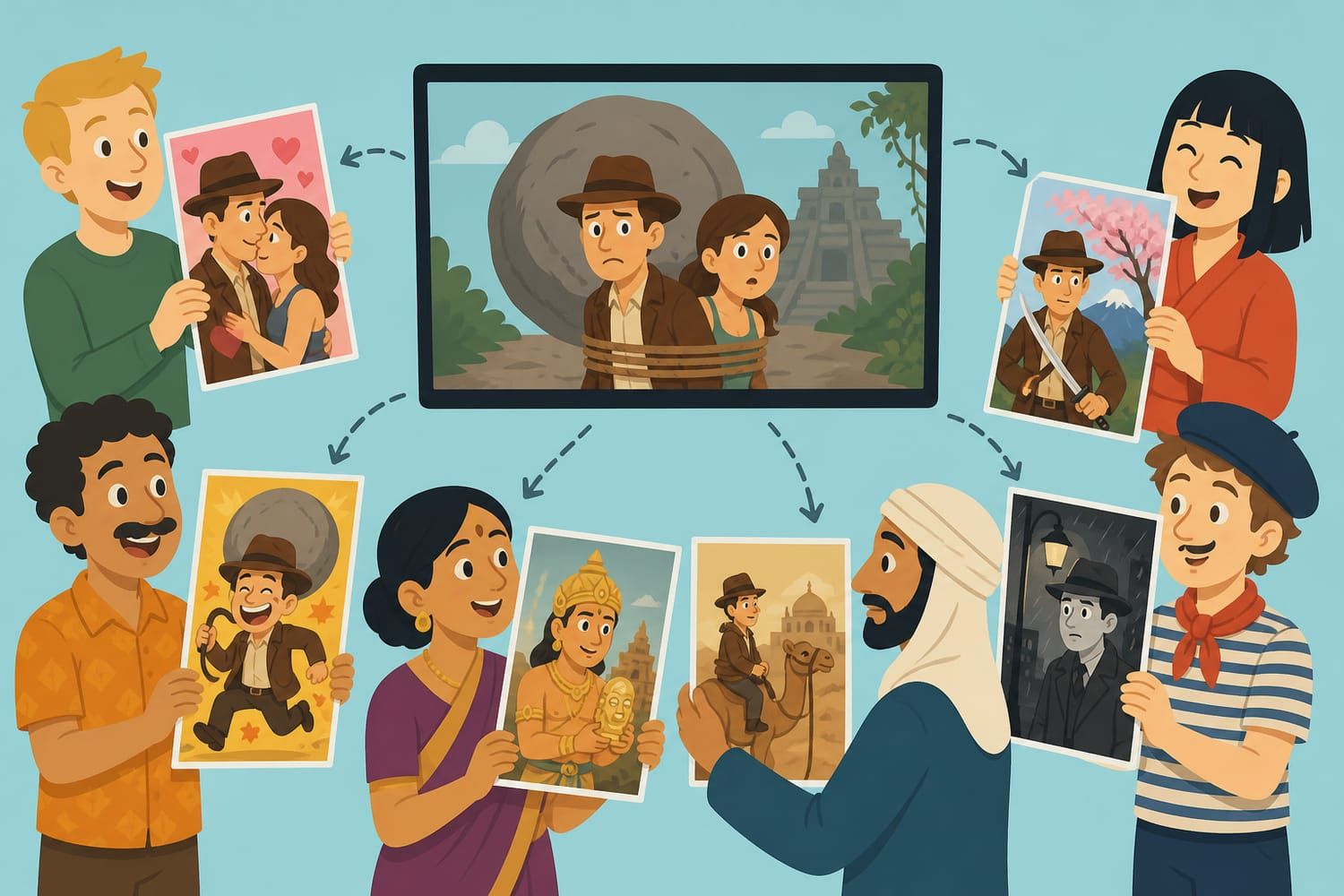
The same movie can have different titles around the world because distributors are adapting more than words: they are adapting expectations. A title must make sense, suggest the right kind of entertainment, and stand out locally. Sometimes that means translating it; sometimes it means giving it an entirely new identity.
Consider The Hangover. In France, the 2009 comedy arrived as Very Bad Trip. Not a French translation, but a different English title. France’s national cinema agency lists it under those exact words. Apparently, a disastrous weekend can travel internationally without surrendering its English vocabulary.
It is tempting to treat changes like this as translation mishaps. But the more interesting question is not “Who got the words wrong?” It is “What job is the new title trying to do?”
A Movie Title Is Also a Tiny Advertisement
A title has remarkably little space to work with. Before viewers know the plot, it can suggest romance, danger, silliness, or prestige. Research on film-title translation emphasizes this persuasive function: titles are meant not only to identify films but also to attract audiences.
Think of a hypothetical thriller called The Visitor. The name leaves room for mystery. Rename it Someone Is Inside the House, and you have made a much more specific promise. Neither title requires a different movie, but each invites the audience to imagine a different experience.
Real international titles can make similar adjustments. The British comedy Grimsby became The Brothers Grimsby in North America. The added words tell unfamiliar audiences something useful: this is about brothers, not simply a place they may never have heard of.
That does not mean every replacement is inspired. It means that a title can be linguistically accurate yet commercially unhelpful—or linguistically adventurous yet effective at introducing the story.
Why Word-for-Word Translation Can Miss the Point
A dictionary can help translate individual words. It cannot guarantee that their associations, humor, or emotional effect will survive the journey. As Uncover Words explores in how translation changes meaning, carrying a message between languages involves choices about context as well as vocabulary.
Puns Are Especially Awkward Travelers
A pun asks one expression to do two jobs at once. Another language may offer a perfectly good equivalent for each meaning—but no single expression that combines them.
Pixar’s Inside Out offers a neat comparison. In Spain, it is Del revés, an expression corresponding to “inside out” or “backward.” In Disney’s Latin American marketing, it is Intensa-Mente. Disney’s regional pages document both versions.
The second title takes another route. Spanish intensamente means “intensely,” while mente means “mind.” Separating the word visually highlights the mind inside the adverb—a particularly fitting bit of wordplay for a film about emotions operating inside a child’s head. Rather than reproducing the English wording, it creates a new connection between language and story.
Which title is more faithful? One stays closer to the original expression; the other invents a different verbal trick. That depends on whether you value matching the words or recreating their playfulness.
It is the same challenge behind why jokes do not always translate: preserving a reaction may require changing the language that produces it.
Sometimes the New Title Stays in English
Very Bad Trip is especially revealing because it overturns an obvious assumption: localization does not necessarily mean replacing English with another language.
The French title changes the emphasis. The Hangover names the unpleasant aftermath; Very Bad Trip suggests the whole experience going spectacularly wrong. Those are different ways of framing the same comedy, even though both use English.
Keeping English can also preserve recognition. In research involving German distributor TOBIS, a company representative explained that audiences may already know an original title through media coverage and social networks. The company retained 12 Years a Slave, for example, rather than introducing a German replacement.
There is a useful distinction here: understanding every word of a title and recognizing it as the name of a movie are not the same thing. A familiar name already has value.
Even English-Speaking Countries Disagree
You do not need a language barrier to get a title change. Sometimes the obstacle is what a familiar name already means in another country.
The American comedy Neighbors became Bad Neighbours in the United Kingdom. Besides adding the British spelling, the change helped distinguish it from the Australian television soap Neighbours. The issue was not whether British viewers understood the original word. It was which entertainment property that word might bring to mind.
Disney’s animal-city adventure provides another recognizable example. American audiences know it as Zootopia, while Disney’s official UK movie page calls it Zootropolis.
The names offer slightly different associations: Zootopia combines the animal idea with “utopia,” while Zootropolis leans toward “metropolis.” Same rabbit detective, different linguistic address.
These examples also suggest a useful caution. A title change is not, by itself, evidence that a whole nation has different tastes. Sometimes a distributor simply needs a clearer distinction between products.
One Language Does Not Mean One Market
The Spanish titles of Inside Out demonstrate another important point: there is no automatic one-to-one relationship between a language and a release title. Spain and Latin America received different Spanish-language branding for the same film.
The reverse happens too: one film can cross into a new language market while retaining much of its original identity.
Disney’s Moana became Vaiana: La Légende du Bout du Monde for French-speaking audiences in its European release context. Disney used that title in its own announcement about the film’s Tahitian-language translation. The added French subtitle means approximately “the legend from the end of the world.”
Compare the effect of those names. Moana introduces a person. Vaiana: La Légende du Bout du Monde introduces a person plus the promise of a faraway legend. The subtitle gives the audience an extra clue about the scale and atmosphere of the adventure.
For readers, the lesson is simple: “the French title” or “the Spanish title” may be an incomplete description. Territory matters.
Who Actually Chooses the Name?
Before blaming a subtitle translator for an unexpected title, pause. The person translating the dialogue may not control the name on the poster.
A study examining practices in Croatia and Germany found different arrangements. At Croatian public broadcaster HRT, translators could propose titles, with an editor making the final choice. At German distributor TOBIS, the advertising department selected titles, subject to agreement with the licensor. These are examples of particular workflows, not a universal industry rule.
That distinction changes how we judge the result. The title is not necessarily a translator’s answer to a vocabulary question. It may be a marketing team’s answer to “How do we introduce this film here?”
How to Read a Renamed Movie
Next time an international title seems baffling, try asking:
- What does it emphasize? A character, a setting, a relationship, or the genre?
- What might the original wording lose abroad? A pun, an association, or an immediately recognizable reference?
- What does the replacement gain? Clarity, humor, familiarity, or a stronger promise?
- Am I judging a natural title—or an awkward English back-translation?
That last question is worth lingering over. Imagine someone translating Intensa-Mente back into English as “Intense-Mind.” The result would sound clumsy, but the clumsiness would belong to the back-translation, not necessarily to the Spanish title.
A renamed movie is an invitation to compare two introductions to the same story. One may be more elegant, another more revealing, and a third rather overenthusiastic.
Before calling the new name a mistake, ask what it makes you expect. Sometimes the words have changed precisely so the movie’s invitation can remain the same.