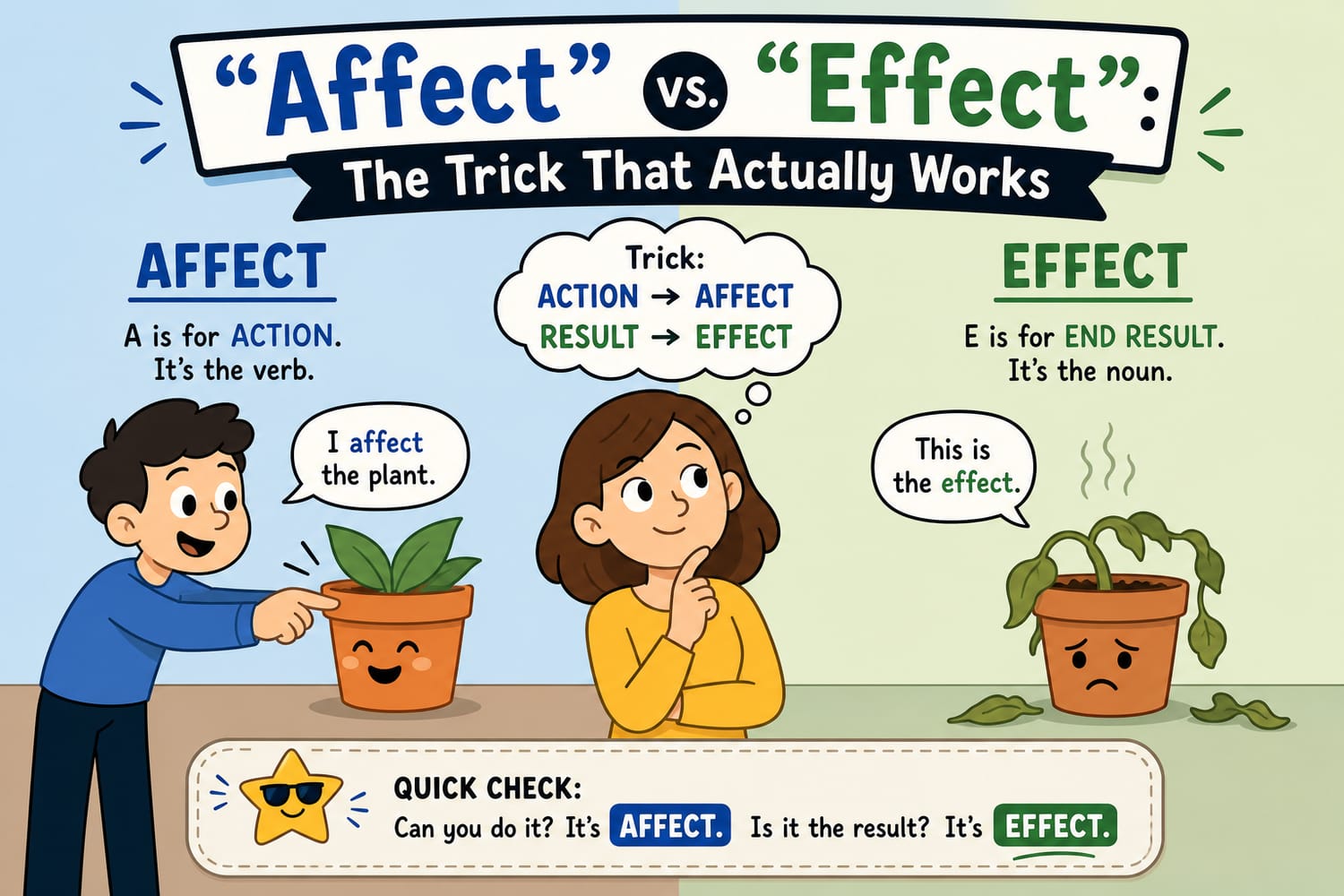
The Tiny Word Pair That Causes Big Feelings
Few grammar choices can make a perfectly confident writer suddenly stare into the distance like they’ve just been asked to defuse a bomb.
Is it affect or effect?
You write a sentence like:
The weather can ___ your mood.
And instantly, your brain opens a dusty filing cabinet labeled “Grammar Things I Sort of Know” and finds only a sticky note that says: “One is a verb?? Maybe??”
Good news: this pair is not as mysterious as it seems. Even better, there is a practical trick that works almost every time.
Most of the time:
- Affect is a verb meaning “to influence.”
- Effect is a noun meaning “a result.”
So:
The weather can affect your mood.
The weather had a strange effect on my mood.
That’s the basic rule. But because English enjoys making us earn our snacks, there are exceptions. We’ll get to those too.
First, let’s make the main difference stick.
The Trick: “Influence” vs. “Result”
Here’s the trick that actually works:
Ask yourself:
Do I mean influence or result?
If you mean influence, use affect.
If you mean result, use effect.
Let’s test it.
Lack of sleep can ___ your memory.
Can lack of sleep influence your memory? Yes.
So:
Lack of sleep can affect your memory.
Now try this one:
The new law had an immediate ___.
Did the new law have an immediate result? Yes.
So:
The new law had an immediate effect.
This trick works because it focuses on meaning instead of grammar labels. You don’t have to pause and mutter, “Wait, is this a transitive verb? Is this a noun phrase? Am I still alive?” You just ask what you mean.
Affect = influence.
Effect = result.
Simple, portable, reliable. Like a grammar umbrella.
“Affect” Usually Does the Action
Most of the time, affect is a verb. It describes something acting on something else.
Examples:
The rain affected our travel plans.
Your attitude can affect the whole team.
The medication may affect your appetite.
Rising costs are affecting small businesses.
In each sentence, something is influencing or changing something else.
The rain influenced the travel plans.
The attitude influenced the team.
The medication influenced the appetite.
The costs influenced the businesses.
That’s affect doing what it usually does: acting as a verb.
A helpful mini-test is to see whether you can replace the word with influence, change, or alter.
The rain changed our travel plans.
Your attitude can influence the whole team.
If that works, you probably want affect.
“Effect” Usually Names the Result
Most of the time, effect is a noun. It names the outcome, consequence, or result of something.
Examples:
The speech had a powerful effect on the audience.
The new policy produced several unexpected effects.
The medicine’s side effects include dizziness.
The movie’s special effects were incredible.
In these examples, effect is a thing. You can often put an, the, or some in front of it:
an effect
the effect
some effects
several effects
That’s a strong clue that you need effect, not affect.
Another useful test: Can you replace it with result, outcome, or consequence?
The speech had a powerful result on the audience.
That sounds a little awkward, but the meaning is close enough. Better:
The speech had a powerful impact on the audience.
Still a noun. Still effect.
The Classic Memory Shortcut: RAVEN
If you like memory tricks, try this one:
RAVEN: Remember, Affect is a Verb, Effect is a Noun.
Affect = Verb.
Effect = Noun.
A raven may not help you file your taxes, but it can help you remember this grammar rule.
Just keep in mind: RAVEN describes the common uses, not every possible use. There are exceptions, because English has a flair for drama. But for everyday writing, this shortcut will save you most of the time.
The Sentence Test That Makes It Even Easier
Here’s another quick test.
If the word comes after the, an, a, any, some, many, or an adjective, it is probably effect.
Examples:
The effect was immediate.
It had an effect on morale.
There were many effects of the storm.
That was a surprising effect.
Because effect is usually a noun, it often behaves like other nouns.
You wouldn’t say:
The influence was immediate.
Actually, you would. That’s the point: effect works like influence when influence is being used as a noun.
Now look at affect:
The storm affected the town.
The decision affected everyone.
Music affects my concentration.
Here, the word follows the subject and shows action. It behaves like a verb.
So your quick checklist can be:
- Do I mean influence as an action? Use affect.
- Do I mean result as a thing? Use effect.
- Is there an article like the, a, or an before it? It is probably effect.
Examples From Real Life
Let’s make this practical.
Work
The manager’s tone affected the meeting.
The tone influenced the meeting. Verb. Use affect.
The manager’s tone had a negative effect on the meeting.
The tone had a result or impact. Noun. Use effect.
Health
Exercise can affect your energy levels.
Exercise can influence your energy levels.
One effect of regular exercise is better sleep.
Better sleep is a result.
School
Missing class may affect your grade.
Missing class may influence your grade.
The effect of missing class was obvious on the test.
The result was obvious.
Technology
Too much screen time can affect your sleep.
It can influence your sleep.
The effects of too much screen time vary from person to person.
The results vary.
The Exceptions, Because English Insists
Now for the part where English walks in wearing sunglasses and says, “Actually…”
There are two important exceptions:
- Effect can be a verb.
- Affect can be a noun.
These are less common, but they do exist.
When “Effect” Is a Verb
As a verb, effect means “to bring about,” “to cause,” or “to make happen.”
The most common phrase is:
effect change
This does not mean “influence change.” It means “bring about change.”
Examples:
The organization hopes to effect real change.
The new CEO was hired to effect a turnaround.
The reforms were designed to effect improvements in the system.
This use is more formal. You’ll often see it in business, politics, law, and academic writing.
Here’s the key difference:
The new policy affected change.
This means the policy influenced change. Maybe change was already happening, and the policy altered it somehow.
The new policy effected change.
This means the policy caused change to happen.
In everyday writing, you probably won’t need verb effect very often. But when you do, remember:
To effect something = to bring it about.
When “Affect” Is a Noun
As a noun, affect is mostly used in psychology and medicine. It refers to a person’s outward emotional expression.
Example:
The patient displayed a flat affect.
That means the person showed little visible emotional response. Their voice, face, or body language may have seemed emotionally neutral.
This is a specialized use. Unless you’re writing in a psychological, medical, or literary-critical context, you probably won’t use noun affect much.
Also, pronunciation may differ. The common verb affect is usually pronounced like “uh-FECT.” The noun used in psychology is often pronounced with the stress at the beginning: “AF-fect.”
So yes, affect can be a noun. But for most everyday writing, it’s the verb.
Common Phrases to Remember
Some phrases are so common that it helps to memorize them.
Use effect in:
cause and effect
side effect
special effects
sound effects
in effect
take effect
come into effect
the desired effect
a lasting effect
have an effect on
Examples:
The rule will take effect on Monday.
The medicine has several side effects.
The lighting created a dramatic effect.
Use affect in:
affect your mood
affect the outcome
affect performance
affect the results
affect someone deeply
negatively affect
directly affect
Examples:
Stress can negatively affect performance.
The decision will directly affect employees.
Her words affected him deeply.
Notice something useful: affect often has an object right after it. It affects something or someone.
Quick Quiz: Affect or Effect?
Try these before checking the answers.
- The loud music did not ___ my concentration.
- The loud music had no ___ on my concentration.
- The charity hopes to ___ meaningful change.
- The ___ of the storm lasted for weeks.
- Her facial ___ seemed unusually calm.
Answers:
- affect
The loud music did not influence my concentration.
- effect
The loud music had no result or impact on my concentration.
- effect
The charity hopes to bring about meaningful change.
- effects
The results or consequences of the storm lasted for weeks.
- affect
This is the psychology-related noun meaning emotional expression.
If you got numbers 3 and 5 wrong, don’t worry. Those are the tricky exceptions. They’re like the bonus round of grammar.
The One-Minute Rule
When you’re writing quickly and don’t want to fall into a grammar rabbit hole, use this one-minute rule:
Step 1: Try “influence.”
If influence fits as an action, use affect.
The news may affect the market.
The news may influence the market.
Step 2: Try “result.”
If result fits as a thing, use effect.
The news had an effect on the market.
The news had a result on the market.
The wording may not always be elegant, but if the meaning is “result,” effect is usually right.
Step 3: Watch for “bring about.”
If you mean “bring about,” especially in a formal phrase like effect change, use effect as a verb.
Leaders must effect change, not just talk about it.
Step 4: Watch for psychology.
If you’re talking about emotional expression, especially in clinical language, affect may be a noun.
The patient’s affect was subdued.
That’s it. Four steps, and most of the confusion disappears.
Final Tip: Don’t Let the Exceptions Bully You
The biggest mistake people make with affect and effect is treating the exceptions as if they are just as common as the main rule.
They aren’t.
In ordinary writing, the standard pattern is overwhelmingly useful:
Affect = verb = to influence
Effect = noun = a result
So when in doubt, start there. The exceptions matter, but they don’t need to take over the room and start rearranging the furniture.
Here’s the simplest version to keep in your pocket:
If something affects you, it has an effect on you.
One sentence. Both words. Correct relationship.
The rain affects your plans.
The rain has an effect on your plans.
The coffee affects your sleep.
The coffee has an effect on your sleep.
The article affects your grammar confidence.
The article has a positive effect on your grammar confidence.
At least, that’s the desired effect.