The Rule in One Sentence
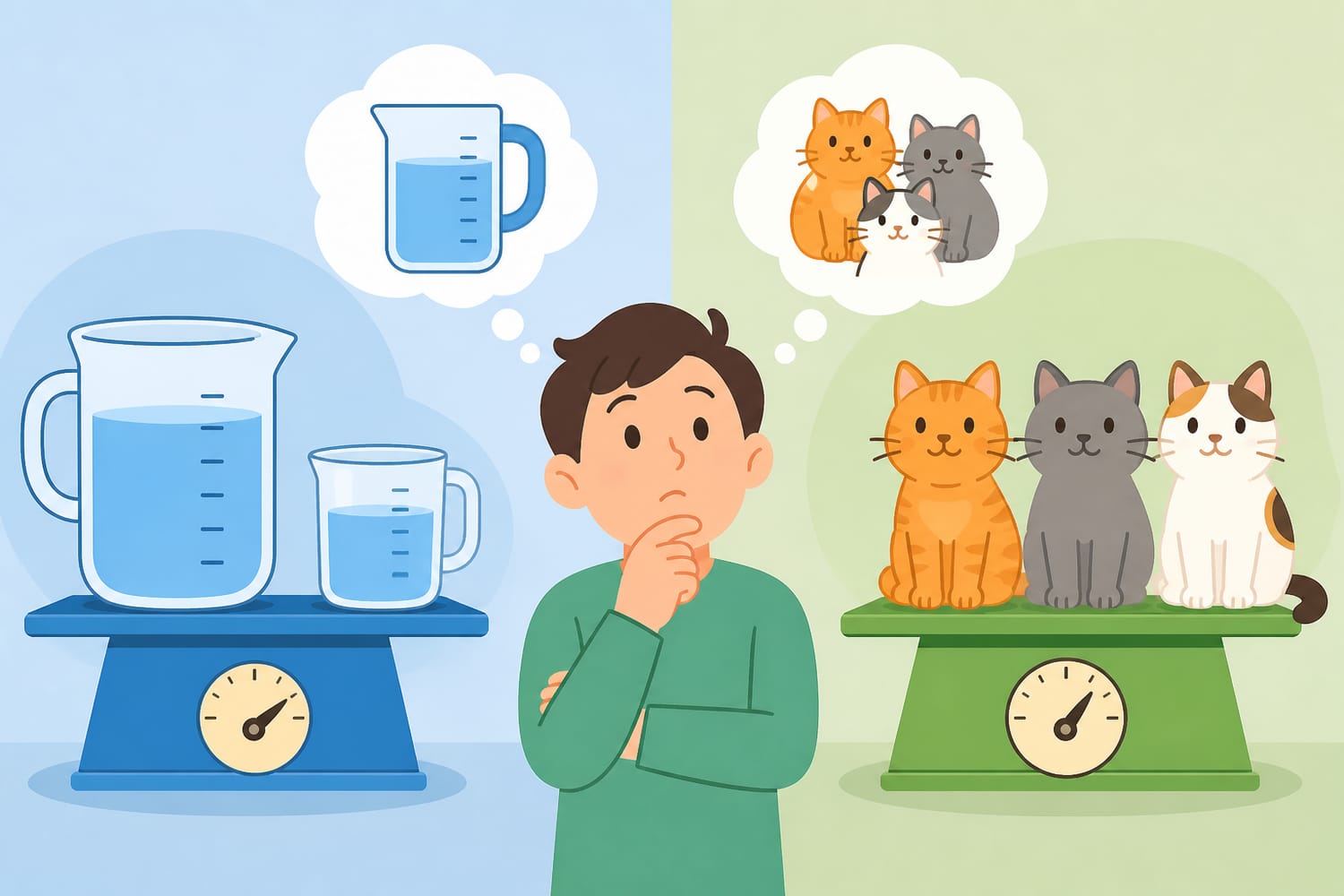
Use “number” with things you can count individually and “amount” with things you measure or treat as a whole. You can count four cookies, six emails, or twelve mistakes, so those take “number.” You measure water, time, patience, and information, so those take “amount.” That is the rule in its simplest form.
Count It or Measure It?
The difference between “amount” and “number” depends on the noun that follows. Grammarians divide nouns into two broad groups: count nouns and mass nouns, also called countable and uncountable nouns.
A count noun can be separated into individual units:
- one chair, two chairs
- one customer, eight customers
- one suggestion, several suggestions
- one raindrop, thousands of raindrops
Because these things can be counted, they pair with “number.”
A large number of customers arrived early.
She received a surprising number of suggestions.
We counted the number of raindrops on the window.
A mass noun is usually understood as a substance, quality, concept, or collection that is not divided into individual units:
- water
- traffic
- information
- patience
- furniture
- work
These nouns pair with “amount.”
Drink a sufficient amount of water.
The project required an enormous amount of work.
We received a useful amount of information.
The Cambridge Dictionary’s guide to “amount,” “number,” and “quantity” summarizes the distinction neatly: “amount” goes with uncountable nouns, while “number” goes with countable nouns.
The Quick “Many or Much?” Test
If you are unsure which word to use, try replacing it with “many” or “much.”
- If many sounds right, choose number.
- If much sounds right, choose amount.
Consider “books.” You would ask, “How many books are there?” Therefore, you need “number.”
Correct: The number of books in the library has increased.
Now consider “reading.” You would ask, “How much reading do we have?” Therefore, you need “amount.”
Correct: The amount of reading assigned this week is intimidating.
Here are a few more:
| Noun | Test | Correct choice | |---|---|---| | Complaints | many complaints | number of complaints | | Sugar | much sugar | amount of sugar | | Employees | many employees | number of employees | | Luggage | much luggage | amount of luggage | | Questions | many questions | number of questions | | Noise | much noise | amount of noise |
This test works because “many” normally modifies count nouns, while “much” modifies mass nouns. It also connects this rule to the familiar difference between “fewer” and “less”: use “fewer” for countable items and “less” for uncountable quantities.
Why Plurals Usually Point to “Number”
A visible plural ending is often the biggest clue.
If the noun following “of” is plural—such as “cars,” “students,” “ideas,” or “mistakes”—“number” is generally the standard choice.
The number of cars on the road is increasing.
A remarkable number of students volunteered.
We found a small number of mistakes in the report.
These would be less appropriate in formal writing:
The amount of cars on the road is increasing.
An impressive amount of students volunteered.
People certainly use “amount” this way in everyday speech, and the intended meaning is rarely mysterious. However, edited English usually prefers “number” when individual items can be counted.
A helpful editing trick is to look directly after “of.” If you see an ordinary plural count noun, “number” is probably waiting in the wings, ready for its cue.
Why Some Nouns Can Go Either Way
English, naturally, refuses to make every rule completely painless. Some nouns can be countable in one sentence and uncountable in another.
Take coffee:
We drank a large amount of coffee.
Here, “coffee” means the beverage as a substance.
The café served a large number of coffees.
Here, “coffees” means individual cups or orders.
The same shift happens with paper:
The printer uses a huge amount of paper.
The professor reviewed a huge number of papers.
In the first sentence, “paper” is a material. In the second, “papers” are individual documents.
Other nouns behave similarly:
- chicken can mean meat or individual birds.
- glass can mean a material or drinking containers.
- experience can mean accumulated knowledge or separate events.
- work can mean effort or individual artistic creations.
That is why blindly looking at the object itself is not enough. Ask how the noun is being used in that particular sentence. As Merriam-Webster explains in its overview of noncount and mass nouns, these nouns generally lack ordinary plural forms and are treated as undivided substances or ideas.
What About Money, Time, and Measurements?
Money creates confusion because dollars, coins, and bills are countable, but money itself is a mass noun.
We spent a considerable amount of money.
We counted the number of dollar bills in the drawer.
The cashier recorded the number of coins collected.
Time follows the same pattern. Time is treated as a whole, while minutes, hours, days, and years are individual units.
I spent a ridiculous amount of time choosing a sandwich.
I spent a ridiculous number of minutes choosing a sandwich.
Both sentences are correct, although the second one makes the delay sound especially dramatic.
The same principle applies to food and other measurable substances:
Use a small amount of flour.
Use a small number of cups of flour.
The recipe contains a surprising amount of sugar.
The recipe contains a surprising number of teaspoons of sugar.
When you introduce a countable unit—cups, teaspoons, gallons, pounds, hours, or miles—you usually switch from “amount” to “number.”
Is “Amount of People” Always Wrong?
In traditional and formal usage, “number of people” is the safer and more widely recommended choice because people are individuals who can be counted.
Preferred: A large number of people attended the concert.
Informal: A large amount of people attended the concert.
However, real-world English is not controlled by a tiny committee wearing grammar robes. “Amount” does sometimes appear with plural count nouns, particularly when speakers imagine the items as one large mass or collection. Merriam-Webster notes that this usage has often been criticized but is established in both speech and writing.
That does not mean the distinction is useless. In school assignments, professional communication, journalism, and other polished writing, following the count-versus-mass rule produces clearer, more conventional sentences.
Think of it as choosing the least distracting option. “A number of people” slips past most readers unnoticed. “An amount of people” may cause some of them to pause—and you probably want them concentrating on your point, not holding an emergency grammar meeting.
“A Number Of” and “The Number Of” Are Different
Once you have chosen “number,” there is one more small trap to avoid.
“A number of” means “several” or “many” and generally takes a plural verb:
A number of employees are working remotely.
A number of problems have appeared.
By contrast, “the number of” refers to one total and generally takes a singular verb:
The number of employees is increasing.
The number of problems has surprised us.
The difference becomes clearer when you substitute another phrase:
Several employees are working remotely.
The total is increasing.
This is the kind of small agreement issue that can hide in otherwise polished writing. If you enjoy catching such details, explore these other common grammar mistakes in social media posts.
A Quick Editing Checklist
Before choosing between “amount” and “number,” ask:
Can I count the noun as individual items?
Use “number.”Am I measuring it or treating it as one undivided quantity?
Use “amount.”Would I naturally say “many”?
Use “number.”Would I naturally say “much”?
Use “amount.”Has the noun changed meaning in this sentence?
Check whether it represents a substance or separate units.Am I writing “a number of” or “the number of”?
Remember that they usually take different verb forms.
Test Yourself
Choose “amount” or “number” for each sentence:
- The ___ of emails in my inbox is terrifying.
- We used a small ___ of paint.
- A surprising ___ of guests wore purple.
- The storm produced a tremendous ___ of rain.
- She completed an impressive ___ of assignments.
- He showed an admirable ___ of patience.
Answers
- number—emails can be counted.
- amount—paint is treated as a substance.
- number—guests can be counted.
- amount—rain is treated as a mass.
- number—assignments are individual items.
- amount—patience is an abstract, uncountable quality.
The Final Word
The entire rule comes down to one question: Are you counting separate things or measuring a whole?
Use “number” for countable people, objects, events, and units. Use “amount” for substances, qualities, activities, and ideas treated as undivided quantities.
English will always provide a few gray areas—that is part of its charm and occasional mischief. But if you remember “many means number; much means amount,” you will choose the right word an impressive number of times with a remarkably small amount of effort.