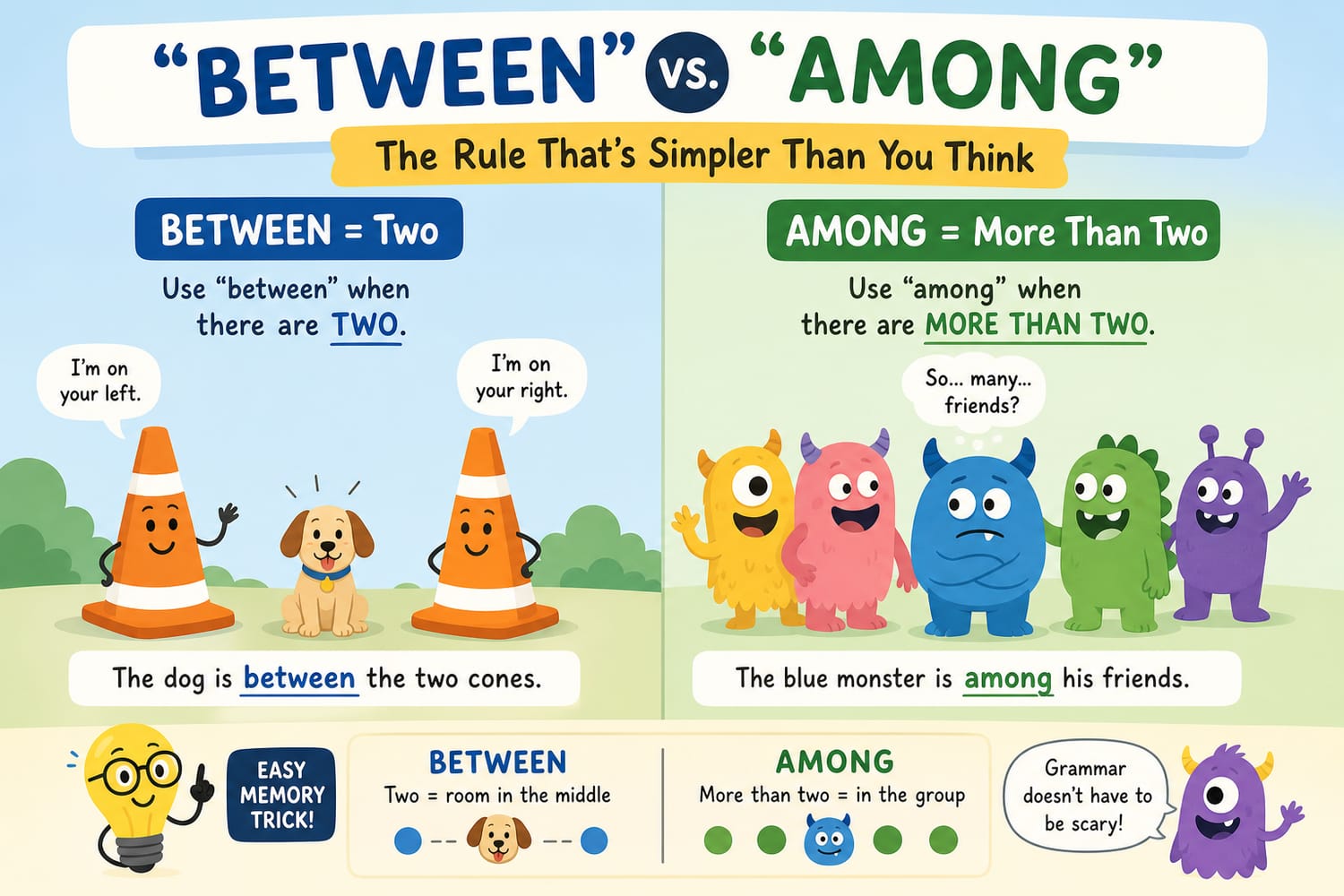
The “Two vs. More Than Two” Rule Is Not the Whole Story
If you were taught that between is for two things and among is for three or more, you’re in excellent company. It’s one of those tidy grammar rules that sounds so reasonable you can practically hear a teacher tapping it onto a chalkboard.
And it is… partly true.
You would say:
- The secret stayed between you and me.
- The prize money was divided among the five winners.
So far, so good.
But then English, being English, strolls in wearing mismatched socks and says things like:
- Trade talks continued between the United States, Canada, and Mexico.
- The argument between the three siblings lasted all morning.
- The cookies were shared among the children.
Wait. “Between the three siblings”? Isn’t that illegal?
Nope. Perfectly grammatical.
The real rule is not simply about numbers. It’s about relationships.
Use between when you’re talking about separate, distinct people or things and the relationships connecting them.
Use among when you’re talking about someone or something in the middle of a group, surrounded by a group, or part of a group in a general way.
That’s the heart of it. The “two vs. more than two” rule is a helpful shortcut sometimes, but it’s not the full map.
The Simple Rule: Distinct Relationships vs. Group Settings
Here’s the clearest way to think about it:
Between is for things considered individually.
Among is for things considered collectively.
Let’s put that into action.
You’d say:
The negotiations between France, Germany, and Italy were complicated.
Why between? Because France, Germany, and Italy are distinct parties. We’re imagining separate relationships, discussions, or positions involving each country.
But you’d say:
She felt comfortable among her colleagues.
Why among? Because her colleagues form a group around her. We are not focusing on one-to-one relationships with each colleague. We’re talking about her being part of a social setting.
Another pair:
The contract was signed between the author, the publisher, and the illustrator.
Each party has a separate role. That calls for between.
The rumor spread among the staff.
The staff is acting like a general group. That calls for among.
A handy test: if you can imagine lines connecting specific people or things, between is probably your word. If you imagine someone standing in a crowd, use among.
Grammar: now with imaginary string diagrams.
When to Use “Between”
Use between when you are referring to a connection, comparison, choice, agreement, disagreement, difference, or division involving specific, separate items.
1. For two people or things
This is the classic use:
- The sandwich was split between Mia and Noah.
- There is a fence between the two houses.
- Let’s keep this between us.
In these examples, the two things are clearly distinct. Easy.
2. For more than two specific people or things
This is the part that surprises people. Between can absolutely be used with more than two items, as long as they are being treated separately.
- The treaty between the four nations was historic.
- There were clear differences between the red, blue, and green designs.
- The responsibilities were divided between the manager, the assistant manager, and the team lead.
In each case, the items are distinct. We are comparing, connecting, or distributing something with attention to individual roles.
3. With choices
We often use between when choosing from a set of options, even if there are more than two.
- I can’t decide between pasta, tacos, and sushi.
- The committee must choose between three proposals.
- She was torn between staying home, going out, and pretending she never got the invitation.
Because the options are separate and identifiable, between works well.
4. With differences
Use between when pointing out differences involving specific things.
- What’s the difference between affect and effect?
- The difference between lions, tigers, and leopards is easier to see once you know what to look for.
- There’s a big difference between being confident and being rude.
The things being compared are distinct, so between is the natural choice.
When to Use “Among”
Use among when you’re talking about things in a group, surrounded by a group, mixed into a group, or distributed through a group in a general way.
1. When someone or something is in a group
- She stood among the trees.
- He found his keys among the laundry.
- The old cabin was hidden among the pines.
Here, the person or thing is surrounded by other things. We are not focusing on separate relationships with each tree, sock, or pine needle. We’re looking at the group as a whole.
2. When something happens within a group
- Excitement spread among the fans.
- There was disagreement among the students.
- The news caused confusion among voters.
The fans, students, and voters are being treated collectively. We don’t need to identify each individual relationship.
3. When distributing something to a group
This can be slightly tricky because between can also be used for division. The difference depends on whether the recipients are being emphasized as individuals or as a group.
- The teacher distributed the handouts among the students.
- The charity divided the supplies among the families.
- The estate was divided among the heirs.
These examples treat the recipients as members of a group.
But if you want to emphasize precise individual shares, especially with named people, between may sound better:
- The inheritance was divided between Anna, Ben, and Clara.
- The duties were split between the editor, the designer, and the developer.
Both words can sometimes be grammatically possible, but they create slightly different emphasis.
The Cookie Test
Let’s use the most important grammar tool available: cookies.
Imagine three children: Ava, Liam, and Zoe.
If you say:
The cookies were divided among the children.
You mean the cookies were distributed to the group. Nice and general. Everyone probably got some, unless there was a very fast toddler involved.
If you say:
The cookies were divided between Ava, Liam, and Zoe.
You are emphasizing the three named individuals as separate recipients. Maybe Ava got two, Liam got three, and Zoe got one because she said she “wasn’t hungry” and then immediately changed her mind.
Now imagine this:
There was an argument between Ava, Liam, and Zoe about the last cookie.
That’s correct because the argument involves distinct people interacting with one another.
But:
The last cookie disappeared among the children.
That means it vanished somewhere in the group, possibly into someone’s suspiciously crumb-covered mouth.
The cookie test may not solve every grammar problem, but it does make learning tastier.
Common Phrases with “Between”
Some expressions strongly prefer between because they involve separation, comparison, or connection.
“Between you and me”
This is the standard phrase:
Between you and me, I think the meeting could have been an email.
Not “between you and I.” After a preposition like between, we use object pronouns: me, him, her, us, them.
So:
- between you and me
- between him and her
- between us and them
If you’re ever tempted to say “between you and I,” try removing “you and.” You wouldn’t say “between I.” You’d say “between me.” Grammar detective work complete.
“Between a rock and a hard place”
This means stuck between two bad options:
I’m between a rock and a hard place: clean the garage or explain why I still haven’t cleaned the garage.
“Read between the lines”
This means to understand an implied meaning:
Her email said “No worries,” but I could read between the lines.
The lines are distinct things, and the meaning is found in the space separating them.
Common Phrases with “Among”
Among appears in many expressions involving groups, surroundings, or shared status.
“Among friends”
Relax—you’re among friends.
This means you are in a friendly group or environment.
“First among equals”
The chairperson was considered first among equals.
This phrase means someone has a leading role in a group whose members are technically equal.
“Among other things”
The job requires writing, editing, research, and, among other things, heroic patience.
Here, the phrase refers to items included within a broader group.
What About “Amongst”?
Now for the word that sounds like it should be spoken by someone carrying a candle through a castle: amongst.
Amongst means the same thing as among. The difference is mostly style and region.
- Among is more common in American English.
- Amongst is more common in British English than in American English, though among is still widely used in Britain too.
- Amongst often sounds a bit more formal, old-fashioned, or literary.
Examples:
- She walked among the flowers.
- She walked amongst the flowers.
Both are correct. If you’re writing for a broad modern audience, among is usually the safer, simpler choice. If you’re writing fantasy dialogue for a mysterious forest guardian, amongst may be just the ticket.
Quick Comparison Examples
Let’s sharpen the difference with a few side-by-side examples.
The discussion between the board members became heated.
This emphasizes interaction among specific members.
There was tension among the board members.
This describes a general atmosphere within the group.
The map showed the border between the three regions.
The regions are distinct areas with boundaries.
The village lay among the three regions.
This suggests the village is situated within or surrounded by that general area.
The money was divided between Sam, Priya, and Elena.
The named individuals are treated separately.
The money was divided among the participants.
The participants are treated as a group.
The Mistake to Avoid
The biggest mistake is thinking between is wrong whenever more than two things are involved.
It isn’t.
These are correct:
- The agreement between the five companies took months to complete.
- The differences between the four versions are small but important.
- I’m choosing between chocolate, vanilla, and strawberry.
The better question is not “How many things are there?” but:
Am I thinking of them as separate items, or as part of a group?
Separate items? Use between.
A group? Use among.
That one question will get you much further than the old two-versus-three rule.
A Simple Rule to Remember
Here’s the pocket-sized version:
Use between for specific, distinct people or things, especially when discussing relationships, choices, comparisons, or divisions.
Use among for groups, crowds, surroundings, or general distribution within a group.
So yes, between can be used for more than two things. And yes, among is still your best friend when someone is standing in a crowd, hiding in the laundry, or distributing cupcakes to a suspiciously excited room of children.
English grammar often looks trickier than it is because the “rules” we learn are sometimes shortcuts, not complete explanations. In this case, the real rule is refreshingly simple:
Between draws lines. Among paints the crowd.