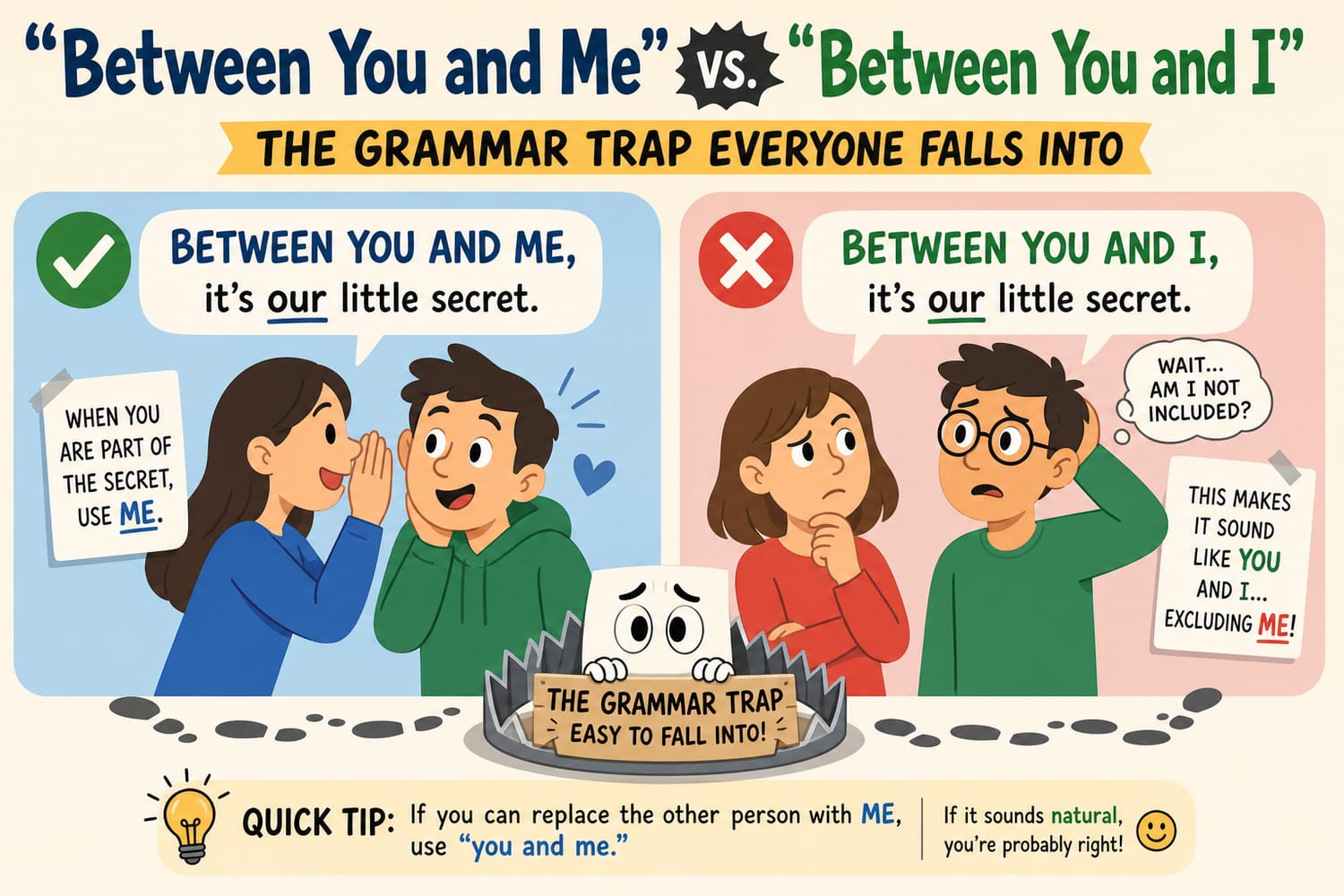
The Tiny Phrase That Causes Big Grammar Panic
Let’s say you’re about to share a secret.
You lean in, lower your voice, and say:
“Between you and I…”
Somewhere, a grammar teacher drops a red pen.
The correct phrase is:
“Between you and me.”
Yes, really. Even though “between you and I” sounds fancy, polished, and possibly like something said by someone wearing a blazer with elbow patches, it is not considered correct in standard grammar.
This is one of those sneaky grammar traps that catches almost everyone at some point. Why? Because we’re often taught that “you and I” sounds more proper than “you and me.” And sometimes it is! But not here.
So, between you and me, let’s untangle this once and for all.
The Short Answer: It’s “Between You and Me”
If you only remember one thing from this article, make it this:
Correct: Between you and me
Incorrect in standard grammar: Between you and I
Why?
Because between is a preposition, and prepositions are followed by object pronouns.
That means we use:
- me
- him
- her
- us
- them
- whom
Not:
- I
- he
- she
- we
- they
- who
So we say:
- between you and me
- between him and her
- between us
- between them
We do not say:
- between you and I
- between he and she
- between we
- between they
Unless, of course, you are writing dialogue for a character who is meant to sound dramatically confused.
Why “Me” Is Correct After “Between”
The word between is a preposition. A preposition shows a relationship between words, often involving location, direction, time, or connection.
Common prepositions include:
- in
- on
- under
- beside
- with
- for
- to
- from
- between
After a preposition, we generally use the object form of a pronoun.
That’s why we say:
- This gift is for me.
- She sat beside him.
- The decision is up to us.
- The conversation stayed between you and me.
You probably would never say:
- This gift is for I.
- She sat beside he.
- The decision is up to we.
Those sound obviously wrong. But when we add “you and,” our instincts sometimes wobble.
Suddenly, “between you and I” starts sounding formal. But grammar is not impressed by fancy vibes.
The “You and I” Problem
Here’s where the confusion begins.
Many of us were corrected as children for saying things like:
“Me and Sarah went to the store.”
An adult would swoop in and say:
“Sarah and I went to the store.”
And that correction is absolutely right.
In that sentence, “Sarah and I” is the subject. It is doing the action.
Correct: Sarah and I went to the store.
Incorrect: Sarah and me went to the store.
So we learn: “Aha! ‘Sarah and I’ sounds smarter. I should always say ‘you and I’ instead of ‘you and me.’”
But that rule is too broad. The real rule is not “always use I.” The real rule is:
Use I when the pronoun is the subject.
Use me when the pronoun is the object.
Compare these:
Subject:
- You and I should talk.
- Liam and I are making dinner.
- She and I finished the project.
Object:
- The teacher called you and me.
- They invited Liam and me.
- The secret is between you and me.
“I” is for doing the action.
“Me” is for receiving the action or following a preposition.
The Easiest Test: Remove the Other Person
A handy trick for many “you and I” vs. “you and me” situations is to remove the other person and see what sounds right.
For example:
“Emma gave the tickets to you and I.”
Remove “you and”:
“Emma gave the tickets to I.”
Nope. That sounds like a robot trying to be royal.
So the correct sentence is:
“Emma gave the tickets to you and me.”
Try another:
“You and me should start a band.”
Remove “you and”:
“Me should start a band.”
Unless your band is called Me Should Start a Band, that’s wrong.
So the correct sentence is:
“You and I should start a band.”
Now, this test is a little trickier with between, because “between me” by itself sounds incomplete. The word “between” usually needs two or more things. But the principle still works if you compare it with other prepositions:
- with me, not with I
- for me, not for I
- beside me, not beside I
- between you and me, not between you and I
If the pronoun follows a preposition, use the object form.
Hypercorrection: When Trying to Be Right Goes Wrong
“Between you and I” is a classic example of something called hypercorrection.
Hypercorrection happens when people apply a grammar rule too aggressively because they’re trying hard to sound correct.
It’s like wearing a tuxedo to a picnic. The intention is respectable. The result is awkward.
People know that “you and I” is often considered more proper than “you and me,” so they use it everywhere—even in places where “me” is actually correct.
That gives us sentences like:
- Between you and I, I hated the movie.
- The manager spoke to Rachel and I.
- This is a photo of my brother and I.
- The invitation is for you and I.
All of these should use me:
- Between you and me, I hated the movie.
- The manager spoke to Rachel and me.
- This is a photo of my brother and me.
- The invitation is for you and me.
Again, the key is not whether the sentence sounds elegant. The key is the pronoun’s job in the sentence.
But Doesn’t “Between You and I” Sound More Natural?
To many people, yes. That’s part of the trap.
Language is influenced by what we hear. And “between you and I” appears in conversation, on television, in songs, and even in writing. Because it is so common, it can start to sound normal.
But in standard edited English—especially in school, publishing, journalism, business writing, and formal communication—“between you and me” is the accepted form.
That does not mean everyone who says “between you and I” is committing a moral failure. Nobody needs to be escorted out of brunch for it.
It simply means that if you want the grammatically standard version, especially in writing, use me.
Think of it this way:
“Between you and I” is common.
“Between you and me” is standard.
Common and standard are not always the same thing.
What About “Between You and Myself”?
Ah, another fancy-looking option enters the room.
Some people say:
“Between you and myself…”
This is also usually incorrect.
Myself is a reflexive pronoun. Reflexive pronouns are words like:
- myself
- yourself
- himself
- herself
- ourselves
- themselves
They are used when the subject and object refer to the same person:
- I taught myself guitar.
- She reminded herself to call.
- We prepared ourselves for the exam.
You can also use reflexive pronouns for emphasis:
- I made it myself.
- The mayor herself attended the event.
But in “between you and myself,” there is usually no reason to use “myself.” The simpler and correct choice is:
Between you and me.
Similarly:
Incorrect: Please send the report to James and myself.
Correct: Please send the report to James and me.
“Myself” may sound formal, but it often just adds a velvet cape to a sentence that needed sneakers.
“Between You and Me” in Real Sentences
Let’s look at some examples:
Correct:
- Between you and me, I think the meeting could have been an email.
- Let’s keep this between you and me.
- There has always been trust between you and me.
- Between you and me, that cake was a little dry.
- The agreement is between you and me, not the whole office.
Notice that in each case, me follows the preposition between as part of the phrase “you and me.”
Now compare:
Correct with “I”:
- You and I should discuss this privately.
- You and I know the truth.
- You and I have very different opinions about pineapple on pizza.
In these sentences, “you and I” is the subject. It is doing the action.
So both “you and me” and “you and I” can be correct. It all depends on how they are used.
A Simple Cheat Sheet
Here’s a quick guide you can keep in your mental grammar drawer.
Use you and I when the phrase is the subject:
- You and I are friends.
- You and I need to leave.
- You and I should write a book.
Use you and me when the phrase is the object:
- They saw you and me.
- The joke confused you and me.
- This stays between you and me.
Use you and me after prepositions:
- for you and me
- with you and me
- about you and me
- between you and me
If a preposition comes right before the phrase, “me” is almost always the word you want.
The Final Word, Between You and Me
The phrase “between you and me” is correct because between is a preposition, and prepositions take object pronouns.
The phrase “between you and I” is a common hypercorrection. It happens because people know “you and I” is sometimes right and assume it must always be better. But grammar does not work on fanciness points.
Remember:
You and I do things.
Things happen to you and me.
Secrets stay between you and me.
So the next time you’re about to share a juicy observation, office whisper, or controversial opinion about a movie everyone else loved, you can say it with confidence:
“Between you and me…”
And somewhere, a grammar teacher will smile.