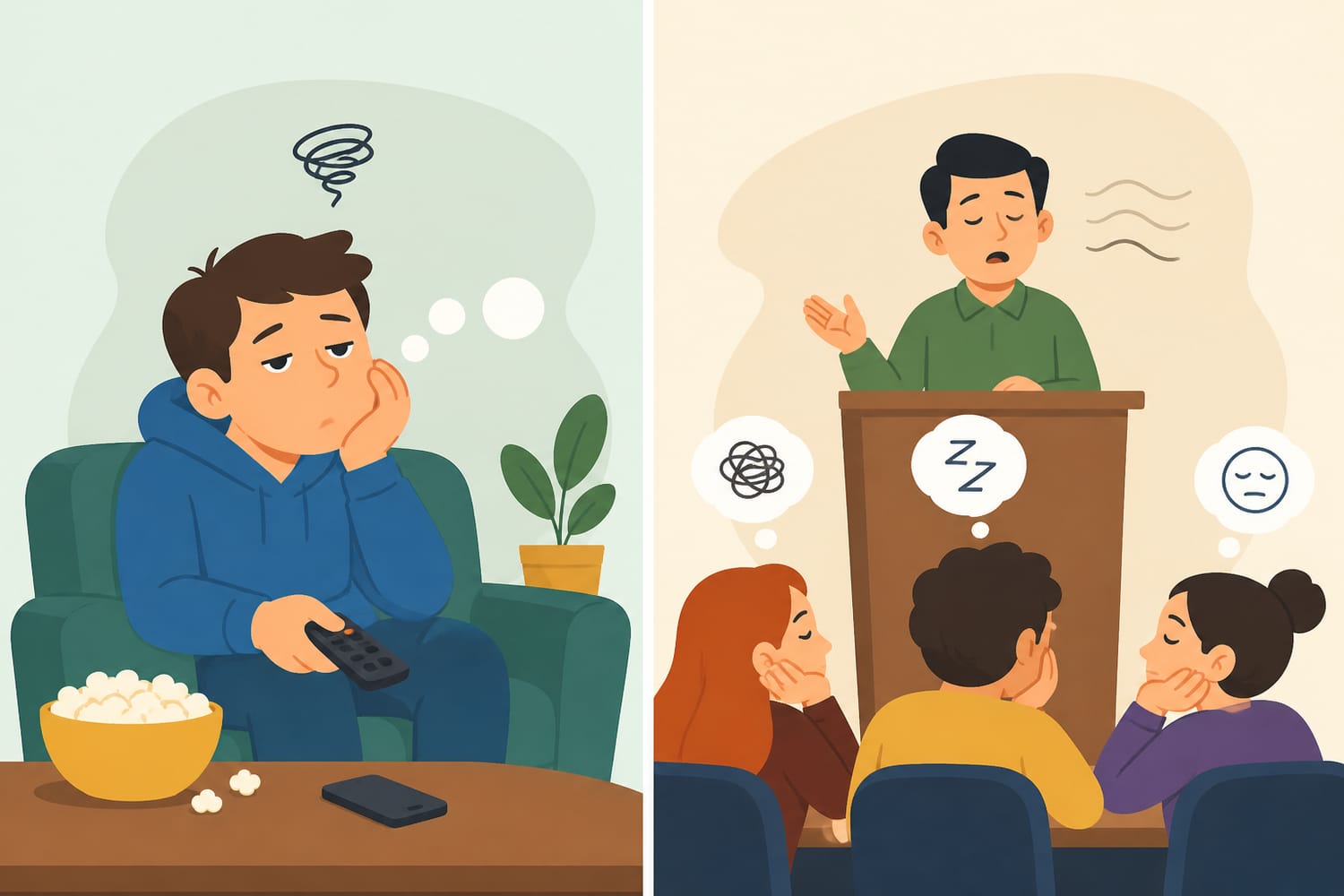
Bored describes how someone feels; boring describes someone or something that causes that feeling. If you’re bored, you want something more interesting to happen. If you’re boring, other people may wish you’d change the subject. The ending shifts you from experiencing boredom to causing it.
Imagine texting a friend during a slow afternoon: “Help. I’m so boring.”
You probably meant that you needed entertainment. Instead, you’ve delivered a surprisingly harsh review of your own personality.
One small ending, one very different message. Fortunately, the distinction becomes much easier once you know which question each word answers.
The Basic Difference: Feeling vs. Effect
Both words connect to the verb bore, meaning to make someone lose interest. But they describe different sides of that experience.
| Word | What it describes | Example | |---|---|---| | Bored | Someone experiencing a lack of interest | “I felt bored during the speech.” | | Boring | Someone or something that doesn’t hold interest | “The speech was boring.” |
Think of a very long slideshow about office staplers.
- The boring slideshow is the source of the problem.
- The bored audience is experiencing the problem.
- The staplers would probably prefer not to be involved.
These are two perspectives on the same situation: what produces the feeling and who experiences it. That’s the distinction in Cambridge’s guide to “bored” and “boring”.
When to Use “Bored”
Use bored when you mean that someone feels uninterested, has nothing engaging to do, or shows that feeling. It can appear after words such as feel, look, get, and become, or directly before a noun.
For example:
- “I’m bored. Shall we play a game?”
- “The children got bored during the delay.”
- “She looked bored halfway through the explanation.”
- “A bored customer checked his watch.”
In each sentence, bored points toward the person’s experience.
What About a “Bored Expression”?
A face doesn’t experience boredom separately from its owner. Nevertheless, phrases such as a bored expression and a bored look are standard: they describe an outward sign of someone’s feelings. Cambridge’s dictionary explicitly includes this use.
Compare these invented examples:
“Leo gave me a bored look.”
Leo looked uninterested.
“Leo gave a boring explanation.”
His explanation failed to hold my attention.
The first describes a visible reaction. The second describes something that produces a reaction.
When to Use “Boring”
Use boring for something—or someone—that isn’t interesting or exciting. It can describe an activity, conversation, place, object, or person.
Consider:
- “Copying these numbers is boring.”
- “The film had a boring middle section.”
- “We abandoned the boring game.”
- “His story became boring after the fourth unnecessary detour.”
The word tells us about the subject’s effect on someone’s interest, rather than the subject’s own feelings.
For a more precise sentence, try naming the person having the reaction:
“I found the documentary boring, but Priya loved it.”
That wording leaves room for different tastes. Perhaps Priya genuinely enjoys a detailed history of municipal drainage. There’s a documentary audience for everything.
Yes, People Can Be “Boring”
Forget the tempting shortcut that says “-ed is for people, and -ing is for things.” People can receive either description. What matters is whether they experience the feeling or cause it.
Compare:
“The teacher was bored.”
The teacher felt uninterested.
“The teacher was boring.”
The teacher didn’t hold someone’s interest.
The noun stays the same. Its role in the situation changes.
Here’s an even sharper pair:
“My date was bored.”
Your date wasn’t enjoying the experience.
“My date was boring.”
You weren’t finding your date interesting.
Both sentences are grammatically possible. Neither guarantees a second date.
If you’re choosing wording for an actual conversation, consider describing the specific problem instead: “We struggled to find common interests” communicates more than a sweeping verdict on someone’s personality.
The Endings Don’t Tell You the Time
Another trap is assuming that bored must describe the past because it ends in -ed, while boring must describe the present because it ends in -ing.
In these adjective uses, the endings distinguish meanings, not when the situation happens. These words come from verb forms, but they can function as adjectives.
Look at the surrounding verbs:
| Time | Experiencing boredom | Causing boredom | |---|---|---| | Past | “I was bored yesterday.” | “Yesterday’s task was boring.” | | Present | “I am bored now.” | “This task is boring.” | | Future | “I will be bored tomorrow.” | “Tomorrow’s task will be boring.” |
Here, was, am/is, and will be locate the situation in time. The adjective keeps its meaning.
What About “You’re Boring Me”?
In “You’re boring me,” are boring is a verb phrase: it describes someone causing another person to lose interest. Compare that with “You’re boring,” where boring describes the person. Cambridge’s entry for the verb bore illustrates this use with a question about boring another person.
You don’t need to label every grammatical part in conversation. Just notice that boring isn’t always doing the same job.
The Same Pattern Unlocks Other Word Pairs
Once you understand bored and boring, several other pairs become less troublesome. For these emotion-related adjectives, -ed generally describes the feeling, while -ing describes what produces it. The British Council’s explanation of -ed and -ing adjectives follows this pattern.
| Someone’s feeling | What causes it | Example | |---|---|---| | Interested | Interesting | “The interesting puzzle kept us interested.” | | Excited | Exciting | “The exciting announcement made us excited.” | | Confused | Confusing | “The confusing directions left me confused.” | | Annoyed | Annoying | “That annoying noise is making me annoyed.” | | Surprised | Surprising | “We were surprised by the surprising result.” | | Tired | Tiring | “The tiring journey left everyone tired.” |
Some of these examples are deliberately repetitive so you can see the relationship. In everyday writing, you might prefer “The journey exhausted everyone.”
And don’t turn this helpful pattern into a rule for every adjective ending in those letters. Red isn’t an emotion, and talented doesn’t mean someone has experienced “talenting.” English adjective forms are more varied than that.
For more ways to express genuine interest, explore Uncover Words’ guide to words that show curiosity in conversation.
Is It “Bored With,” “Bored By,” or “Bored Of”?
You may encounter all three:
- “I’m bored with this game.”
- “I was bored by the presentation.”
- “She’s bored of hearing the same excuse.”
Cambridge records bored with and bored of, while its verb entry also illustrates bored by. The preposition doesn’t change the central point: the person is experiencing boredom.
For a learner-friendly starting point, practice bored with something and bored by something. Keep the main distinction separate from the preposition: a presentation can be boring, and you can be bored by it.
Try the “Feels or Makes” Check
When you hesitate, expand your intended meaning:
- Feels uninterested? Choose bored.
- Makes someone feel uninterested? Choose boring.
This is a practical way to apply the feeling-versus-effect distinction described by Cambridge.
Try these sentences before checking the answers:
- “We had nothing to do, so we felt ___.”
- “The instructions repeated the same point ten times. They were ___.”
- “Nina is usually entertaining, but today she seems ___.”
- “I hope my speech isn’t ___.”
- “The ___ audience started whispering.”
Answers: 1. bored; 2. boring; 3. bored; 4. boring; 5. bored.
For number three, bored fits the intended meaning that Nina seems uninterested today. Boring would also be grammatical—but it would mean she seems uninteresting instead.
That’s why this distinction is about meaning, not simply spotting an “incorrect” sentence.
One Ending, Two Very Different Messages
Keep this compact reminder handy: bored names the feeling; boring describes its source. A bored reader wants something more engaging. A boring article needs a better edit.
Before sending that text or finishing that sentence, ask yourself: “Am I describing someone’s reaction, or what caused it?”
And if you catch yourself writing “I’m boring,” pause before pressing send. You may only need a new activity—not a personality overhaul.