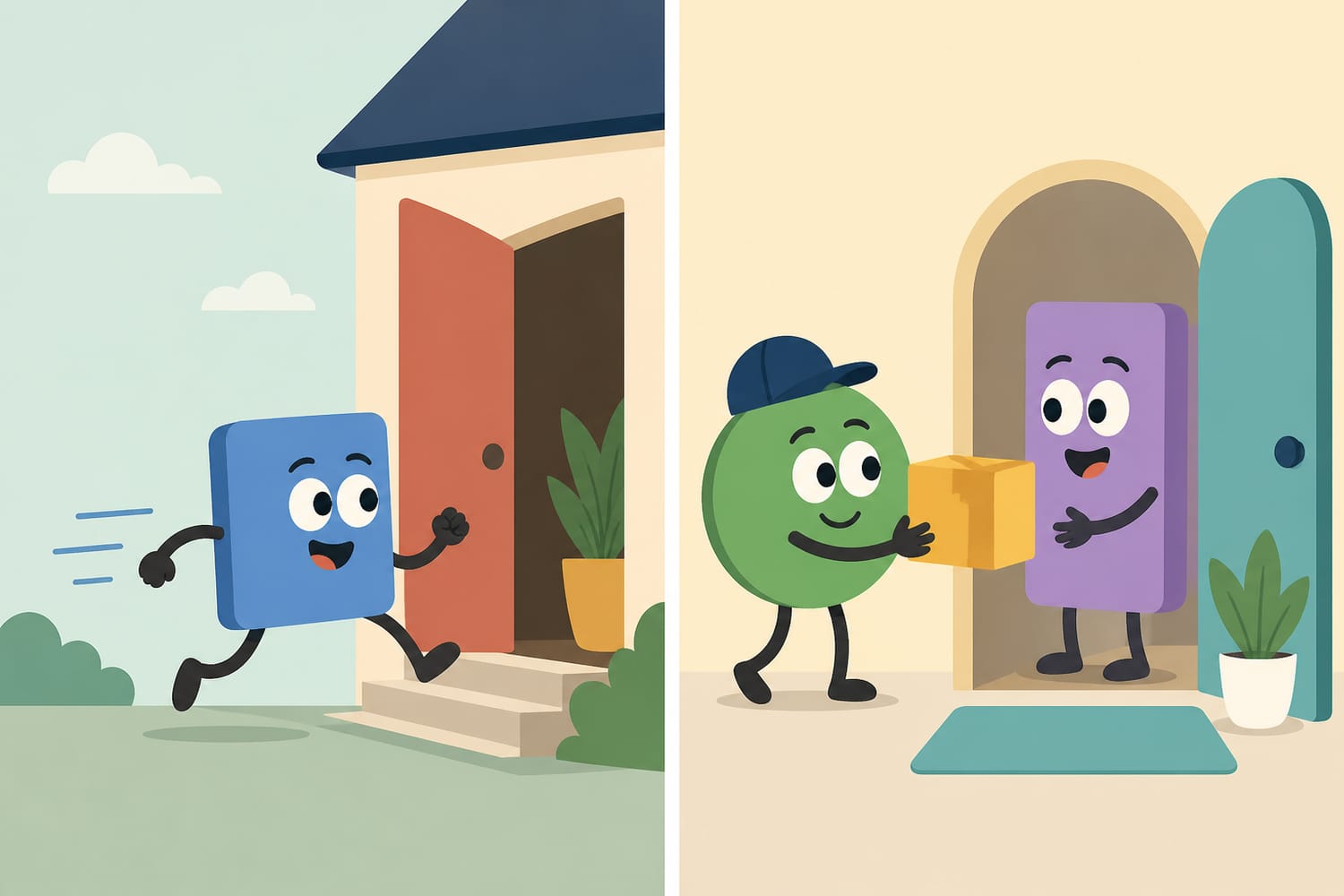
The One-Space Answer
Use into when you mean movement toward the inside of something, a change into something else, or involvement in something: She walked into the bakery. Use in to when in belongs with the word before it and to begins a separate phrase: She stepped in to buy bread. One space, two different jobs.
If that sounds suspiciously simple, English has a surprise waiting. The difference isn’t always about whether someone goes indoors. It’s about which words belong together. Once you spot the pairings, you can stop staring at that little gap as though it might offer a confession.
When “Into” Is One Word
Into is a preposition. Most often, it shows movement toward or inside a place, object, or area.
The puppy climbed into the laundry basket.
The puppy started outside the basket and ended up inside it—presumably among the clean towels. The same idea works in pour water into a glass, walk into a room, and tuck a note into a pocket. Cambridge Dictionary’s guide to in and into explains this distinction between position and direction: in often tells you where something is; into often tells you where it’s going.
But into has more than one trick. It can describe a change:
The magician turned a scarf into a bouquet.
No one entered a bouquet. The scarf became one. Similarly, a plan can turn into a project, and a short chat can develop into a three-hour conversation.
Into can also describe interest or involvement:
My brother is really into astronomy.
He is interested in astronomy, not floating around inside it. That figurative use is why “Does it mean inside?” is a helpful first question, but not a complete rule.
When “In To” Needs Its Space
Unlike into, in to isn’t a single expression with one fixed meaning. It’s two separate words that happen to stand next to each other.
Often, in completes a verb such as step in, come in, give in, or turn in. Then to starts the next part of the sentence. It may introduce a purpose—to help—or a recipient—to the teacher.
Mia stepped in to help her friend.
Here, stepped in means intervened. To help her friend tells us why. Writing stepped into help would turn into into a preposition with no sensible destination after it.
Leo turned his assignment in to the teacher.
The action is turned in: Leo submitted his assignment. To the teacher identifies the recipient. Take away the space, and Leo appears to have transformed his assignment into the teacher. That would make for a memorable school day, but probably not the one you meant. The Blue Book of Grammar and Punctuation’s explanation uses this same distinction between a verb ending in in and the separate phrase that follows it.
The Verb Is Your Best Clue
When you’re unsure, look immediately to the left. Does in belong with the verb before it? If so, keep the space before to.
Compare these pairs:
| One word: into | Two words: in to | |---|---| | She stepped into the hallway. | She stepped in to settle the argument. | | He dived into the pool. | He dived in to retrieve the keys. | | They turned the old shed into a studio. | They turned the forms in to the office. |
In the left-hand sentences, into introduces a destination or a result: the hallway, the pool, a studio. In the right-hand sentences, stepped in, dived in, and turned in each make sense as a verb phrase; to begins something new.
A useful editing trick is to pause after in and read the sentence aloud. She stepped in. Why? To settle the argument. That pause reveals the structure, even if you wouldn’t pause there in ordinary conversation. The space is doing quiet work on the page.
Two Traps Worth Avoiding
“If there’s movement, use ‘into’”
Movement is a clue, not a guarantee. In He ran into the kitchen, the kitchen is the destination, so into fits. In He ran in to escape the rain, in completes ran in, while to escape the rain explains his purpose. He moves in both sentences; the words are grouped differently.
“If I can say ‘inside,’ use ‘into’”
This test works beautifully for a puppy and a basket. It’s less helpful for turning an idea into a business or being into jazz. Neither involves a literal inside, but into is still the right word. Ask what the sentence means, not just whether you can picture a door.
There’s one more small wrinkle: in and into can sometimes both work with a verb of movement. You can say Put the milk in the fridge or Put the milk into the fridge. The choice there is between in and into, not necessarily between in to and into. English occasionally offers more than one good route to the refrigerator.
Try the One-Space Test
Choose into or in to for each sentence before checking the answers.
- The kitten crawled ___ the cardboard box.
- Priya came ___ ask about the meeting.
- The chef turned leftover rice ___ fried rice.
- We handed the permission slips ___ the coach.
- Sam is ___ old detective movies.
Answers:
- Into — the kitten entered the box.
- In to — Priya came in; to ask explains why.
- Into — the rice became fried rice.
- In to — we handed in the slips; to the coach names the recipient.
- Into — Sam is interested in those movies.
If you missed one, don’t worry. This is the same sort of tiny visual puzzle as everyday versus every day: the space is easy to overlook, but it changes how the words work together.
What to Remember When You Write
Here’s the whole decision in two questions: Does “into” introduce a destination, a change, or an interest? Use one word. Does “in” finish a verb phrase while “to” starts another phrase? Use two.
And if your sentence claims that someone turned their homework into their teacher, give it one last look before you hit send. Unless, of course, you’re writing a story about a truly extraordinary homework assignment.