“Then” vs. “Than”: Why Two Tiny Words Cause Big Trouble
English has many word pairs that seem designed to trip us in public. Affect and effect. Its and it’s. Your and you’re. And then—yes, then—we have then and than.
They differ by just one letter, they sound very similar in casual speech, and spellcheck does not always come charging in to save you. But these two little words do very different jobs.
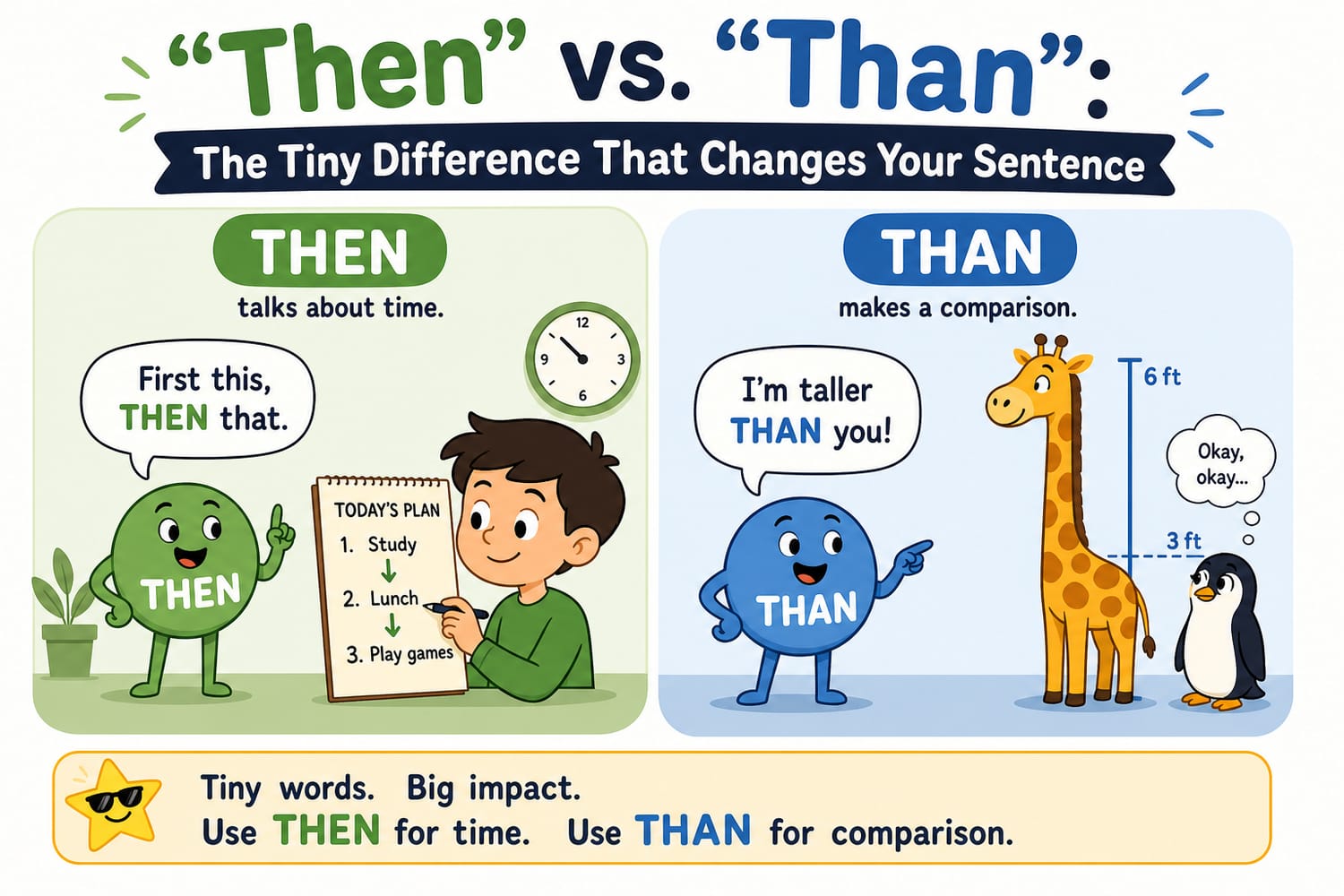
Here’s the short version:
- Then is usually about time, order, or result.
- Than is used for comparisons.
If you remember nothing else, remember this:
Then = time
Than = comparison
That tiny vowel swap can change the meaning of a sentence completely. So let’s uncover the difference—without making grammar feel like a dentist appointment.
What Does “Then” Mean?
Then is most often used when talking about when something happens, what happens next, or what follows as a result.
Think of then as a word that points along a timeline. It says, “After that,” “at that time,” or “in that case.”
1. “Then” for time
Use then when you mean at that time.
Examples:
- I lived in Chicago back then.
- We didn’t have smartphones then.
- She was the manager then, but now she owns the company.
In each case, then points to a particular time in the past.
2. “Then” for sequence
Use then when one thing happens after another.
Examples:
- First, preheat the oven. Then, mix the batter.
- We went to dinner, then saw a movie.
- He grabbed his coat and then ran out the door.
Here, then means “next” or “after that.” It helps move the action along, like a tiny traffic cop for events.
3. “Then” for result or consequence
Use then when something follows logically from something else.
Examples:
- If it rains, then we’ll stay inside.
- If you miss the train, then you’ll need to take a bus.
- You don’t want pizza? Then what do you want?
In these examples, then introduces what happens as a result.
You can often leave then out of “if” sentences and the meaning still works:
- If it rains, we’ll stay inside.
- If it rains, then we’ll stay inside.
Both are correct. The version with then just makes the cause-and-effect relationship more explicit.
What Does “Than” Mean?
Than is the word you want when comparing things.
If a sentence involves more, less, better, worse, taller, shorter, older, younger, rather, or other, there’s a good chance than is nearby.
Examples:
- My dog is louder than your dog.
- This book is better than the movie.
- She is taller than her brother.
- I would rather walk than wait for the bus.
- There were more cookies than we expected.
In each sentence, than connects two things being compared: dog vs. dog, book vs. movie, she vs. brother, walking vs. waiting, cookies vs. expectations.
The comparison test
Ask yourself: Am I comparing two things?
If yes, use than.
- Correct: This coffee is stronger than tea.
- Incorrect: This coffee is stronger then tea.
Unless your coffee somehow becomes stronger after tea—which sounds like a science experiment—than is the right choice.
The Easiest Trick: Time vs. Comparison
When you’re stuck, use this simple test:
Use then if you mean:
- at that time
- after that
- next
- in that case
Use than if you mean:
- compared with
- instead of
- rather than
- more/less/better/worse than
Let’s try it:
I ate breakfast, ___ I went to work.
This is about sequence: breakfast first, work next.
Answer: thenI like waffles more ___ pancakes.
This is a comparison: waffles vs. pancakes.
Answer: thanIf you’re tired, ___ go to bed.
This is a result or recommendation.
Answer: thenHe is older ___ I thought.
This is a comparison between his age and your expectation.
Answer: than
Tiny word, big responsibility.
Common Mistakes with “Then” and “Than”
Because then and than are so similar, they often sneak into each other’s sentences wearing fake mustaches. Here are some common mix-ups.
Mistake 1: Using “then” after a comparative word
Incorrect:
- She is smarter then me.
- This route is faster then the highway.
- The sequel was worse then the original.
Correct:
- She is smarter than me.
- This route is faster than the highway.
- The sequel was worse than the original.
Words like smarter, faster, and worse are comparative words. They need than, not then.
Mistake 2: Using “than” for sequence
Incorrect:
- We finished dinner, than went home.
- Turn left, than drive two miles.
- She smiled, than waved.
Correct:
- We finished dinner, then went home.
- Turn left, then drive two miles.
- She smiled, then waved.
These sentences describe what happens next, so they need then.
Mistake 3: “Rather then” instead of “rather than”
Incorrect:
- I’d rather read then watch TV.
Correct:
- I’d rather read than watch TV.
The phrase is rather than, because it compares two options: reading and watching TV.
Mistake 4: “Other then” instead of “other than”
Incorrect:
- Other then Monday, I’m free all week.
Correct:
- Other than Monday, I’m free all week.
Other than means “except for.” It’s a comparison-like phrase, so it uses than.
“Than Me” or “Than I”? A Quick Note
Here’s where English puts on a monocle and gets fancy.
You may have heard that you should say:
- She is taller than I.
But many people naturally say:
- She is taller than me.
So which is correct?
In everyday modern English, than me is widely accepted:
- She is taller than me.
The more formal version is:
- She is taller than I am.
The key is that than I is short for than I am. If you include the missing verb, the sentence sounds complete and formal:
- She is taller than I am.
- He is older than we are.
- They arrived earlier than she did.
In casual writing or conversation, than me is usually fine. In formal writing, especially if you want to avoid criticism from grammar enthusiasts hiding in the bushes, use the full version:
- She is taller than I am.
One important warning: sometimes the choice changes the meaning.
Consider:
- My brother likes pizza more than me.
- My brother likes pizza more than I do.
The first could mean: My brother likes pizza more than he likes me. Rude, but possible.
The second means: My brother likes pizza more than I like pizza.
When in doubt, add the missing words to make your meaning clear.
“Then” Can Also Be an Adjective or Noun
Most of the time, then is an adverb, but it has a couple of other uses.
“Then” as an adjective
You may see then used before a title or role to mean “at that time.”
Examples:
- The then-president gave a speech.
- Her then-boyfriend lived in Boston.
- The company’s then-CEO made the decision.
In this use, then is often hyphenated when it comes before the noun: then-president, then-boyfriend, then-CEO.
“Then” as a noun
Then can also refer to a time.
Examples:
- Since then, everything has changed.
- Until then, keep practicing.
- From then on, they were friends.
These are still time-related, which makes them easy to recognize.
“Than” in Familiar Phrases
Than appears in several everyday phrases. Learning these can help you avoid mistakes.
More than / less than
- The concert lasted more than three hours.
- The repair cost less than expected.
Better than / worse than
- This is better than I imagined.
- The weather was worse than predicted.
Rather than
- Rather than complain, let’s fix it.
- I’d choose tea rather than coffee.
Other than
- Other than a few typos, the essay was excellent.
- I have no plans other than sleeping late.
No sooner than
This phrase is a little dramatic, like English wearing a cape:
- No sooner had we arrived than it started raining.
- No sooner did she sit down than the phone rang.
It means one thing happened immediately after another. Even though the idea involves timing, the phrase uses than.
Why? Because English enjoys keeping us humble.
Quick Practice: Then or Than?
Try filling in the blanks before checking the answers.
- I’d rather stay home ___ go out tonight.
- First we’ll eat, ___ we’ll open presents.
- This puzzle is harder ___ it looks.
- If you don’t like that shirt, ___ try this one.
- She has more books ___ shelf space.
- Back ___, we didn’t know what would happen.
- Other ___ the noise, the apartment is perfect.
- He finished the race faster ___ anyone expected.
Answers
- than — comparing staying home with going out
- then — showing sequence
- than — making a comparison
- then — showing consequence
- than — comparing books and shelf space
- then — referring to a time in the past
- than — part of the phrase “other than”
- than — comparison with expectations
How did you do? If you got them all right, you may now proudly wear an imaginary grammar crown.
Final Tip: Let the Sentence Tell You What It Needs
The best way to choose between then and than is to look at what the sentence is doing.
If it’s moving through time, use then:
- We packed our bags, then left.
- I was younger then.
- If you’re ready, then let’s begin.
If it’s making a comparison, use than:
- This bag is heavier than that one.
- She runs faster than I do.
- I’d rather call than text.
That’s the whole tiny-but-mighty difference.
Then tells us when or what comes next.
Than tells us how things compare.
One letter changes the job, the meaning, and sometimes the entire sentence. But now that you know the trick—then for time, than for comparison—you’re far less likely to mix them up.
And if you do? Fix it, smile, and move on. English is tricky. That’s why we uncover words one at a time.