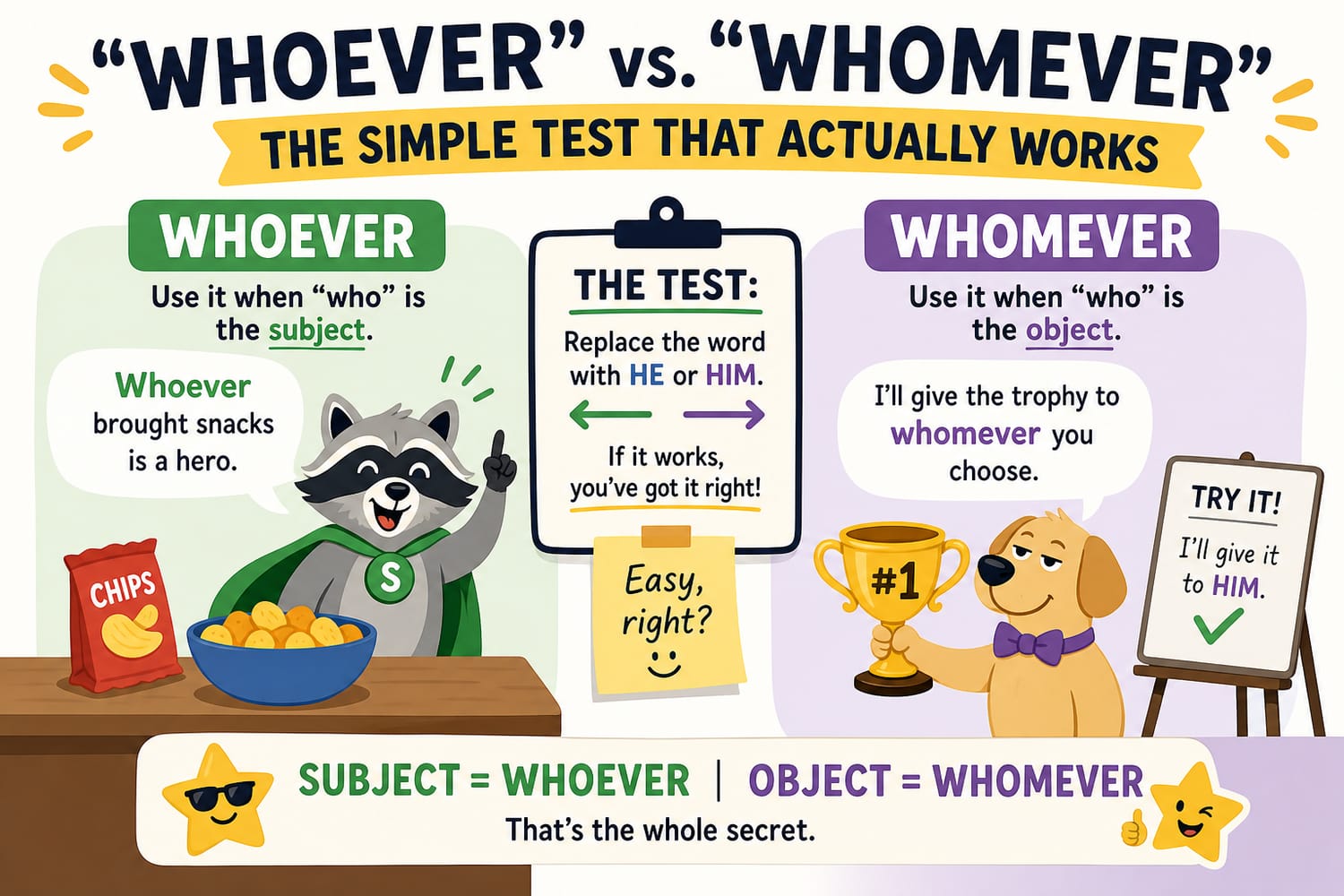
Meet the Grammar Gremlins
Few word pairs can make a perfectly confident writer suddenly stare into the distance like they’ve just been handed a tax form in Latin.
“Whoever” and “whomever” are two of those words.
You may have seen sentences like these:
- Give the prize to whoever wins.
- Give the prize to whomever the judges choose.
Both are correct. But why?
The trouble is that “whomever” sounds fancy, so people often reach for it when they want to sound polished. Unfortunately, that can backfire. A misplaced “whomever” is like wearing a tuxedo to a beach picnic: technically impressive, but not quite right for the occasion.
The good news? There is a simple test that actually works. Once you understand where to look, “whoever” and “whomever” become much less mysterious.
Let’s uncover the trick.
The Quick Difference Between “Whoever” and “Whomever”
At the simplest level:
- Whoever is used for a subject.
- Whomever is used for an object.
That’s the same difference as:
- who vs. whom
- he vs. him
- she vs. her
- they vs. them
A subject does the action.
Whoever called you should apologize.
Here, “whoever” is doing the calling.
An object receives the action.
You may invite whomever you like.
Here, “whomever” is being liked/invited. It is not doing the action.
So far, so manageable.
But then sentences get sneaky.
The Trap: Don’t Judge by the Word Before It
Many people think that if “whoever/whomever” comes after a preposition like “to,” “for,” or “with,” it must be “whomever.”
That seems logical. After all, we say:
Give it to him.
Give it to whom?
So shouldn’t it be:
Give it to whomever wants it?
Nope.
The correct sentence is:
Give it to whoever wants it.
Wait, what?
Here’s the key: “whoever wants it” is a whole clause. The preposition “to” does not control just the word “whoever.” It controls the entire group of words: “whoever wants it.”
Inside that group, “whoever” is the subject of “wants.”
Whoever wants it = he wants it
So the correct choice is whoever.
This is the mistake that causes most of the confusion. You must look at the role “whoever” or “whomever” plays inside its own clause, not just at the word right before it.
The Simple Test That Actually Works
Here’s the test:
Replace “whoever/whomever” with “he” or “him” inside the clause.
- If he sounds right, use whoever.
- If him sounds right, use whomever.
You can also use:
- she/her
- they/them
But “he/him” is traditional because the forms are easy to distinguish.
Let’s try it.
Give the prize to whoever wins.
Focus on the clause:
___ wins.
Would you say:
He wins.
or
Him wins.
You would say he wins, so use whoever.
Correct:
Give the prize to whoever wins.
Now try this one:
Give the prize to whomever the judges choose.
Focus on the clause:
The judges choose ___.
Would you say:
The judges choose he.
or
The judges choose him.
You would say him, so use whomever.
Correct:
Give the prize to whomever the judges choose.
That’s the test. Simple, reliable, and much cheaper than hiring a grammarian to follow you around.
Why “Whoever” Is Correct After “To” Sometimes
Let’s revisit the sentence that causes so much trouble:
Give it to whoever needs it.
A lot of people want to write:
Give it to whomever needs it.
But apply the test.
Look at the clause:
___ needs it.
Would you say:
He needs it.
or
Him needs it.
“He needs it” is correct, so the sentence should be:
Give it to whoever needs it.
The entire clause “whoever needs it” is the object of the preposition “to.” But inside that clause, “whoever” is still the subject of “needs.”
This is the heart of the matter.
The word may come after “to,” but that does not automatically make it “whomever.”
More examples:
Send the file to whoever requested it.
Give a discount to whoever signs up today.
I’ll make lunch for whoever is hungry.
In each case, the word is doing the action inside its clause:
- whoever requested
- whoever signs up
- whoever is hungry
So we use whoever.
When “Whomever” Really Is Correct
Now let’s give “whomever” its moment in the spotlight.
Use whomever when the word is the object inside its own clause.
Examples:
Invite whomever you want.
Test it:
You want ___.
Would you say:
You want he.
or
You want him.
“Him” is correct, so use whomever.
More examples:
Hire whomever you trust.
Choose whomever you prefer.
We will support whomever the committee selects.
The company can promote whomever it considers qualified.
In each sentence, “whomever” receives the action:
- you trust him
- you prefer him
- the committee selects him
- the company considers him qualified
That’s object territory, so whomever is the standard choice.
The Sneakiest Sentences: “You Think” and “You Say”
Some sentences hide the real job of “whoever” or “whomever” behind phrases like “you think,” “you believe,” or “they say.”
Consider this sentence:
Hire whoever you think is best.
Many people choose “whomever” because “you think” seems to need an object.
But test the real clause:
You think ___ is best.
Now ask: would you say:
You think he is best.
or
You think him is best.
“He is best” is correct, so the answer is:
Hire whoever you think is best.
Here, “whoever” is the subject of “is,” not the object of “think.”
More examples:
Vote for whoever you believe will do the best job.
Choose whoever you think can handle the pressure.
Support whoever they say is the strongest candidate.
In all of these, the word is the subject of a verb later in the clause:
- whoever will do
- whoever can handle
- whoever is
So use whoever.
Now compare:
Hire whomever you think we should interview.
Test:
We should interview ___.
Would you say:
We should interview he.
or
We should interview him.
“Him” is correct, so use:
Hire whomever you think we should interview.
The phrase “you think” is not the deciding factor. The pronoun’s actual role in the clause is.
A Mini Cheat Sheet
Here are some common patterns.
Use whoever when it means “the person who” and that person is doing the action:
Whoever arrives first should save seats.
Give the ticket to whoever asks for it.
Whoever broke the vase should confess.
I’ll talk to whoever is in charge.
Pick whoever seems most qualified.
Use whomever when it means “the person whom” and that person receives the action:
Invite whomever you like.
Thank whomever helped arrange the event.
Choose whomever the panel recommends.
I’ll sit with whomever you assign me to.
Contact whomever the instructions mention.
One caution: “Thank whomever helped arrange the event” is actually wrong if “whomever” is the subject of “helped.” The correct version is:
Thank whoever helped arrange the event.
Why? Because:
He helped arrange the event.
Not:
Him helped arrange the event.
This is exactly why the test matters.
“Whoever” and “Whomever” in Real Life
In everyday speech, many people avoid “whomever” altogether. They use “whoever” for both subject and object situations, especially in casual conversation.
For example, you will often hear:
Invite whoever you want.
Strictly speaking, in formal grammar, whomever is the traditional choice because:
You want him.
So the formal version is:
Invite whomever you want.
But “whomever” can sound stiff or overly formal in casual contexts. Depending on your audience, “whoever” may feel more natural.
That said, in formal writing, professional communication, exams, edited publications, or anywhere grammar precision matters, it is useful to know the distinction.
A good practical rule:
- In casual speech, whoever often sounds natural.
- In formal writing, use the he/him test and choose carefully.
- Don’t use whomever just to sound fancy.
Fancy is not the same as correct. Ask any peacock trying to parallel park.
The One-Sentence Rule to Remember
If you remember only one thing, make it this:
Use “whoever” if the word is doing the action inside its clause; use “whomever” if it is receiving the action inside its clause.
Or, even shorter:
He = whoever. Him = whomever.
Let’s do a final quick round.
Give the job to ___ deserves it.
He deserves it.
So:
Give the job to whoever deserves it.
Give the job to ___ the manager recommends.
The manager recommends him.
So:
Give the job to whomever the manager recommends.
We’ll support ___ can solve the problem.
He can solve the problem.
So:
We’ll support whoever can solve the problem.
We’ll support ___ the voters choose.
The voters choose him.
So:
We’ll support whomever the voters choose.
Final Thoughts: Don’t Fear the “M”
“Whomever” is not evil. It is not obsolete in every context. It is simply more formal, and it has a specific job: object duty.
The real danger is overcorrecting. Many writers use “whomever” whenever a sentence feels formal or whenever the word follows “to” or “for.” But grammar doesn’t work by vibes alone, tempting as that would be.
Instead, look inside the clause. Ask whether the person is acting or being acted upon. Try the he/him test.
- He wins → whoever wins
- They choose him → whomever they choose
- He needs help → whoever needs help
- We invite him → whomever we invite
And there you have it: the grammar gremlin has been tamed.
Use whoever and whomever with confidence—or, at the very least, with fewer dramatic pauses at your keyboard.