What Is an Eggcorn?
An eggcorn is a word or phrase created by mishearing another expression and replacing it with something that sounds similar—but seems more logical. “For all intensive purposes,” for example, is an eggcorn for “for all intents and purposes.” It is incorrect in standard English, yet its meaning feels surprisingly convincing.
Unlike a random verbal stumble, an eggcorn has an internal logic. The speaker has not simply scrambled the sounds. Their brain has quietly remodeled an unfamiliar expression using words it recognizes.
That makes eggcorns more than amusing mistakes. They are tiny demonstrations of the mind trying to make language behave itself.
The Nutty Mistake That Gave Eggcorns Their Name
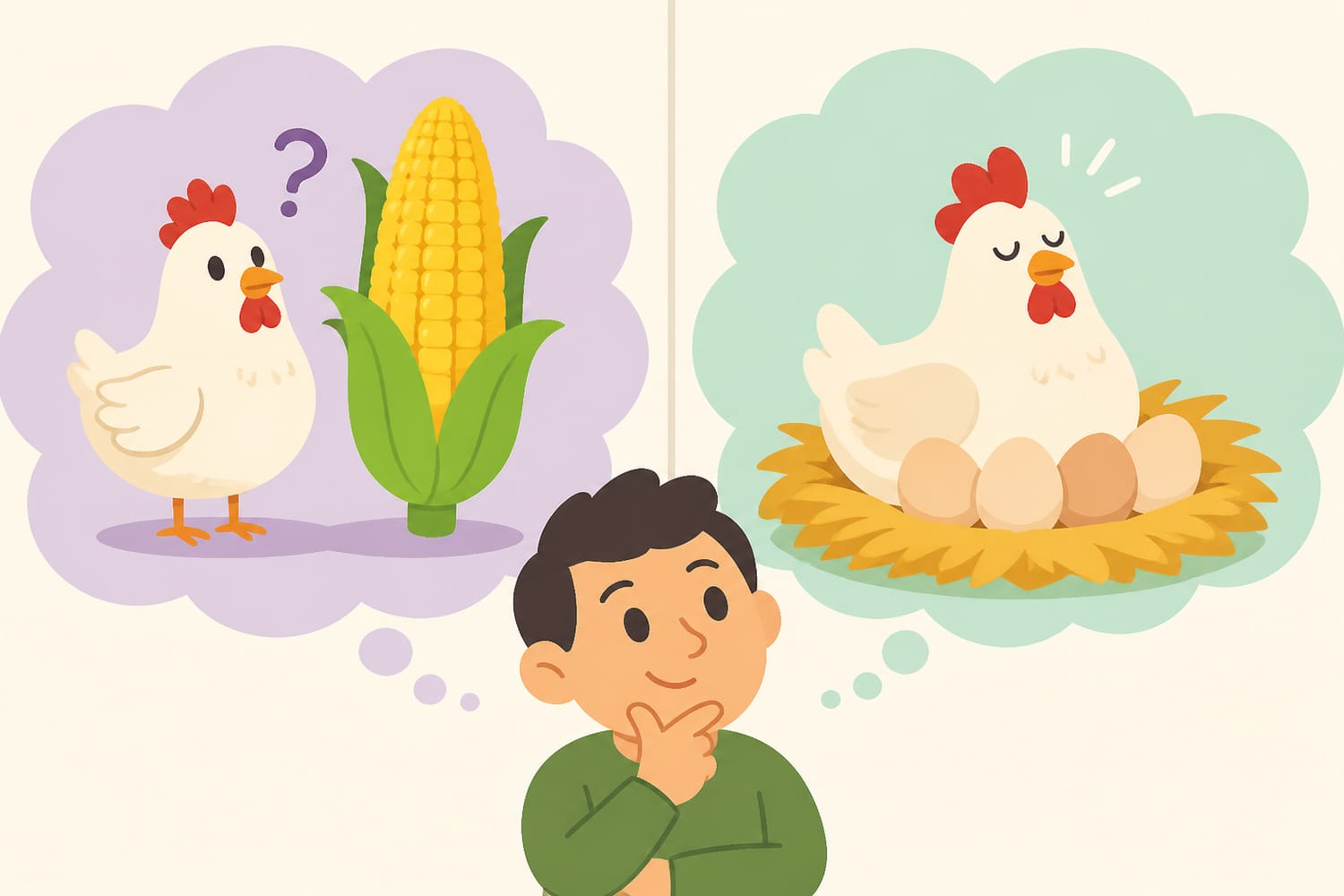
The term began with an actual acorn—or, more precisely, with someone who understood acorn as egg corn. The substitution makes a peculiar kind of sense. An acorn is roughly egg-shaped, and it contains the beginnings of a new oak tree. You could almost argue that it really is an oak’s egg.
In September 2003, linguist Mark Liberman discussed the example on the linguistics blog Language Log. Linguist Geoffrey Pullum then suggested using egg corn as the name for this entire category of mistake. The label was eventually written as one word: eggcorn. Merriam-Webster’s history of the term dates its first known use to 2003, while Language Log’s account of the word’s rise explains how it entered major dictionaries.
Best of all, eggcorn is itself an eggcorn. It wears its own definition like a name tag.
For lovers of funny-sounding words that are completely real, it is difficult to ask for anything more satisfying.
Why Eggcorns Make So Much Sense
Language reaches us primarily as a stream of sound. In ordinary speech, people rarely pause neatly between every word. Sounds run together, syllables weaken, and familiar expressions may be spoken so quickly that their individual parts become difficult to identify.
When the brain encounters a phrase it does not fully understand, it may rebuild that phrase from familiar pieces. Crucially, it does not always choose replacements at random. It looks for words that fit the situation.
Consider deep-seated, meaning firmly established. If you have never encountered that particular use of seated, you might hear deep-seeded instead. Seeds can be planted deep in the ground, where they take root and become difficult to remove. The revised image is wrong, but it is wonderfully coherent.
Eggcorns are especially likely to appear when an expression contains:
- An old or uncommon word
- A word used in an unfamiliar sense
- Sounds that blur together in speech
- A metaphor whose original image is no longer obvious
- A replacement that creates a more familiar mental picture
In other words, eggcorns flourish in the gaps between sound and meaning.
Eight Eggcorns Hiding in Plain Sight
Some eggcorns are easy to recognize once they are written down. Others can survive unnoticed for years because the revised version fits the intended meaning so well.
| Eggcorn | Standard expression | Why the mistake feels logical | |---|---|---| | For all intensive purposes | For all intents and purposes | Something “intensive” sounds thorough or all-encompassing. | | Deep-seeded | Deep-seated | A deeply planted seed suggests a belief with strong roots. | | Mute point | Moot point | A point no longer worth discussing might as well be silent. | | Free reign | Free rein | “Reign” suggests having power and freedom to act. | | Tow the line | Toe the line | “Tow” creates an image of pulling or moving a line. | | Old wise tale | Old wives’ tale | Traditional sayings often present themselves as old wisdom. | | On tender hooks | On tenterhooks | “Tender hooks” sound painful, delicate and uncomfortable. | | Beckon call | Beck and call | Someone waiting to be beckoned may also be “on call.” |
Many of these substitutions are so plausible that the standard version can initially look like the mistake. Tenterhooks, for instance, is confusing if you have never encountered a tenter: historically, a frame used to stretch cloth. Without that background, tender hooks may sound much more natural.
This is similar to the confusion caused by words that mean something different from what they appear to mean. When familiar-looking parts point us in the wrong direction, the brain eagerly invents a clearer explanation.
Eggcorn, Mondegreen or Malapropism?
English has an impressive collection of names for language going sideways. Their boundaries can occasionally be fuzzy, but each term describes a slightly different phenomenon.
Eggcorn
An eggcorn is a plausible reinterpretation that sounds like the original and still works reasonably well in context.
Example: Baited breath instead of bated breath. Breath that is “baited” might seem as though it is waiting expectantly for something to happen.
Mondegreen
A mondegreen usually results from mishearing a song lyric, line of poetry or other spoken passage. The new version may create a completely different—and often ridiculous—meaning.
One famous type is hearing “kiss the sky” as “kiss this guy.” The sounds are similar, but the mental scene changes dramatically. Dictionary.com’s explanation of mondegreens also distinguishes them from the more logically motivated eggcorn.
Malapropism
A malapropism occurs when someone substitutes a similar-sounding word that does not properly fit the intended meaning.
A classic literary example is calling someone “the very pineapple of politeness” instead of the pinnacle of politeness. The pineapple may be memorable, but it does not provide a sensible reinterpretation of excellence.
Typo
A typo is usually a mechanical accident rather than a genuine reinterpretation. If you type form instead of from, you probably do not believe that “form” is the correct word.
The key question is: Does the mistaken version reveal a believable alternative meaning? If so, you may have found an eggcorn.
What Eggcorns Reveal About the Brain
It is tempting to treat eggcorns as evidence that someone was not listening carefully. In reality, they often show that the listener was working hard to understand.
Human beings do not store every expression as a meaningless sequence of sounds. We connect words to images, experiences and familiar patterns. When part of a phrase seems obscure, the mind performs a kind of semantic repair job.
That repair may involve:
- Hearing an unfamiliar expression
- Matching its sounds to known words
- Checking whether those words fit the context
- Settling on the most satisfying interpretation
Usually, this process works brilliantly. It helps us follow rapid conversations even when there is noise, an unfamiliar accent or missing information. Occasionally, however, the result is an escape goat rather than a scapegoat.
Context matters too. As explored in how language changes depending on whether we are talking to Grandma or Google, people constantly adjust their language according to audience and situation. Eggcorns offer another example of that flexibility: we do not merely receive language—we interpret and reconstruct it.
Are Eggcorns Always Wrong?
In formal or carefully edited writing, an eggcorn should generally be replaced with the established expression. A report containing “for all intensive purposes” may distract readers, even if everyone understands it.
However, language is not preserved beneath glass. Forms change as people repeat, reinterpret and pass them on. A nonstandard expression can become widespread, and widespread usage can eventually influence what dictionaries and speakers accept.
That does not mean every eggcorn is destined for respectability. Most remain mistakes under current conventions. Nevertheless, they demonstrate one of the forces that shapes language over time: people prefer expressions they can understand.
Today’s error may remain an error—or it may be an early glimpse of tomorrow’s English.
How to Catch an Eggcorn Before It Hatches
Because eggcorns are meaningful, spellcheckers do not always flag them. Every individual word may be spelled correctly. The problem lies in the phrase as a whole.
To check a suspicious expression:
- Look it up as a complete phrase. A reliable dictionary can confirm the standard form.
- Examine the literal image. If the wording creates an oddly specific picture, it may be a reinterpretation.
- Pay attention to unfamiliar words. Tenterhooks and bated may look strange, but strange does not necessarily mean wrong.
- Check before correcting someone. You may discover that your own “obvious” version is the eggcorn.
- Correct kindly. These mistakes come from logical sense-making, not from a lack of intelligence.
Above all, enjoy them. Language would be far less entertaining without the occasional old wise tale or jar-dropping surprise.
A Mistake Worth Celebrating
An eggcorn occupies a delightful middle ground between error and invention. It is not the standard form, but neither is it meaningless. It is language rebuilt by a brain that wants every phrase to tell a sensible story.
That is why eggcorns are so charming. They remind us that listeners are not recording devices. We are interpreters, pattern hunters and accidental poets.
And if egg corn still seems more sensible than acorn, you are not alone. The mistake may be wrong—but it has certainly planted a seed.