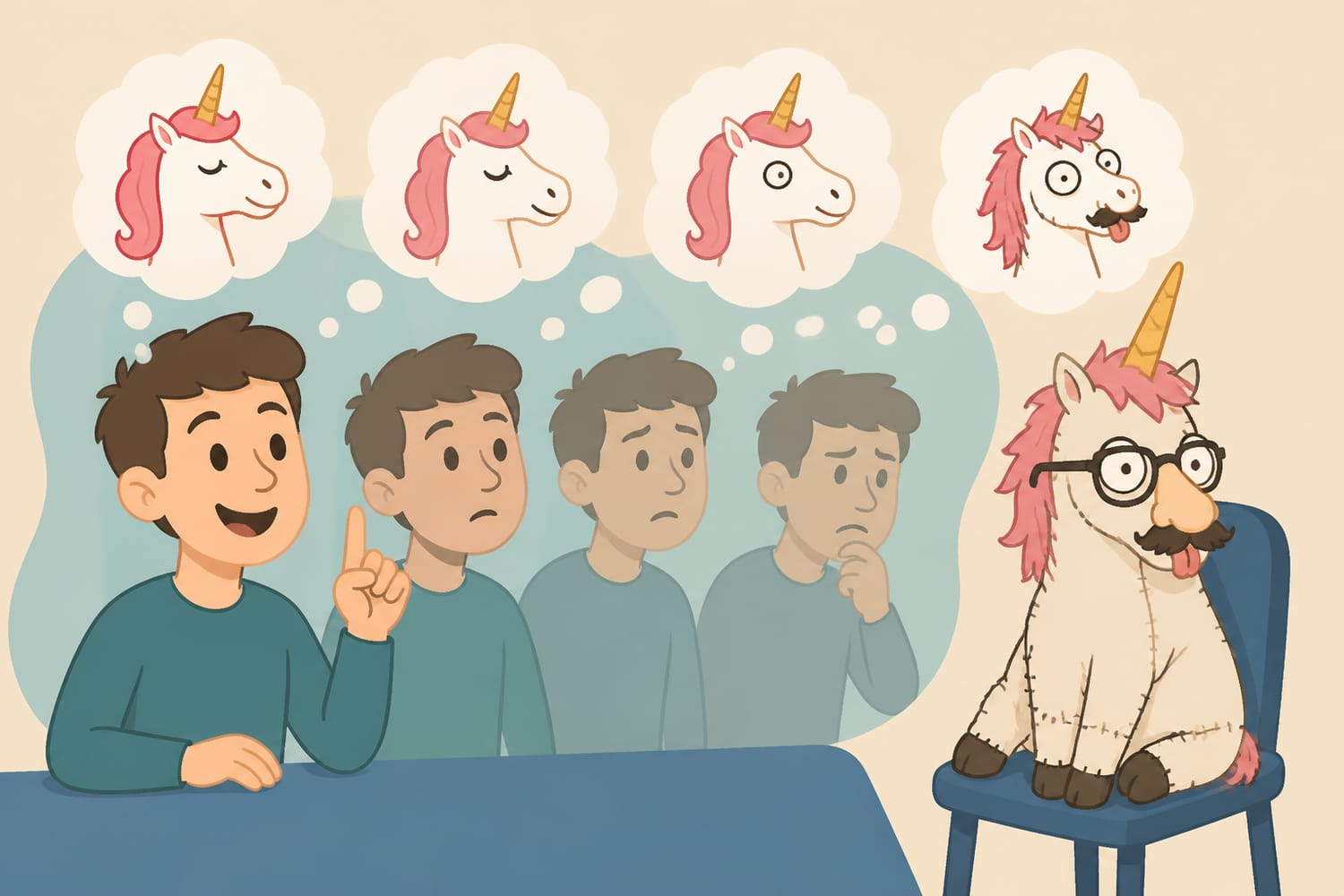
Semantic satiation is the temporary feeling that a familiar word has lost its meaning after repeated use. Say “spoon” over and over, and it may stop feeling like the name of a utensil and start sounding like nonsense. Researchers study this effect, but its exact mechanism remains debated.
Spoon. Spoon. Spoon. Spoooon.
What an unreasonable noise for something you eat soup with.
That little wobble between “perfectly ordinary word” and “surely someone invented this as a joke” is what makes semantic satiation so entertaining. You don’t need an obscure dictionary entry to find linguistic weirdness. Sometimes, you just need to bother a normal word until it becomes suspicious.
Here’s what the phenomenon means, what researchers think might cause it, and how to explore it yourself.
What Does “Semantic Satiation” Mean?
The American Psychological Association’s definition of semantic satiation describes a word seeming to lose its meaning after being repeated many times in rapid succession. Crucially, it seems to lose meaning: the dictionary hasn’t changed, and “spoon” hasn’t officially resigned from English.
The name is less intimidating when you unpack it. Semantic concerns meaning; satiation suggests having had enough. Think of it, loosely, as reaching the “no more, thank you” stage of a word buffet.
That’s a useful image, not a literal account of what your brain is doing. The APA notes that the reasons behind the effect remain poorly understood.
Unlike the unfamiliar vocabulary in these words that look fake but are completely legitimate, the fun here is choosing something almost aggressively ordinary.
“Cabinet” will do. So will “elbow.” No wizard-level vocabulary required.
Try a Little Word-Weirdness Experiment
Want to see what the fuss is about? Here’s an informal demonstration—not a diagnostic test or a guaranteed laboratory procedure.
- Choose a familiar word. Try “spoon,” “window,” “rabbit,” or “paper.”
- Say it repeatedly at a comfortable, steady pace. Aim for roughly 20 to 30 repetitions as a starting point, rather than treating that number as a magic threshold.
- Notice your impression. Does the word still call up its usual meaning? Does its sound suddenly seem ridiculous? Or does nothing much happen?
- Stop and change activities. Then try the word in a normal sentence: “Please pass me a spoon.”
Don’t strain to manufacture a dramatic moment. The interesting question is simply whether your experience of the word changes.
You could also invite a friend to try a different word, then compare descriptions. “It sounded fake,” “I noticed the syllables,” and “I mostly felt silly” are all observations worth recording.
For a playful comparison, try “hippopotamus” and then “cup.” Which one seems stranger afterward? Make a prediction first. Your kitchenware deserves a fair scientific hearing.
Why Might Repetition Make Meaning Fade?
The tempting explanation is that your brain gets tired of the word.
That’s memorable, but too tidy. Researchers have considered several possibilities: changes in processing the word’s form, changes in accessing meaning, or changes in the connection between the two. These explanations aren’t interchangeable.
Imagine a word as a label attached to a mental filing cabinet. There are at least three places a temporary difficulty could arise:
- The label becomes harder to process.
- The information inside becomes less accessible.
- The route from the label to the information becomes less effective.
That filing cabinet is an analogy, of course. There is no tiny office worker inside your head refusing to open the “SPOON” drawer.
One influential study testing an associative explanation supported the third possibility. Its results suggested that repetition could make the connection between a particular word and its meaning less efficient, without requiring either the word representation or the meaning itself to disappear.
Under that account, the problem isn’t that you’ve deleted your knowledge of spoons. It’s more like repeatedly taking the same shortcut until, briefly, that shortcut becomes less helpful.
The important distinction is between describing the experience and explaining its mechanism. “The word feels meaningless” describes what happens. Exactly why it feels that way is the harder scientific question.
How Do Scientists Study Something This Slippery?
Asking someone, “Does ‘cabbage’ sound weird yet?” captures the spirit of the phenomenon. It doesn’t settle what has changed.
Researchers therefore use tasks involving meaning and measure responses. For example, participants might judge whether a target word belongs to a category. In the 2010 associative-account study, responses gradually slowed when the same category label was repeatedly used in a meaning-based task. Other experimental conditions helped the researchers distinguish between competing explanations.
Brain recordings offer another approach. A 2017 study of semantic satiation and the N400 compared words repeated three times with words repeated 30 times. The N400 is an electrical brain response sensitive to semantic relationships. The researchers found a reduced N400 relatedness effect after heavier repetition, supporting an effect involving meaning rather than merely the words’ visual appearance.
That doesn’t mean scientists have located a “words sound fake” button. Earlier findings were inconsistent, and experimental design matters. A good explanation has to account for measurable effects—not just provide a satisfying story about sleepy neurons.
Does It Only Happen When You Speak?
No. Repeated visual presentation can also produce evidence consistent with semantic satiation. In the 2017 experiment, participants silently read words on a screen; they weren’t chanting them aloud.
That makes the phenomenon more interesting than a tongue getting bored with its assignment.
For your own informal comparison, write a familiar word on a card and repeatedly read it silently. On another occasion, try saying it aloud. Note whether the experiences feel alike.
Keep your conclusions modest, though. A home demonstration can help you notice something curious; it can’t identify which stage of language processing caused it. “Window has become a strange object in my mouth” is an excellent description, but not yet a neuroscience paper.
Is This the Same as Forgetting a Word?
There’s a useful contrast between semantic satiation and the tip-of-the-tongue experience.
With lethologica, the frustrating feeling of being unable to remember a word, you’re searching for the expression you want. You might know what the object does while its name refuses to appear.
With semantic satiation, the word is right there—you may be saying it repeatedly—but its usual sense of meaning temporarily weakens.
Put playfully:
Tip of the tongue: “I know the thing. Where’s its name?”
Semantic satiation: “I have the name. Why does it sound like that?”
Neither description should be stretched into a diagnosis. They’re simply two different ways to talk about familiar language experiences.
But Isn’t Repetition Supposed to Help Us Learn?
It’s reasonable to wonder how repetition can make a word both more familiar and temporarily stranger.
The key is not to treat every kind of repetition as the same activity. Rapidly recycling one word in isolation is different from encountering it in a conversation, using it in a sentence, or connecting it with a new example. Semantic satiation research concerns particular tasks and conditions; it doesn’t establish that repetition generally damages learning.
Compare these two activities:
“Spoon, spoon, spoon, spoon, spoon.”
And:
“The wooden spoon is beside the stove.”
The first turns the word into the entire performance. The second gives it a job.
If a word starts feeling peculiar while you’re writing, try taking a short break or reading the whole sentence instead. Treat that as a practical reset to try, not a guaranteed scientific cure.
The Ordinary Word Is the Weird One
You could finish this article by learning a magnificent oddity like “snollygoster.”
Or you could look at a spoon.
Semantic satiation offers a wonderfully small-scale language mystery: repetition can temporarily make a familiar word feel disconnected from the meaning you normally take for granted. The experience has a name, even though its precise explanation remains unsettled.
For a word lover, that’s an excellent excuse to pay attention to everyday language.
Just perhaps not while ordering lunch.
“Soup, soup, soup, soup” is an experiment. It is also a challenging instruction for your server.