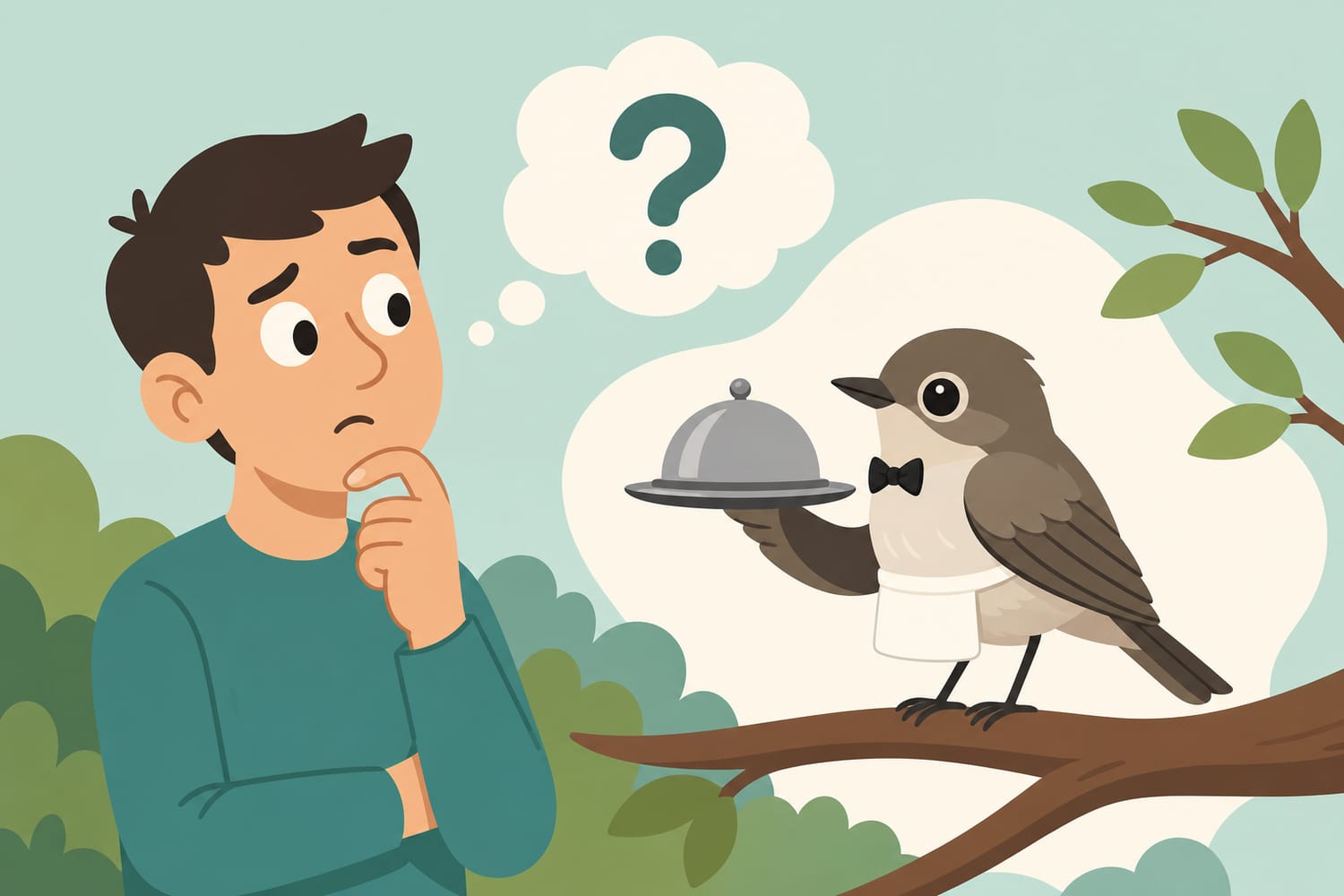
Meet the Word That Sounds Like a Cartoon Villain
A gobemouche is a gullible person—someone who believes almost anything they’re told, especially if it’s ridiculous, dramatic, or delivered with enough confidence.
If your friend forwards you a message claiming that eating twelve bananas under a full moon will improve your Wi-Fi signal, and they ask, “Do you think this is true?”—you may be dealing with a gobemouche.
The word is rare today, but it’s too good to leave buried in the dictionary. It has the charm of an old insult, the elegance of French, and the comic punch of something you might call a person who just fell for a fake “free yacht” email.
In short: a gobemouche is a sucker. A dupe. A credulous soul. A person whose eyebrows rise and mouth falls open at every unbelievable claim.
And the literal meaning? Somehow, it gets even better.
A “Fly-Swallower,” Literally
Gobemouche comes from French, where it is built from two parts:
- gober — to swallow or gulp down
- mouche — fly
So, literally, a gobemouche is a fly-swallower.
Yes, really.
The image behind the word is wonderfully unflattering: imagine someone standing around with their mouth hanging open, so vacant or astonished that flies could wander right in. That open-mouthed look became associated with foolishness, naïveté, and easy belief.
In French, gobe-mouche can also refer to a flycatcher, a type of bird that catches insects. But when applied to a person, the meaning becomes figurative: someone who “swallows” whatever is presented to them—facts, rumors, gossip, scams, tall tales, and possibly flies.
English borrowed the word from French, keeping its sense of a credulous or easily fooled person. It never became common, which is a shame, because “gobemouche” does a lot of work in one strange little package.
How Do You Pronounce Gobemouche?
Because it comes from French, gobemouche may look a bit intimidating at first. A rough English-friendly pronunciation is:
GOHB-moosh
or
gob-uh-MOOSH
The French original is closer to gob-moosh, with a soft, compact sound.
Don’t worry too much about perfect pronunciation. This is not a word you’re likely to hear shouted across a crowded room—though perhaps it should be.
Try saying it aloud:
“Don’t be such a gobemouche.”
It has a lovely rhythm, doesn’t it? Insulting, but classy. Like being hit with a velvet dictionary.
What Kind of Person Is a Gobemouche?
A gobemouche is not necessarily stupid. That’s important.
The word is more about credulity than intelligence. A smart person can be a gobemouche in the right circumstances. Anyone can be fooled by a polished lie, a convincing story, or a rumor that arrives wearing a lab coat.
A gobemouche is someone who tends to:
- Believe gossip without checking it
- Fall for exaggerated claims
- Trust confident people too easily
- Accept stories because they sound exciting
- Forget that “I saw it online” is not the same as “it is true”
- Swallow nonsense whole, like the metaphorical fly-swallower they are
For example:
Malcolm was such a gobemouche that he bought a “haunted toaster” from an online marketplace and insisted it only burned bread on Tuesdays.
Or:
The tabloid relied on gobemouches who would believe every headline about celebrity alien weddings.
It’s a funny word, but it points to a very real human habit: we often believe things not because they are true, but because they are interesting, flattering, frightening, or repeated often enough.
Gobemouches in the Wild
The gobemouche is not extinct. In fact, the modern world may be its ideal habitat.
In earlier centuries, a gobemouche might have believed a traveling salesman’s miracle tonic could cure baldness, heartbreak, and squeaky hinges. Today, the gobemouche might click on a headline that says, “Scientists Discover One Weird Trick to Become Fluent in Dolphin.”
Same creature. New ecosystem.
You can spot gobemouche behavior in many places:
Social Media
A shocking post appears. It includes a blurry image, too many capital letters, and the phrase “THEY don’t want you to know this.” Within minutes, thousands have shared it.
The gobemouche does not pause. The gobemouche reposts.
Office Gossip
Someone whispers that the company is replacing the entire accounting department with parrots trained in spreadsheets. A gobemouche immediately starts updating their résumé.
Scam Emails
“Dear respected winner, you have inherited $18 million from a prince you have never met.”
The gobemouche replies with bank details and a cheerful “How exciting!”
Pseudoscience
A product claims to “detoxify your aura using quantum cucumber energy.” The gobemouche orders three.
Of course, we laugh—but most of us have had gobemouche moments. We’ve believed a fake quote, trusted a rumor, clicked a suspicious link, or repeated something we later wished we had checked.
To be human is to be occasionally gobemouche-adjacent.
A Word with Comic Bite
One of the pleasures of gobemouche is that it sounds playful rather than cruel. Calling someone a “fool” can feel blunt. Calling someone a “gobemouche” sounds like you’re inviting them into a 19th-century drawing room for tea and mild humiliation.
It belongs to a family of delightful old words for gullible or foolish people, such as:
- dupe — someone who has been tricked
- simpleton — a foolish or naïve person
- nincompoop — a silly person
- credulist — someone inclined to believe too readily
- greenhorn — an inexperienced or easily misled person
But gobemouche has a special flavor. It is more visual. You can almost see the person standing there, mouth open, taking in every absurd claim the world throws at them.
It’s not just a label. It’s a tiny cartoon.
Is Gobemouche an Insult?
Yes—but a relatively mild and whimsical one.
If you call someone a gobemouche, you are saying they are too ready to believe things. Depending on context, it can be teasing, literary, or insulting.
Among word lovers, it might land as charming:
“I was a total gobemouche when I believed that fake Shakespeare quote.”
In an argument, it might sound condescending:
“Only a gobemouche would believe that.”
So use it carefully. It’s best deployed with humor, especially when describing yourself, fictional characters, or people who are not currently holding sharp objects.
Why We Become Gobemouches
The word may be old, but the behavior is timeless. Human beings are belief machines. We look for patterns, trust familiar voices, and prefer stories that make sense of chaos.
There are several reasons people become gobemouches:
We Like a Good Story
A boring truth often struggles against an exciting lie. “The bridge was closed for maintenance” is less thrilling than “The bridge was closed because someone found a dragon skeleton underneath it.”
We Trust Confidence
People often mistake certainty for accuracy. If someone says nonsense with enough authority, it can sound suspiciously like expertise.
We Believe What Fits Our Views
If a claim supports what we already think, we are more likely to accept it. The gobemouche inside us loves confirmation.
We’re Busy
Fact-checking takes time. Believing is quick. In a fast-moving world, gullibility can be a side effect of exhaustion.
Recognizing this doesn’t mean we should become cynical about everything. It just means we should keep our inner gobemouche on a shorter leash.
How Not to Be a Gobemouche
The cure for gobemouchery is not suspicion of everything. It’s healthy skepticism.
Here are a few simple habits:
- Ask, “Where did this information come from?”
- Check whether reliable sources are reporting the same thing
- Be cautious with claims that are extremely emotional or sensational
- Watch out for “secret knowledge” language
- Remember that confidence is not proof
- Pause before sharing anything shocking
A useful rule: if something makes you want to react immediately, wait a moment. The gobemouche reacts. The wise person checks.
Or, to put it another way: don’t swallow the fly until you know it’s not bait.
A Few Example Sentences
Want to use gobemouche in real life? Here are some examples:
“I can’t believe I fell for that fake headline. What a gobemouche I am.”
“The con artist made a fortune from gobemouches who believed his invisible umbrella business was real.”
“She was no gobemouche; she asked for evidence before accepting the claim.”
“Every rumor in town eventually found its way to Gerald, the village gobemouche.”
“The advertisement promised eternal youth in a bottle, and the gobemouches lined up eagerly.”
It works especially well in humorous writing, character descriptions, and any situation where “gullible person” feels too plain.
Why Gobemouche Deserves a Comeback
English has no shortage of words for foolishness, but gobemouche deserves more attention. It is vivid, funny, and oddly elegant. It gives us a way to talk about gullibility without sounding completely ordinary.
It also reminds us that people have always worried about credulity. Long before clickbait, conspiracy threads, fake screenshots, and suspiciously generous princes in email inboxes, there were already people swallowing flies—figuratively, at least.
The next time someone believes an outrageous rumor, don’t sigh and call them gullible. Reach for something stranger.
Call them a gobemouche.
Then, ideally, explain what it means—before they believe it’s a rare tropical fish, a medieval soup, or a French superhero with insect powers.