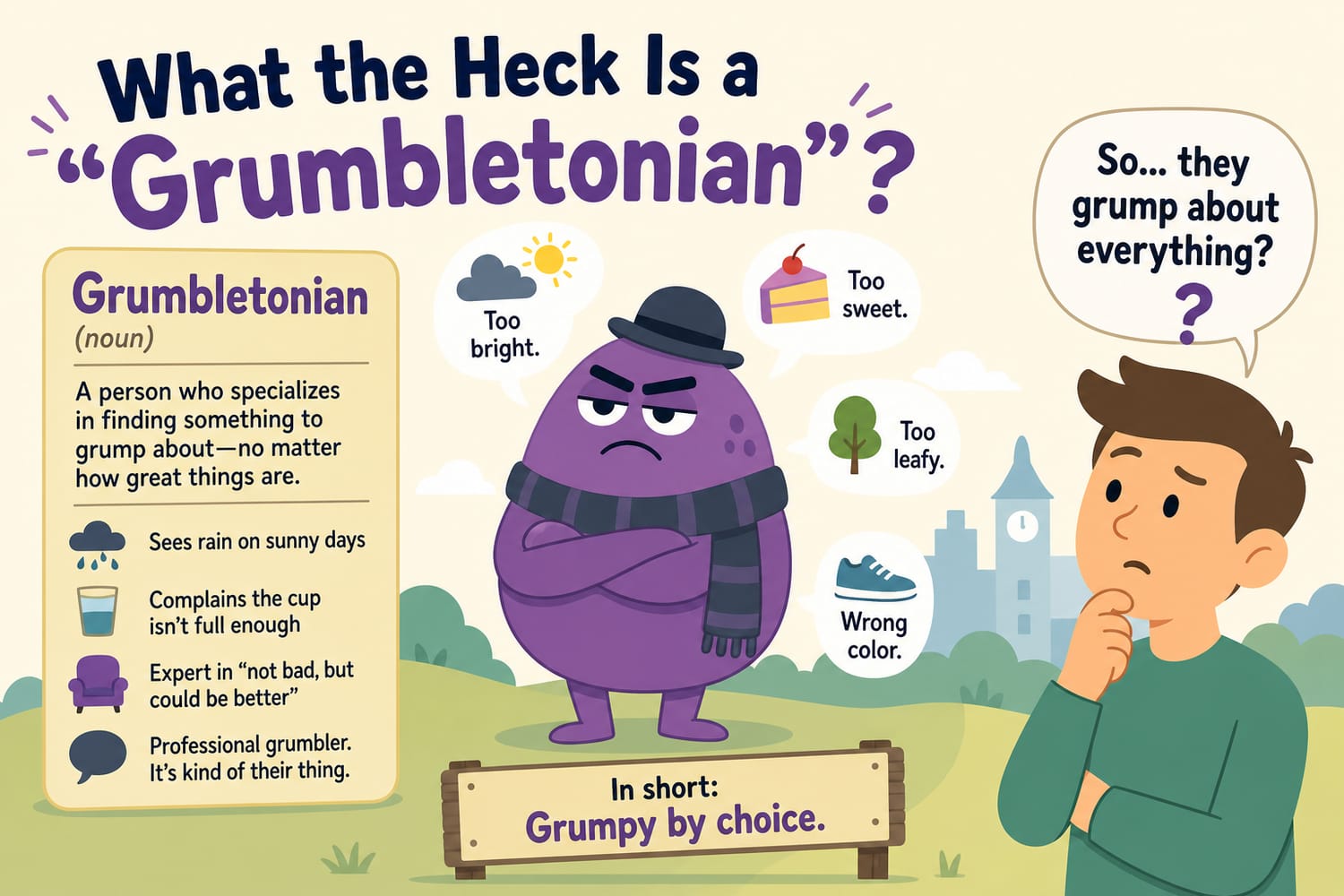
Meet the Grumbletonian
A grumbletonian is a person who grumbles—especially someone who grumbles about politics, public affairs, leaders, taxes, institutions, or the general state of things.
In other words, a grumbletonian is not just someone who says, “This soup is cold.” A grumbletonian is more the sort of person who says, “This soup is cold, and frankly it is a perfect symbol of the decline of civilization.”
It’s a wonderfully lumpy word: grumble-tonian. It sounds like both a citizen of a fictional town called Grumbleton and a member of some gloomy philosophical movement devoted to sighing loudly at breakfast. And that is part of its charm. The word is funny because it sounds official, almost scholarly, while describing a very ordinary human activity: complaining.
In its broadest sense, a grumbletonian is a habitual complainer or discontented person. Historically, though, it had a sharper political flavor. A grumbletonian was someone who was dissatisfied with the government or the people in power—a political malcontent, a critic, a mutterer in the national corner.
So if you’ve ever looked at the news and felt an ancient noise rise in your chest—something between a groan, a sigh, and a speech beginning “Now listen here…”—congratulations. You may have felt the spirit of the grumbletonian.
Where Did “Grumbletonian” Come From?
The word grumbletonian is built on the familiar verb grumble, meaning to complain in a low, muttering, dissatisfied way. The ending -tonian makes it sound like someone from a place, as in Bostonian or Newtonian—though in this case the “place” is imaginary. A grumbletonian is, jokingly, a person from Grumbleton, a land where everyone is forever displeased.
The word appears in English from the late seventeenth century, a period when political language was particularly colorful. English political life after the Civil War, the Restoration, and the Glorious Revolution was noisy, divided, and full of pamphlets. Public argument was everywhere. Coffeehouses buzzed with opinions. Writers traded insults in print. Political nicknames flourished.
In that world, grumbletonian became a handy term for people who complained about the government or the administration of the day. It could be used dismissively: “Oh, don’t listen to him—he’s one of those grumbletonians.” In other words, the word could suggest that someone’s criticism was not noble, principled opposition, but mere chronic grumbling.
That distinction is important. A grumbletonian is not always simply “a concerned citizen.” The word carries a wink. It implies that the person may enjoy complaining a little too much.
A Political Word with a Comic Hat
One of the best things about grumbletonian is that it belongs to a long tradition of humorous political labels. English speakers have always enjoyed turning politics into wordplay. We don’t merely disagree; we invent names for the people we disagree with.
A grumbletonian, historically, was a political grumbler: someone discontented with the powers that be. But the word doesn’t sound harsh or cruel. It sounds theatrical. You can imagine a group of grumbletonians gathering in a candlelit room to draft a manifesto titled Everything Is Worse Than It Used to Be.
That comic tone matters. Compared with words like rebel, radical, traitor, or agitator, grumbletonian is softer and sillier. It suggests annoyance more than revolution. A grumbletonian may complain about the king, Parliament, the prime minister, the mayor, or the local council—but the word pictures someone grumbling into their tea rather than storming the palace.
It is a word for discontent with a waistcoat on.
What Exactly Counts as Grumbling?
To understand grumbletonian, it helps to think about the word grumble itself.
To grumble is not usually to make a clear, ringing complaint. It is more often to complain in a low, murmuring, irritated way. Thunder can grumble. A stomach can grumble. People can grumble when they are hungry, tired, cold, overtaxed, underpaid, or forced to attend a meeting that “could have been an email.”
Grumbling has a sound built into it. The word itself seems to rumble in the throat: grum-ble. It suggests dissatisfaction that has not quite become a shout. It is complaint as background noise.
That makes grumbletonian especially vivid. A grumbletonian is not necessarily a bold public critic delivering polished speeches. They may be the person in the back muttering, “Typical,” every five minutes. They may write letters to the editor. They may post long comments online. They may begin sentences with “I’m not one to complain, but…”—a phrase that almost always means the opposite.
Is Being a Grumbletonian Bad?
Not necessarily.
This is where the word becomes surprisingly interesting. On one hand, grumbletonian can be dismissive. It can mean someone who complains habitually, perhaps unfairly, perhaps without offering solutions. Every office, family, and neighborhood has known this figure: the person who can locate the cloud inside any silver lining.
On the other hand, grumbling is not always pointless. Many social and political improvements begin with dissatisfaction. People notice unfairness. They object to waste, corruption, cruelty, incompetence, or absurdity. They refuse to accept “that’s just how things are” as a final answer.
From the viewpoint of those in power, critics often look like grumbletonians. From the viewpoint of history, some of those grumblers may turn out to have had a point.
So the word depends on tone. If you call yourself a grumbletonian, you might be doing it affectionately: “Yes, I complain, but only because I care.” If you call someone else a grumbletonian, you might be gently teasing them—or accusing them of being professionally dissatisfied.
The line between healthy criticism and habitual grumbling is not always easy to draw. A useful test might be: does the person want things to improve, or do they simply enjoy the performance of displeasure?
How to Use “Grumbletonian” Today
Although grumbletonian is rare today, it is perfectly usable if your audience enjoys unusual words. It has an old-fashioned, comic flavor, which makes it excellent for lighthearted writing.
Here are a few examples:
- “Every neighborhood meeting attracts at least one grumbletonian with strong views about parking.”
- “My uncle is a cheerful grumbletonian: he complains about the government, the weather, and the price of biscuits, but he does it with a twinkle in his eye.”
- “The comments section quickly filled with grumbletonians.”
- “She had the grumbletonian habit of beginning every political discussion with a sigh.”
- “I try not to be a grumbletonian, but the train being late three days in a row has tested my principles.”
You can use it as a noun:
“He is a grumbletonian.”
Or as an adjective:
“The debate took a grumbletonian turn.”
That adjective form is especially fun. A grumbletonian mood, a grumbletonian speech, a grumbletonian letter to the council—all of these suggest complaint with a touch of theatrical gloom.
Grumbletonians in the Digital Age
If the seventeenth century had pamphlets and coffeehouses, we have social media, comment sections, group chats, podcasts, and review sites. In other words, we may be living in a golden age of the grumbletonian.
Modern life gives grumbling endless material. Delayed flights. Software updates. Political scandals. Subscription fees. Packaging that says “easy open” but requires scissors, teeth, and a minor act of faith. Even small frustrations can now be shared instantly with a global audience.
The internet has also blurred the difference between public criticism and everyday irritation. A person can begin the morning complaining about potholes, move on to national policy by lunch, and end the day writing a one-star review of a toaster. The grumbletonian range is vast.
But the word also reminds us to laugh at ourselves. Everyone grumbles. The trick is not to let grumbling become a permanent address. Visit Grumbleton if you must; just don’t buy property there.
Cousins of the Grumbletonian
English has many words for people who complain, each with its own shade of meaning.
A complainer is the plain, everyday term. It is direct but not especially colorful.
A grouch is someone habitually irritable or bad-tempered. The word feels domestic and cartoonish, like a person scowling over the morning paper.
A curmudgeon is often older, stubborn, and crusty, though sometimes lovable. A curmudgeon may complain about modern music, modern manners, modern technology, and possibly modern bread.
A malcontent is more serious. It means someone dissatisfied, especially with existing conditions or authority. It has a political or social edge.
A miserabilist is someone who seems drawn to gloom or negativity, though the term can also describe a bleak artistic style.
A grumbletonian overlaps with all of these but has its own personality. It is political like malcontent, comic like grouch, and old-fashioned like curmudgeon. It is the perfect word for someone whose complaints have become part of their identity—but who remains, somehow, entertaining.
Why This Weird Word Deserves a Comeback
Some rare words survive because they name something rare. Grumbletonian survives, at least in dictionaries and word-lover circles, because it names something extremely common.
We all know a grumbletonian. Many of us are one occasionally. Some of us are one before coffee. The word gives us a playful way to describe a familiar type: the person who is always dissatisfied, especially with public affairs, and who expresses that dissatisfaction in a steady rumble of complaint.
It also has the great advantage of being funny without being vicious. Calling someone a grumbletonian is usually gentler than calling them a crank, bore, or nuisance. It sounds like an invitation to smile at human nature.
And perhaps that is the best use of the word today. It lets us criticize complaining while admitting that complaint is part of life. A world without grumbletonians might be more peaceful, but it might also be less alert, less funny, and much less interesting.
So the next time someone launches into a passionate complaint about taxes, traffic, politics, weather forecasts, or the shocking decline in sandwich quality, you can nod wisely and say:
“Ah. A grumbletonian.”
Just be careful. If you say it too smugly, they may grumble about that too.