Meet the Tiny Moon on Your Nail
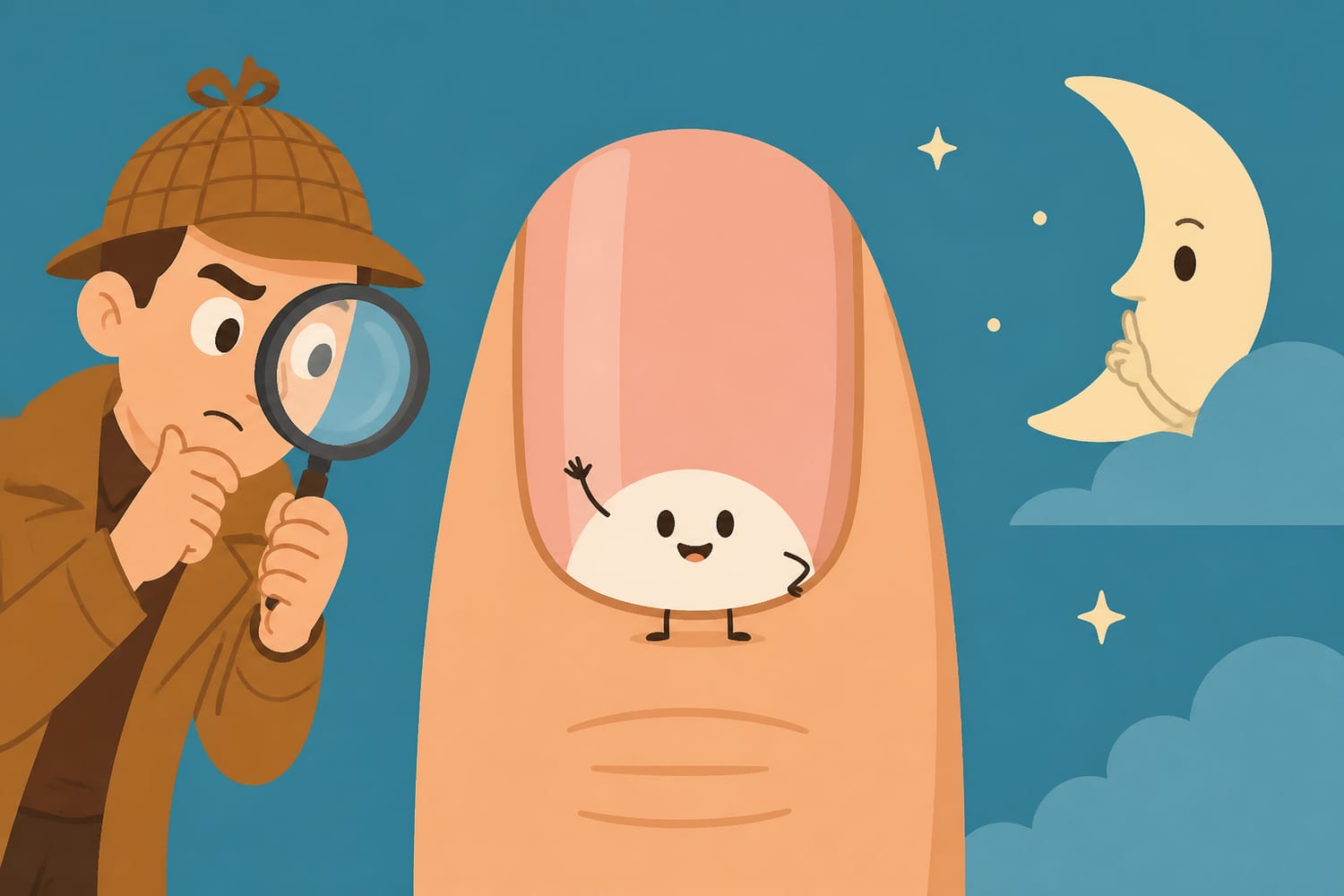
A lunula is the pale, crescent-shaped area at the base of a fingernail or toenail. It is the visible portion of the nail matrix—the tissue that produces the nail plate. Lunulae are usually easiest to spot on the thumbs, although having small, hidden, or seemingly absent ones is often perfectly normal.
Look closely at your thumbnail. See that whitish half-moon near the cuticle? That is your lunula, quietly sitting there with a name that sounds like either a Roman goddess or an expensive piece of patio furniture.
It is pronounced LOO-nyuh-luh, and the plural is lunulae—roughly, LOO-nyuh-lee. You may also encounter the word lunule, which can describe the same crescent-shaped feature. If you would rather hear the pronunciation than attempt linguistic gymnastics, Cambridge Dictionary provides an audio version.
Why Is It Called a Lunula?
The word comes from the Latin lunula, meaning “little moon.” It combines luna, meaning “moon,” with a diminutive ending indicating something small.
It is difficult to argue with the logic. The lunula is small. It looks like a moon. The ancient word-makers nailed this one—an expression that, for once, is almost literal.
The same moon-related root appears in familiar English words such as:
- Lunar, meaning related to the moon
- Lunation, the period between successive new moons
- Lunette, a crescent-shaped object or architectural feature
“Lunula” can also refer more generally to other crescent-shaped structures or markings. However, the fingernail version is the one most people carry around all day without realizing it has a name.
What Exactly Is the Lunula?
To understand the lunula, it helps to forget the idea that your nail is simply one solid object. A nail is more like a tiny construction project involving several different parts.
The hard surface you clip is the nail plate. Under that lies the nail bed, which contains blood vessels that help give much of the nail its pinkish appearance. At the base is the nail matrix, a growth center that produces the cells forming the nail plate.
Most of the matrix is hidden beneath the skin at the base of the nail. The lunula is the portion you can see extending beyond that covering. In other words, it is not a painted-on mark or a separate layer sitting on top of the nail. It is a visible part of the nail’s growth machinery.
The Cleveland Clinic’s guide to nail anatomy explains how the lunula fits alongside structures such as the nail plate, bed, folds, matrix, cuticle, and hyponychium. Yes, your humble fingernail has enough named components to deserve its own organizational chart.
Why Does the Lunula Look White?
Most of your attached nail looks pink because the translucent nail plate allows the blood-rich nail bed beneath it to show through. The lunula looks paler because the tissue and developing nail material in this area are structured differently.
The nail matrix has a relatively thick layer of cells, and the newly forming nail contains cellular material that scatters light. Together, these features make the blood vessels underneath less visible and give the lunula its cloudy white appearance.
So the lunula is not white in quite the same way that white nail polish is white. Its color is largely an optical result of how light passes through—or fails to pass cleanly through—the tissues there.
It is a tiny anatomical special effect.
Is the Lunula the Same as the Cuticle?
No, although the two are close neighbors and are frequently confused.
The lunula is the pale half-moon visible through the nail plate. The cuticle is a thin layer of tissue that seals the gap between the skin and nail plate, helping protect the nail area from germs and irritants.
The cuticle may overlap and hide part of the lunula. The skin fold at the base of the nail can cover it too, which is one reason some people appear to have no lunulae on certain fingers.
This distinction matters during nail care. Aggressively cutting, scraping, or pushing around the base of the nail can damage protective tissue and irritate the nearby matrix. A manicure should not feel like an archaeological excavation.
Why Can You See Some Lunulae but Not Others?
Lunula visibility varies considerably from person to person—and even from finger to finger on the same hand.
Thumb lunulae are often the largest and most obvious. The lunulae on index fingers may also be visible, while those on ring fingers and pinkies can be tiny or completely concealed beneath the skin.
Their appearance can depend on factors such as:
- The natural size and shape of the nail matrix
- How far the matrix extends beyond the proximal nail fold
- The shape of the nail
- The thickness and position of the surrounding skin
- Normal individual anatomy
Researchers note that a detectable lunula may be present on some fingers but not others, depending partly on the length of the matrix and how the nail fold covers it.
That means you do not need ten perfectly matching half-moons. Human anatomy is rarely that committed to symmetry.
Does an Invisible Lunula Mean You Are Unhealthy?
Usually, no.
A lunula may be difficult to see because it is small, naturally pale, or mostly covered by skin. Some healthy people have prominent lunulae on nearly every finger; others can see them only on their thumbs.
The internet occasionally treats fingernails like miniature medical crystal balls. You may encounter claims that absent lunulae automatically prove you have a vitamin deficiency, thyroid problem, poor circulation, or some other condition. Nail changes can sometimes accompany health problems, but lunula visibility alone is not a reliable do-it-yourself diagnostic test.
A single glance at your pinkie is not a substitute for bloodwork, an examination, or medical advice.
Can Changes to the Lunula Matter?
Although natural variation is common, a new or unexplained change deserves more attention than a lunula that has always looked a particular way.
Consider speaking with a healthcare professional if you notice:
- A significant new change in lunula color
- Pain, redness, or swelling around the nail
- A nail separating from the nail bed
- A new or changing dark streak
- Major changes in nail shape, thickness, or growth
- Changes affecting several nails at once
- A persistent abnormality without an obvious cause
Certain illnesses, medications, injuries, and skin conditions can affect the nail matrix or alter the color and appearance of the lunula. That does not mean every unusual half-moon signals disease—only that sudden, persistent changes are worth evaluating in context.
The American Academy of Dermatology offers a useful overview of nail changes that a dermatologist should examine. It also emphasizes that changes to the nails or half-moons do not always indicate an illness.
What Happens If the Nail Matrix Is Injured?
Because the lunula is part of the visible matrix area, an injury near the base of the nail can affect how the nail grows.
Crushing a fingertip, repeatedly picking at the base of the nail, or receiving an overly aggressive manicure may disturb the matrix. The resulting nail can develop a groove, ridge, split, or irregular texture. Minor damage may simply grow out, while a severe matrix injury can cause longer-lasting changes.
Patience is required because nails are not known for their speed. Fingernails generally grow about three millimeters per month, and replacing an entire fingernail can take at least six months. Toenails grow more slowly and may require 12 to 18 months for full regrowth.
Your nail may therefore preserve evidence of an old injury long after you have forgotten shutting your finger in that drawer.
A Few Lunula Facts for Your Next Trivia Emergency
Need to rescue a conversation from awkward silence? Deploy one of these:
- “Lunula” literally means “little moon.”
- The plural is “lunulae.”
- It is the visible portion of the nail matrix.
- It is generally easiest to see on the thumbs.
- Not seeing one on every finger is often normal.
- Fingernails and toenails can both have lunulae.
- The lunula is not the cuticle.
Will these facts make you the most popular person at a party? Results may vary. But they will make you the person staring knowledgeably at everyone’s thumbnails.
Another Name for Something You See Every Day
The lunula belongs to a delightful family of words that label ordinary things we rarely think to name. The groove beneath your nose is your philtrum. The holder around a hot drink can be called a zarf. And the tiny moon on your nail is your lunula.
Words like these make the familiar world feel newly detailed. Nothing about your hand physically changes when you learn “lunula,” but suddenly your nail is no longer just a nail. It has a plate, a bed, a matrix, a cuticle, and a moon.
That is the joy of exploring weird words hiding in everyday life: they reveal that even the most ordinary objects are full of features, stories, and surprisingly elegant names.
The Final Word on the Lunula
The lunula is the pale crescent at the base of your nail and the visible part of the matrix responsible for producing the nail plate. Its appearance varies naturally, with the largest and clearest examples commonly found on the thumbs.
Its name may sound mysterious, but its meaning could hardly be simpler: little moon.
So the next time you trim your nails, pause for a moment and admire the miniature moons at your fingertips. They have been there all along—quietly helping reveal where your nails begin, waiting patiently for someone to learn their wonderfully lunar name.