A Word That Sounds Like It Fell Down the Stairs
Some words enter a room politely. Others burst through the door wearing a hat, juggling spoons, and shouting nonsense. Quockerwodger is one of the second kind.
At first glance, it looks invented—like something a Victorian child might yell during a game of make-believe, or a creature from a forgotten Dr. Seuss draft. But quockerwodger is a real word, and a wonderfully weird one at that.
Pronounced roughly KWOK-er-WOD-jer, a quockerwodger originally referred to a wooden puppet or toy figure whose limbs jerked about when pulled by a string. Picture a little jointed figure, maybe roughly carved, flailing its arms and legs in a frantic dance whenever someone tugged the mechanism.
That image is already delightful. But the word gets even better.
Over time, quockerwodger also became a political insult. It came to describe a person—especially a politician—who appears to act independently but is actually being controlled by someone else. In other words: a puppet.
So if you’ve ever watched a public figure make a dramatic speech and thought, “Hmm, I wonder who’s really pulling the strings here,” congratulations: you have understood the spirit of quockerwodger.
The Puppet Behind the Word
The literal meaning of quockerwodger is the key to its charm.
Before screens, batteries, and app-controlled toys, entertainment often came in the form of simple mechanical figures. A child might have a wooden doll or puppet with loose limbs attached by string. Pull the string, and the figure would jerk, wobble, kick, and wave in an exaggerated way.
That jerky movement is important. A quockerwodger wasn’t a graceful ballerina puppet. It was more of a ridiculous flailing thing, moving not because it wanted to, but because it had been yanked into motion.
The word belongs to the world of old-fashioned toys, street amusements, and comic performance. It feels physical. You can almost hear the rattle of the wooden joints and see the puppet’s little arms snapping upward.
That is probably why the metaphor worked so well. A person called a quockerwodger is not just controlled—they are visibly, awkwardly controlled. They move, speak, and act, but the real force comes from elsewhere.
It’s a funny word, but it carries a sharp little jab.
From Toy Box to Politics
Language loves a good puppet metaphor. We still call people “puppets” today when we mean they are controlled by a more powerful person or group. Quockerwodger is an older, more colorful version of that idea.
In political slang, a quockerwodger is someone who holds a position, gives speeches, signs papers, and seems important—but is really following instructions. The person may have the title, the costume, and the stage presence, but someone else has the strings.
This made the word especially useful in satire. British political writing in the 19th century had a great appetite for comic insults, and quockerwodger fits beautifully into that tradition. It sounds ridiculous enough to make readers smile, but the meaning is pointed enough to leave a mark.
Calling someone a “puppet” is direct. Calling someone a “quockerwodger” is more theatrical. It suggests not just obedience, but a kind of absurd, jerking performance.
Imagine a cartoon of a pompous official waving his arms while a shadowy figure behind the curtain tugs strings attached to his wrists. That official is not merely influenced. He is quockerwodgering.
Yes, that should be a verb. No, it probably isn’t one. But it feels like it ought to be.
Where Did “Quockerwodger” Come From?
Here is where things become slightly mysterious.
Quockerwodger is generally recorded as a 19th-century British English word, but its deeper origin is uncertain. That uncertainty is common with old slang and dialect words. Many such words lived in speech before anyone wrote them down, and by the time they appear in print, their beginnings may already be foggy.
The word’s shape suggests a playful or dialectal formation. It has the bouncy, lumpy feel of a word built for sound as much as meaning. The first part, quocker, may evoke jerking, quaking, or wobbling movement, though we should be careful not to claim a definite origin where there isn’t one. The second part, wodger, is equally odd and may simply contribute to the comic force of the whole.
In short: we know what it meant, but we do not know with certainty exactly how its pieces came together.
And honestly, that suits the word. A term as strange as quockerwodger almost deserves a slightly shadowy past. It belongs to the linguistic attic: dusty, wooden, jointed, and still able to startle you when pulled into the light.
Why the Word Works So Well
Part of the fun of quockerwodger is that the sound matches the image.
Say it out loud: quockerwodger.
It clunks. It wobbles. It has too many moving parts. The word itself seems to jerk at the elbows.
That is an example of what people sometimes call sound symbolism: the sense that a word’s sound somehow suits its meaning. Not all words work this way, of course. There is nothing especially “table-like” about the sound of table. But with comic or descriptive words, sound can do a lot of heavy lifting.
Consider words like:
- flibbertigibbet — a flighty or chattering person
- skedaddle — to run away quickly
- gobbledegook — confusing or meaningless language
- thingamabob — an unnamed object
- ragamuffin — a scruffy person, especially a child
These words are memorable partly because they are fun to say. Quockerwodger belongs to the same family of verbal oddballs. It’s not sleek. It’s not dignified. It is a word with elbows, knees, and probably a squeaky hinge.
That makes it perfect for ridicule. If you call someone a quockerwodger, the insult begins before the definition even arrives.
Is “Quockerwodger” Still Used Today?
Not much—but that’s part of its appeal.
Quockerwodger is rare and largely obsolete. You are unlikely to hear it in everyday conversation unless your friends are historical lexicographers, word nerds, or unusually theatrical political commentators.
But rare words have a special kind of usefulness. They can name something familiar in a fresh way. We all understand the idea of a person controlled by others. We have words for it: puppet, figurehead, mouthpiece, stooge. But quockerwodger adds color and comic exaggeration.
A figurehead may be blandly symbolic. A stooge may be foolishly obedient. A puppet may be controlled.
But a quockerwodger? That person is flapping about on strings, and everyone can see it.
You could use it today in a sentence like:
“The minister claimed the decision was entirely his own, but critics dismissed him as a quockerwodger for party leadership.”
Or, less formally:
“Every group project has one person who acts like the boss but is clearly a quockerwodger for whoever made the spreadsheet.”
That second example may be too real.
Quockerwodgers in Everyday Life
Although the word has a political flavor, quockerwodgers are not limited to government. The concept can show up anywhere people perform authority while someone else quietly directs the action.
You might find a quockerwodger in the office: the manager who announces “their” new policy, even though everyone knows it came straight from corporate headquarters.
You might spot one in a club or committee: the official leader who waits for a nod from the real decision-maker before saying anything.
You might even find one in social life: the friend who insists they made the plan themselves but somehow always chooses exactly what their partner, parent, or more forceful friend wanted.
To be clear, we all take advice, follow rules, and respond to pressure. That does not automatically make someone a quockerwodger. The word is most fitting when there is a mismatch between appearance and reality—when someone looks independent but is obviously being operated from behind the curtain.
A quockerwodger performs autonomy. The strings tell another story.
Why Weird Words Matter
It’s tempting to treat words like quockerwodger as mere curiosities: fun to collect, but not especially useful. Yet weird words often preserve little pieces of history.
This one reminds us of old toys, old political insults, and the long human habit of mocking people in power. It also shows how metaphors travel. A child’s wooden puppet becomes a symbol for manipulation. A toy-box image becomes a political jab. A silly-sounding word ends up carrying a surprisingly precise meaning.
Words like this also make language feel alive. English is not just a neat system of practical labels. It is a crowded museum, a junk drawer, a costume shop, and a playground. Some words are polished tools. Others are antique contraptions with springs sticking out.
Quockerwodger is definitely one of the contraptions.
And while you may not need it every day, having it in your vocabulary gives you a wonderfully specific way to describe a very recognizable character: the person who struts across the stage, unaware—or perhaps pretending not to notice—that someone else is holding the strings.
The Final Tug of the String
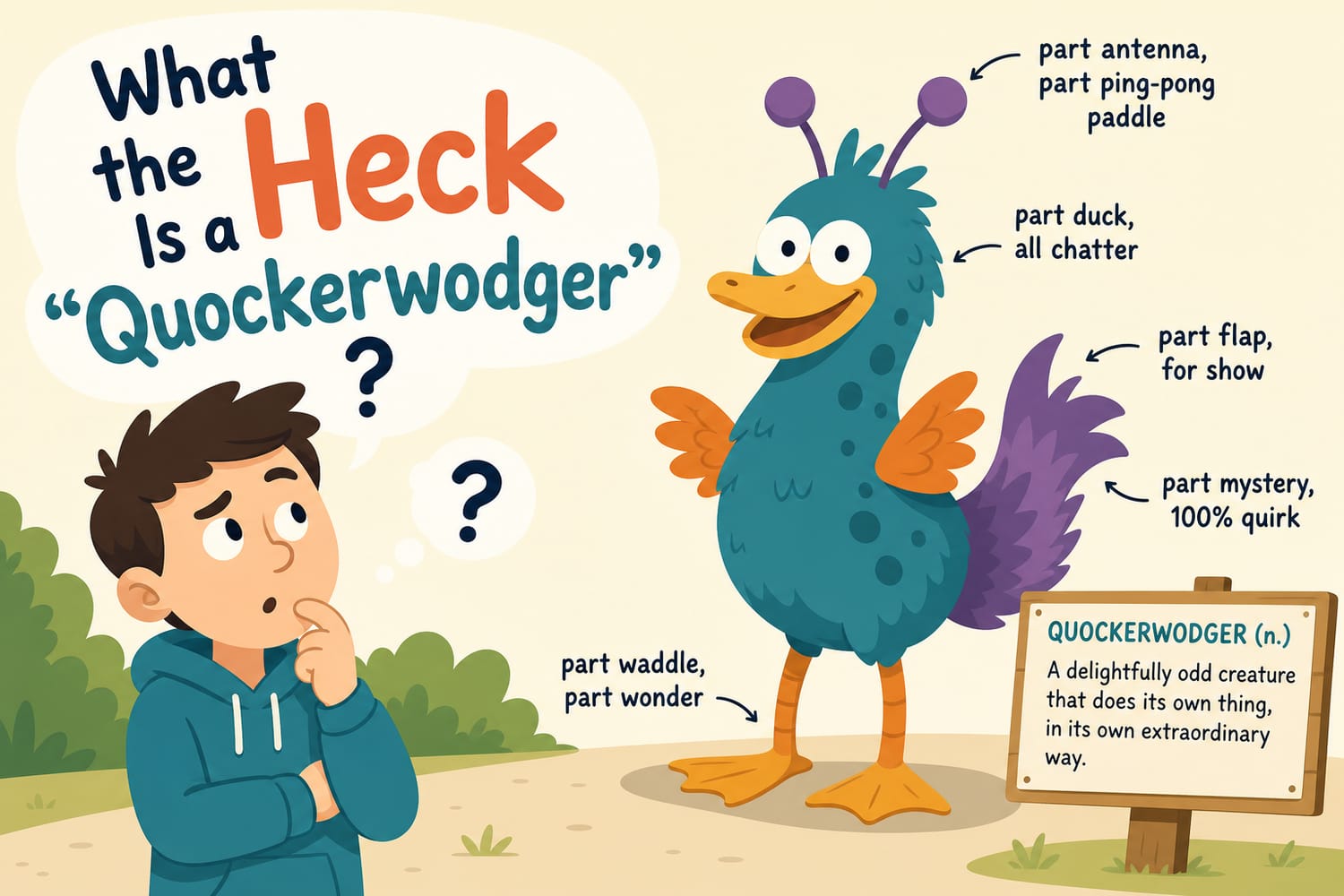
So, what the heck is a quockerwodger?
It is, first, a jerky wooden puppet moved by strings. It is also, by extension, a person—especially a political figure—who appears to act independently but is really controlled by someone else.
It’s rare. It’s old-fashioned. Its origin is uncertain. And it sounds like a duck tripping over a toolbox.
But it is also vivid, funny, and surprisingly useful. The next time you see someone loudly claiming authority while obviously waiting for instructions from offstage, you don’t have to settle for “puppet.”
You can reach into the grand attic of English and say:
“That, my friends, is a quockerwodger.”