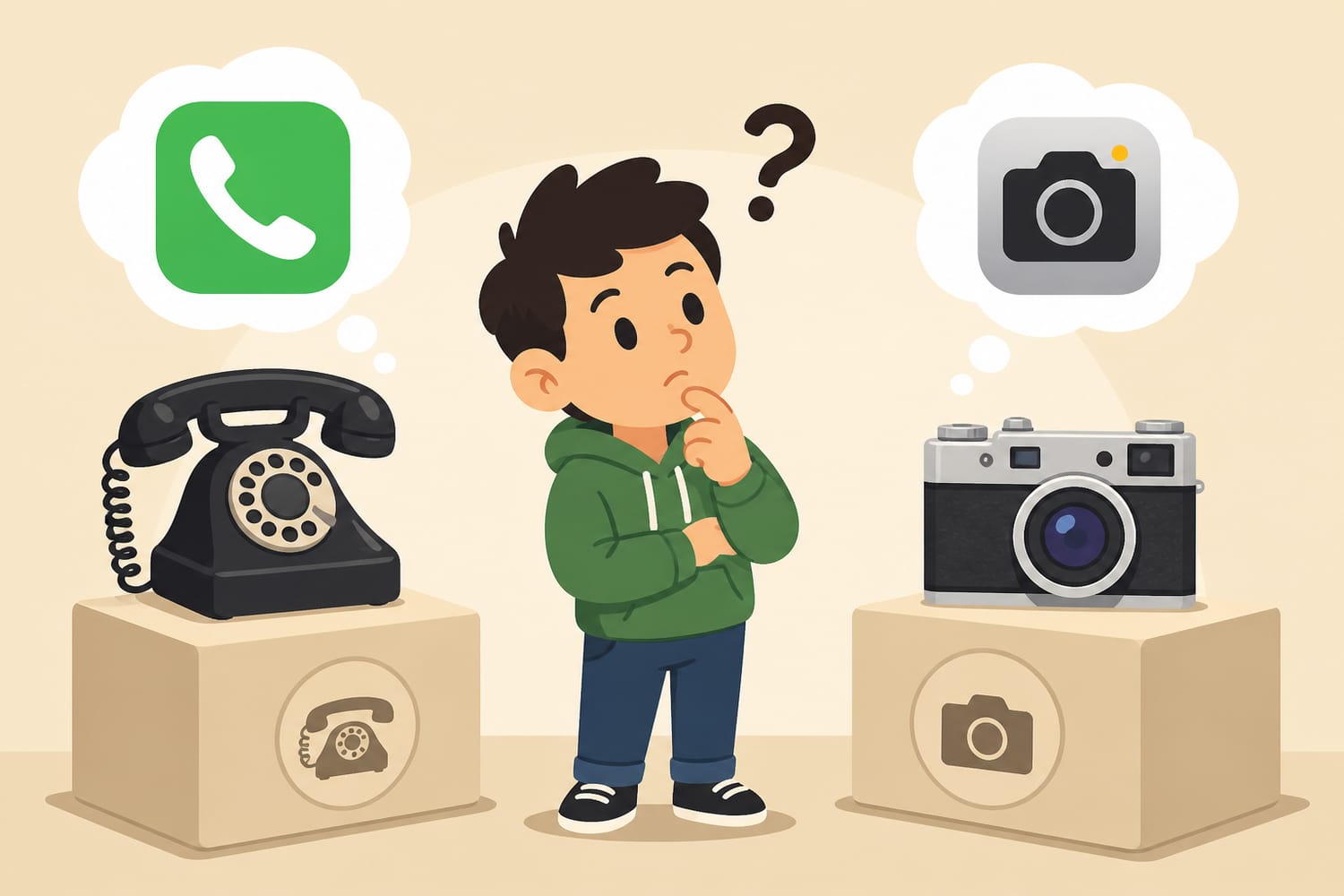
A skeuomorph is a design feature that copies something from an older object or another material, even though the copied detail is no longer necessary for construction or operation. Think of imitation stitching molded into plastic: the material does not need sewing, but it wears the stitches anyway.
In other words, it is design saying, “We’ve always looked like this, and we’re not changing outfits now.”
The word looks intimidating, but the idea is wonderfully familiar. Once you know what to look for, an ordinary object can become a tiny mystery: Why does this have pretend seams? What is that decorative bump copying? And why does a digital notebook need anything resembling a leather cover?
Welcome to the peculiar world of things that remember being other things.
First, How Do You Say It?
Pronounce skeuomorph roughly “SKYOO-uh-morf.” The first syllable rhymes with skew. Collins’s dictionary entry provides the pronunciation, definition, and Greek roots.
Those roots are skeuos, meaning “vessel” or “implement,” and morphē, meaning “shape” or “form.” The word is generally credited to physician and antiquarian Henry Colley March, who introduced it in 1889 while discussing ornament. So, despite its association with computer screens, this is a nineteenth-century word built from ancient Greek parts.
A few related forms are useful:
- Skeuomorph: the object or copied feature.
- Skeuomorphic: the adjective describing it.
- Skeuomorphism: the practice or principle of using such features.
You do not need to memorize all three immediately. Start with the noun. It already sounds impressive enough to require its own presentation remote.
Before Apps, There Was Pottery
Skeuomorphs were around long before anyone worried about arranging icons on a phone.
A classic archaeological example is a pottery vessel decorated with imitation metal rivets. Rivets can fasten parts of a metal object together; a rivet-shaped mark on pottery may simply reproduce that familiar construction detail. The appearance has traveled into a material that does not need the original fastening method.
Other examples include ceramic patterns imitating basketry and stone architecture echoing wooden construction. In each case, a maker carries a recognizable appearance across a change in material.
Imagine commissioning a clay container and asking for it to look like a woven basket. The clay can hold its shape without woven fibers, but the basket-like appearance may still be exactly what you want.
That distinction matters: a copied feature can be unnecessary for construction without being meaningless. Archaeological research treats skeuomorphs as more than technological leftovers; their resemblance to familiar objects can help communicate value, identity, or continuity.
The material changes. The visual family resemblance stays.
Everyday Objects Playing Dress-Up
You do not need access to an archaeological excavation to understand the idea. More recent manufactured objects provide plenty of examples.
Anthropologist Nicholas Gessler describes plastic objects with molded screw heads, textile-like textures, and imitation stitching. These details reproduce features associated with other materials or manufacturing methods, even when the plastic itself does not require them.
The stitching example is particularly satisfying. A sewn seam helps join pieces of fabric or leather. A molded line pretending to be stitches can suggest the same craftsmanship without anyone having threaded a needle.
Other documented examples include faux wood finishes on automobiles and cork-like patterns on plastic bottle stoppers. The replacement material borrows the familiar surface appearance of its predecessor.
It is important to identify the copied detail, rather than declare the whole object useless. A plastic stopper still stops a bottle. Its imitation cork pattern is the skeuomorphic part.
For a useful contrast, consider what a ferrule does. That little band around a tool or brush can perform genuine structural work. Looking decorative and being merely decorative are not necessarily the same thing.
Why Your Screen Borrows From the Physical World
In digital design, skeuomorphism commonly describes interfaces that imitate physical objects. A digital folder resembles a paper folder; a trash-bin icon borrows the idea of a physical wastebasket; a floppy-disk symbol represents saving a file.
The computer does not need actual stationery. The resemblance gives people something recognizable to work with.
Nielsen Norman Group’s explanation of skeuomorphism distinguishes between two uses of the term: borrowing familiar objects as learning aids and using elaborate, realistic decoration as a visual style. Those overlap, but they are not identical.
That second sense produced some especially committed digital impersonations. Early reading apps displayed books on virtual shelves, while note-taking interfaces imitated paper, bindings, and other physical details. An academic discussion of digital skeuomorphism likewise points to app bookshelves decorated with simulated wood grain and leather-like features.
A real bookshelf has to support books. A virtual bookshelf mainly has to persuade your eyes that “your books live here.”
No dusting required.
Is Skeuomorphism Helpful—or Just Fake Leather?
The sensible answer is: it depends on what the borrowed detail accomplishes.
Familiar objects can help people approach unfamiliar technology. Gessler describes skeuomorphs as material metaphors that offer cues in new territory, while also warning that those borrowed cues can sometimes lead us astray.
Imagine a digital control designed to resemble a physical dial. If the resemblance helps explain how to adjust it, excellent. If operating it requires awkwardly imitating a real-world movement when a simple input would work better, the costume may be getting in the way.
The useful question is not “Does this look realistic?” It is “Does this resemblance help?”
A recognizable form can provide reassurance, communicate purpose, or simply offer an appearance people enjoy. But copying every limitation of the original object would be a peculiar way to celebrate a new medium. Research on pottery skeuomorphs similarly emphasizes that copied attributes can change function or become less functional through successive copying.
Think of the old design as a helpful introduction—not necessarily a permanent instruction manual.
Didn’t Flat Design Get Rid of All That?
Not quite.
A major historical milestone came on June 10, 2013, when Apple unveiled iOS 7. Apple emphasized cleaner typography, simplicity, translucency, motion, and functional layers in its redesigned interface.
But reducing realistic decoration does not automatically remove every reference to physical objects. A flat drawing of a folder still refers to a folder. Nielsen Norman Group notes that familiar object-based icons have continued beyond the heyday of heavily textured interfaces.
That gives us a useful distinction:
- Visual realism: How much does the image look like an actual object?
- Borrowed meaning: Does the design rely on our understanding of that object?
A design can drop the shadows, stitching, and glossy finish while keeping the underlying metaphor. The leather jacket comes off; the family resemblance remains.
A Three-Question Skeuomorph Hunt
Want to try spotting one? Ask:
What is this detail copying?
Look for a recognizable object, material, or construction method.Was that feature useful in the original?
Think stitching that joined fabric or rivets that fastened metal.Does the new version need it in the same way?
If not, you may have found a skeuomorph.
Treat this as a practical starting point, not an infallible scientific test. Scholars use the term with different emphases, and copied forms can retain, lose, or acquire functions.
It is the same pleasure as learning that those comic-book swearing symbols are called grawlixes: something recognizable suddenly gets a name.
And skeuomorph gives you more than a fancy label. It gives you a question worth carrying around: What older thing is this newer thing remembering?
Sometimes, apparently, progress likes to keep the stitching.