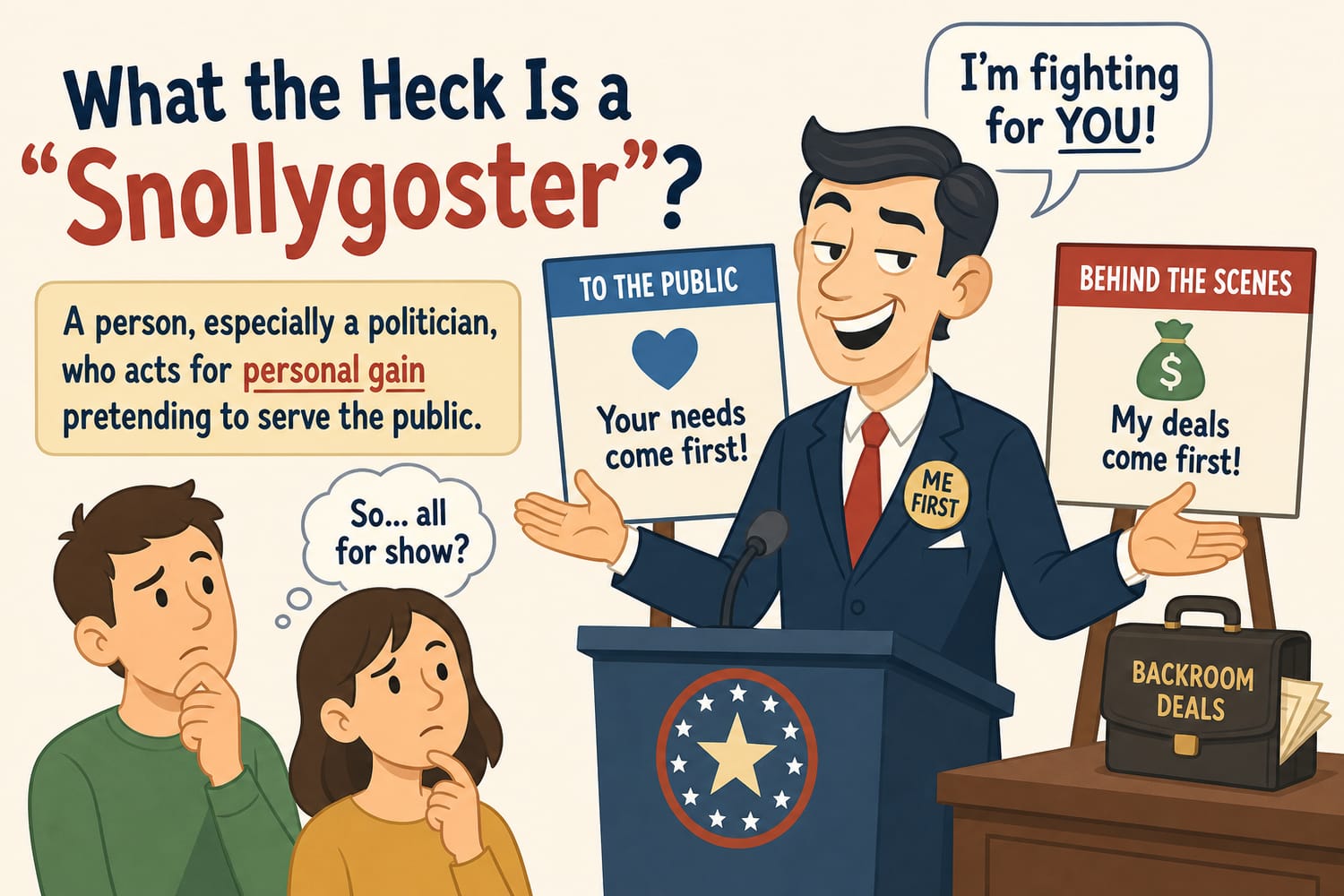
Meet the Snollygoster: A Word With a Wicked Grin
A snollygoster is a clever, unprincipled person, especially the kind who will say or do whatever it takes to get ahead.
In plain English: a snollygoster is a slippery operator. A schemer. A shameless opportunist. The sort of person who treats principles like a hat: useful when it suits the weather, easily changed when it does not.
The word is most often used in politics, where it refers to someone who wants power, office, influence, or applause and is not too bothered by consistency, honesty, or moral backbone. But you do not have to work in government to qualify. A snollygoster could be found in business, school committees, office politics, neighborhood disputes, or anywhere ambition and flexible ethics meet for coffee.
Pronunciation varies a little, but a common version is:
SNAH-lee-goss-ter
It looks ridiculous. It sounds like a cartoon villain. And yet it describes a very real human type.
That is the magic of weird words: sometimes the strangest term is the most precise.
So What Does “Snollygoster” Actually Mean?
The standard definition of snollygoster is:
A shrewd, unprincipled person, especially a politician.
Let’s unpack that.
A snollygoster is not necessarily foolish. In fact, the word often suggests the opposite. This person may be clever, persuasive, and socially skilled. They know how to read a room. They understand what people want to hear. They can change tone, promise, position, and loyalty with impressive speed.
The problem is not intelligence. The problem is character.
A snollygoster is someone whose cleverness is not anchored by principle. They are guided less by “What is right?” and more by “What will work for me?”
For example:
- A politician who supports an idea only when it becomes popular? Possible snollygoster.
- A manager who takes credit for a team’s work and blames others when things go wrong? Snollygoster behavior.
- A public figure who changes beliefs dramatically depending on the audience? Snollygoster-adjacent, at the very least.
- A person who flatters everyone in private and betrays everyone in public? Get the snollygoster net.
The word is funny, but the behavior it describes can be deeply frustrating. A snollygoster is not merely annoying; they are often effective. That is what makes them dangerous. They do not stumble into influence. They wiggle into it.
A Very American Weird Word
Snollygoster is an American word, and like many colorful Americanisms, it seems to have emerged in the 19th century.
Its exact origin is uncertain, which is a polite way of saying that word historians have looked under the linguistic couch cushions and still have not found a definitive answer. The term appears in American English as political slang, and by the late 1800s it was being used to mock unprincipled office-seekers and public figures.
That historical setting makes sense. The 19th-century United States was a lively age for political insults. Newspapers were partisan, speeches were theatrical, and writers loved a good verbal poke in the ribs. A word like snollygoster fit right in: comic, memorable, and sharp enough to leave a mark.
It belongs to the same grand tradition as other flamboyant American insults and oddities. English has always had dignified words like “opportunist” and “hypocrite,” but sometimes those feel too tidy. Snollygoster adds a little mud on the boots. It sounds like something shouted from a porch, printed in a fiery newspaper column, or muttered by someone who has seen one too many campaign promises evaporate.
Is It Related to the “Snallygaster”?
If you are a fan of folklore, the word snollygoster may remind you of snallygaster, and you are not alone.
A snallygaster is a legendary creature from American folklore, especially associated with Maryland. It is usually described as a terrifying, dragon-like or bird-like monster. The name is often said to have roots in German-influenced folklore, though the details are murky and wrapped in legend.
So, are snollygoster and snallygaster related?
Maybe. Maybe not.
Some dictionaries and word historians suggest that snollygoster may have been influenced by or connected to snallygaster, but the evidence is not perfectly clear. Both words have that same odd, lumpy, monster-ish sound. Both feel like they crawled out of a swamp wearing a suspicious smile. But we cannot say with certainty that one directly produced the other.
Still, the possible connection is delightful. A snallygaster is a mythical monster that swoops down from the sky. A snollygoster is a political monster that swoops down on opportunity.
One has wings. The other has talking points.
Why “Snollygoster” Is Better Than “Hypocrite”
English already has plenty of words for people with questionable principles. So why bother with snollygoster?
Because it fills a very particular gap.
A hypocrite says one thing and does another.
An opportunist takes advantage of circumstances.
A demagogue appeals to people’s emotions and prejudices to gain power.
A schemer plots.
A fraud deceives.
A snollygoster can contain bits of all of these.
The word suggests not just dishonesty, but a kind of agile shamelessness. A snollygoster is not merely inconsistent; they are professionally, almost artistically inconsistent. They seem to have no fixed center except self-advancement.
There is also humor in the word, and that matters. Calling someone “an unprincipled opportunist” sounds like a committee report. Calling someone a snollygoster sounds like you have both made your point and enjoyed yourself.
That comic energy softens the insult just enough to make it usable in conversation, while still landing the criticism.
Compare:
“He is a morally unmoored political opportunist.”
Accurate, perhaps. But a little heavy.
Now try:
“He is a grade-A snollygoster.”
Much better. You can practically hear the banjo sting.
How to Use “Snollygoster” in a Sentence
The word may be old-fashioned, but it is surprisingly easy to use. It works best when you want to criticize someone’s lack of principles with a lighthearted sting.
Here are a few examples:
- “The debate was less about policy and more about which snollygoster could dodge the question fastest.”
- “She promised reform, then hired all her friends. Classic snollygoster move.”
- “Every office has at least one snollygoster who agrees with whoever is currently in charge.”
- “I do not mind ambition, but I do mind snollygosters pretending it is virtue.”
- “The town meeting was going well until a local snollygoster discovered a microphone.”
The plural is simple:
snollygosters
As in:
“The committee was overrun with snollygosters, windbags, and one man who kept asking about parking.”
You can also use it playfully, but be careful. It is still an insult. If you call your friend a snollygoster because they took the last slice of pizza after saying they were “too full,” that is probably fine. If you call your boss a snollygoster during a performance review, please do not blame the dictionary.
The Anatomy of a Snollygoster
How can you spot a snollygoster in the wild? Look for these classic signs.
First, the snollygoster has convenient convictions. Their beliefs always seem to line up with whatever benefits them at the moment. Yesterday’s “deeply held principle” becomes today’s “complicated issue.”
Second, the snollygoster is skilled at strategic friendliness. They are warm, charming, and attentive when they need something. Once they have it, their calendar mysteriously fills.
Third, the snollygoster often uses foggy language. They rarely answer a direct question directly. Instead, they pivot, reframe, praise the question, question the question, or explain why now is not the time for questions.
Fourth, the snollygoster has a remarkable ability to survive contradiction. If confronted with their own earlier words, they may insist they were misunderstood, misquoted, evolving, joking, speaking metaphorically, or taken out of context by enemies who fear their vision.
Finally, the snollygoster usually possesses ambition without embarrassment. Ambition itself is not bad. Many admirable people are ambitious. The snollygoster’s flaw is that ambition outranks loyalty, truth, fairness, and sometimes basic decency.
In short: if a weather vane could talk and run for office, it might be a snollygoster.
Why the Word Still Matters
You might think snollygoster is just a dusty antique from old American newspapers. But the concept is as fresh as ever.
Modern life gives snollygosters endless places to thrive. Politics, social media, corporate culture, celebrity branding, and online influence all reward people who can adapt quickly and speak persuasively. Sometimes flexibility is a virtue. Sometimes it is just a costume for having no principles.
That is why words like snollygoster remain useful. They help us notice patterns. They give us a label for behavior that might otherwise slip by under smoother names like “pragmatism,” “networking,” or “personal branding.”
Of course, we should use the word responsibly. Not everyone who changes their mind is a snollygoster. Changing your mind because you learned something new is healthy. Compromise can be wise. Adaptability is often necessary.
The snollygoster is different. The snollygoster does not change because of evidence, empathy, or reflection. The snollygoster changes because the wind did.
A Word Worth Bringing Back
Snollygoster is weird, musical, and wonderfully specific. It sounds silly enough to make people smile, but it carries a serious meaning: a warning about clever people without principles.
It is also a reminder that language can be both useful and fun. We do not always need the plainest word. Sometimes we need the word with elbows. The word that makes corruption sound as ridiculous as it often is. The word that turns a slippery character into something almost visible: a grinning little creature made of ambition, charm, and smoke.
So the next time you encounter someone who treats truth like a prop, loyalty like a rental car, and principles like optional accessories, you will know what to call them.
Not just a schemer.
Not just an opportunist.
Not just a hypocrite.
A snollygoster.