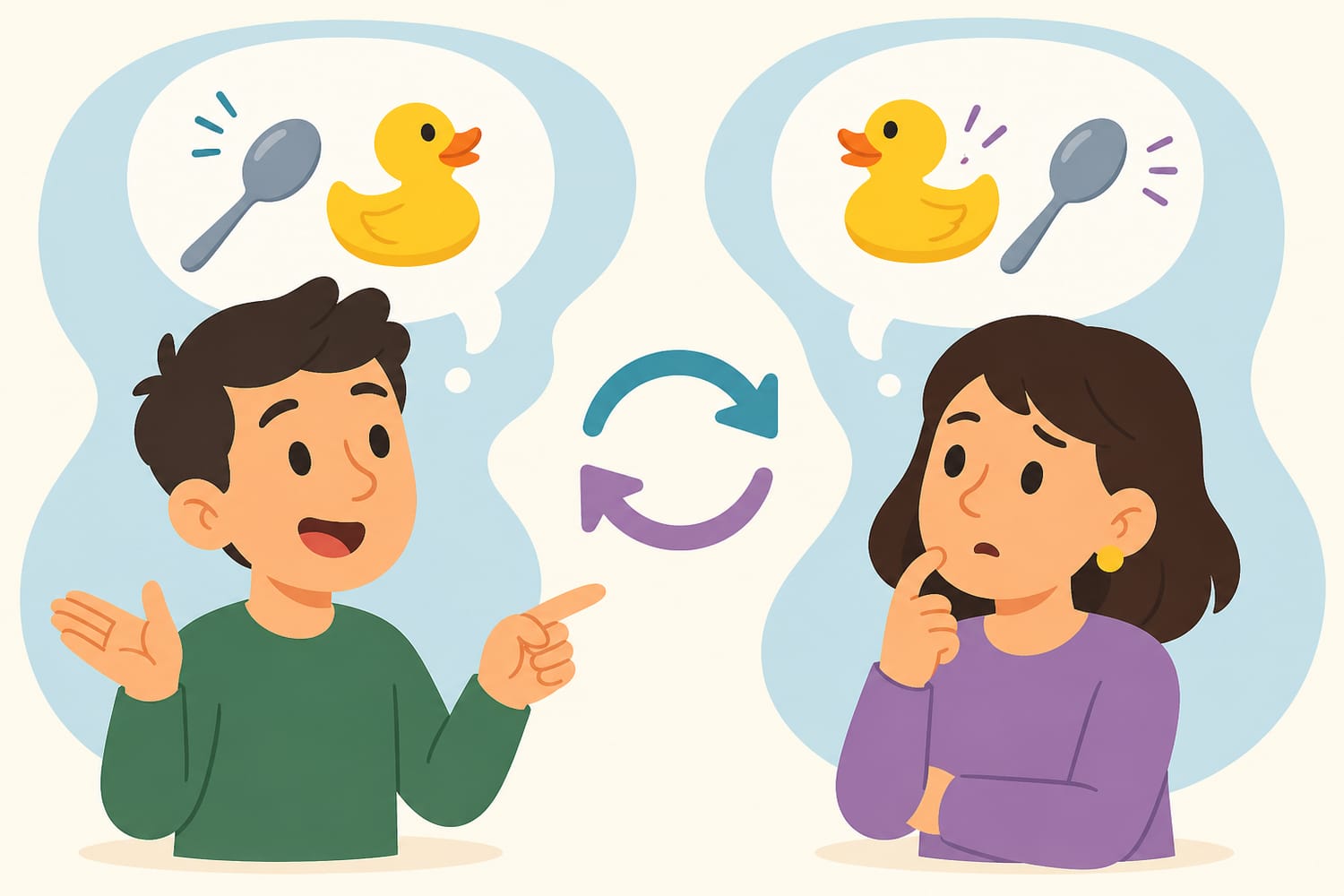
A spoonerism happens when corresponding sounds in two or more words trade places, often with funny results. Imagine saying “bunny phone” instead of “funny bone.” The words stay in their positions, but their opening sounds swap seats. It’s a slip of the tongue—or a deliberate bit of wordplay.
You set out to say something perfectly ordinary. Your mouth delivers a small cartoon instead.
The name sounds like it might describe an obscure utensil, but no spoons are involved. There is, however, an Oxford clergyman, a collection of suspiciously entertaining anecdotes, and a useful lesson about how speech works.
Let’s untangle the words before they untangle us.
How Does a Spoonerism Work?
The easiest way to understand a spoonerism is to watch one happen:
light rain → right lane
The opening l sound of light moves to rain, while the opening r sound travels in the opposite direction. Everything else stays put.
That exchange is the defining feature. You aren’t simply choosing the wrong word or reversing the order of two words. You’re swapping pieces of their pronunciation. Merriam-Webster’s definition of spoonerism specifies that the sounds exchanged are usually at the beginning of the words—not necessarily always.
Think Sounds, Not Letters
This distinction matters because English spelling is not exactly a model of cooperation.
Take this constructed example:
coat shop → shoat cop
The opening k sound trades places with sh, even though sh takes two letters to write. The exchange operates on what you hear, not on how many characters appear on the page.
Likewise, an entire opening consonant cluster can move together, as in the familiar example “crushing blow” → “blushing crow.” Here, cr and bl exchange places.
A useful test is: Can you identify two sounds or sound groups that have traded positions? If so, you’re probably looking at a spoonerism rather than a general verbal muddle.
Spoonerism Examples You Can Actually Follow
Some explanations make spoonerisms sound more complicated than they are. These deliberately constructed examples keep the swaps easy to spot:
| Intended phrase | Spoonerized version | What swaps? | |---|---|---| | Funny bone | Bunny phone | f and b | | Light rain | Right lane | l and r | | Jelly beans | Belly jeans | j and b | | Bad salad | Sad ballad | b and s | | Cool party | Pool carty | k and p |
“Belly jeans” sounds like an ambitious clothing invention. “Sad ballad” could pass unnoticed in a music review. “Pool carty,” meanwhile, is mostly nonsense.
That last example illustrates an important point: the resulting sounds don’t have to form real words. Speech errors aren’t obliged to consult a dictionary before arriving. The examples that produce recognizable, amusing phrases are simply easier to enjoy and remember.
If this sort of verbal silliness is your thing, our collection of funny-sounding words that are completely real offers more vocabulary worth saying aloud.
Who Was Spooner—and Did He Really Say Those Things?
Spoonerisms take their name from William Archibald Spooner (1844–1930), an English clergyman and scholar who became Warden of New College, Oxford. He developed a reputation for mixing up sounds while speaking.
But there’s a twist: many of the entertaining lines attributed to him are probably inventions. The National Portrait Gallery’s biographical entry on William Archibald Spooner explicitly notes that many are apocryphal—widely repeated, but not reliably established as genuine.
One traditional example turns “missed all my history lectures” into “hissed all my mystery lectures.” It’s an excellent demonstration of the mechanism: the opening m and h sounds exchange places. It is not, however, a quotation we should confidently present as something Spooner actually said. Oxfordshire’s Blue Plaques account includes it among examples considered to have been made up by students and others.
That distinction lets us enjoy the joke without accidentally rewriting the man’s biography.
Spooner didn’t need to invent sound-swapping for his surname to become attached to it. His reputation supplied a memorable label; generations of storytellers supplied plenty of additional material.
Why Do Our Sounds Get Mixed Up?
Speaking feels effortless until you try to explain everything involved.
You have to select words, organize them, prepare their sounds, and coordinate their pronunciation. Research on speech errors treats spoonerisms as useful evidence about this planning process: parts of an upcoming utterance can interact before they are spoken.
A helpful analogy is preparing several ingredients on a counter. Everything you need is available, but occasionally something ends up in the wrong bowl.
That’s an analogy, not a literal description of the brain. Researchers investigate different explanations for exactly how sound exchanges arise. One experimental study, for example, detected distinctive brain activity before spoonerisms were spoken and proposed that competing speech plans were involved.
The important takeaway is modest but fascinating: a spoonerism isn’t just random noise. Its structure can reveal something about how speech is assembled. Linguists have found patterns in which sounds exchange, including similarities in their pronunciation and positions within syllables.
For the speaker, it may be an awkward moment. For a language researcher, it’s interesting data wearing a party hat.
Spoonerism vs. Other Word Mix-Ups
Not every verbal wrong turn belongs in the same category. Here’s how to distinguish a spoonerism from a few neighboring curiosities.
Malapropism: The Wrong Word Gets the Job
A malapropism substitutes a similar-sounding but inappropriate word for the intended one. A constructed example would be calling someone “the pineapple of professionalism” when you meant “the pinnacle of professionalism.” There’s no reciprocal sound exchange—just one very unsuitable fruit.
Mondegreen: Your Ears Rewrite the Script
A mondegreen results from mishearing words, especially something sung or recited. The key difference is where the mix-up happens: you hear one phrase as another rather than swapping sounds while producing speech.
Eggcorn: The Mistake Has Its Own Logic
An eggcorn is a mistaken expression that sounds like the original and seems plausible to the person using it. “Cold slaw” for “coleslaw” works as an example because the dish is, after all, served cold. The replacement makes a kind of sense, even though it isn’t the standard expression.
Tongue Twister: The Challenge, Not the Mistake
A tongue twister is difficult to pronounce because of its sequence of sounds. It might trip you up, but it isn’t itself a spoonerism. The phrase is the obstacle; a sound swap might be one possible stumble.
The quick distinction: spoonerisms swap sounds; the others involve different kinds of substitution, mishearing, or pronunciation difficulty.
Can You Make Spoonerisms on Purpose?
Absolutely. Although they’re associated with accidental speech errors, spoonerisms can also be intentional wordplay.
Try this simple recipe:
- Choose a short phrase. Two words are enough.
- Identify their opening sounds. Listen rather than counting letters.
- Exchange those sounds. Leave the remaining parts in place.
- Say the result aloud. Does the exchange still work when spoken?
- Look for an amusing interpretation. Real words are a bonus, not a requirement.
For practice, start with “jelly beans.” Exchange j and b, and you get “belly jeans.” Now imagine trying to sell those.
A good game is to work backward: give someone the swapped phrase and ask them to recover the original. What was “sad ballad” before its opening sounds traded places?
Keep your audience in mind, too. If you’re sharing wordplay with children or coworkers, check the result aloud before unveiling your masterpiece. For a broader look at audience and context, explore how language and humor work across cultures.
A Small Slip With a Surprisingly Good Name
A spoonerism is a specific little disruption: sounds exchange places, and an ordinary phrase emerges wearing the wrong hat.
Once you recognize the pattern, you can appreciate both sides of it—the accidental stumble and the carefully engineered joke. You can also give William Spooner a little historical breathing room instead of blaming him for every sound swap ever invented.
So the next time “funny bone” comes out as “bunny phone,” you’ll know what to call it.
Whether the rabbit answers is another question.