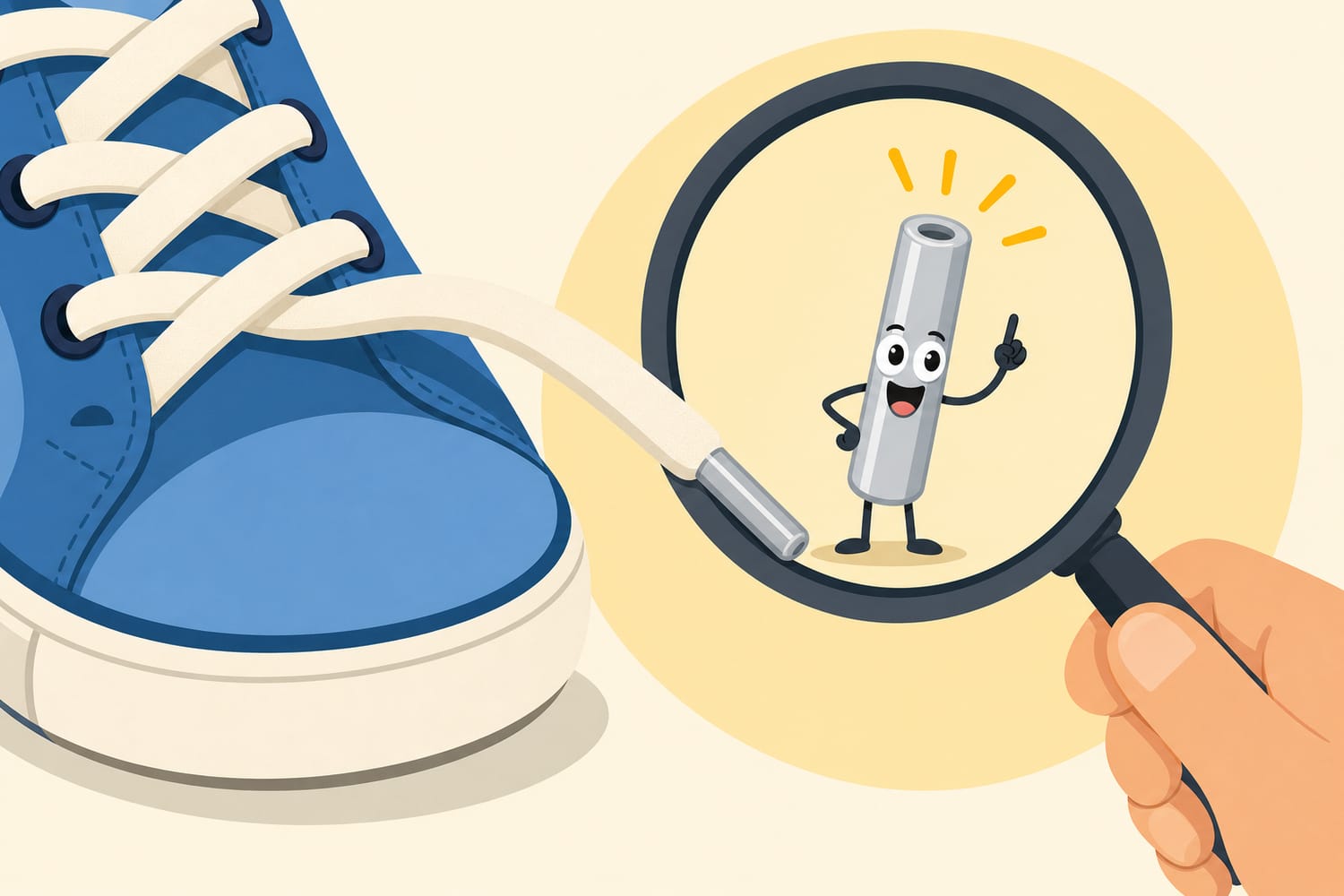
Meet the Aglet: Your Shoelace’s Tiny Bodyguard
An aglet is the small, stiff covering at the end of a shoelace, cord, or drawstring. Usually made from plastic or metal, it prevents the material from fraying and makes it easier to thread through a hole. It is pronounced AG-lət, and yes, it has been quietly helping you tie your shoes all along.
Look down at your sneakers. See those little plastic tubes at the ends of the laces? Those are aglets.
They may not seem important. In fact, you have probably ignored them for most of your life. But remove one, and an ordinary shoelace quickly turns into a fuzzy, uncooperative noodle that refuses to pass through an eyelet.
The dictionary definition of aglet also includes ornamental tags attached to cords or clothing. That broader meaning hints at the word’s surprisingly fashionable past.
What Does an Aglet Actually Do?
An aglet has two main jobs, both of which become painfully obvious the moment it breaks.
It Stops the Lace From Fraying
Most shoelaces are braided from many individual fibers. Once the braid is cut, those fibers naturally want to separate. An aglet holds them together, preserving the lace’s shape and preventing the end from turning into a tiny mop.
Without that protective covering, the damage can gradually travel farther up the lace. What begins as a slightly fluffy tip may eventually become a loose, uneven section that is difficult to tie.
It Helps the Lace Pass Through the Eyelet
The eyelet is the hole in the shoe. The aglet is the tip that passes through it.
This distinction is useful because the two words are sometimes confused. An eyelet without an aglet is merely a small hole waiting to ruin your afternoon.
The aglet gives the lace a narrow, firm end that you can grip and guide through each eyelet. It is the same principle as putting a metal or plastic cap on the end of a cord: the cap transforms a flexible bundle of fibers into something closer to a needle.
That is not a coincidence, as we are about to discover.
Where Did the Word “Aglet” Come From?
The word aglet entered English during the Middle English period. It came through French, particularly the Middle French word aguillette, a diminutive related to aguille, meaning “needle.” Farther back, the word is connected to the Latin acus, also meaning “needle” or “pin.”
In other words, aglet essentially carries the idea of a little needle.
That makes perfect sense. A stiff shoelace tip acts like a needle, helping the cord travel through a narrow opening without bending, splitting, or getting stuck.
It is a wonderfully practical origin for a wonderfully practical object. Unlike some words whose histories wander through five languages and emerge meaning something completely unexpected, aglet has remained loyal to its pointy roots.
The spelling aiglet also exists, although aglet is the standard form most English speakers encounter today.
If you enjoy legitimate words that appear to have escaped from a board game, take a look at these real words that sound completely made up. Aglet will feel right at home among them.
Aglets Were Once Much Fancier
Today’s typical aglet is a modest piece of clear plastic. Its main ambition is to survive the washing machine.
Historically, however, aglets could be decorative accessories. Before modern fasteners became common, cords and ribbons were widely used to secure parts of clothing. The tips helped these cords pass through openings, but they could also be made to look attractive.
Some were metal and highly ornamental. Rather than hiding at the bottom of a sneaker, they might be displayed as part of an elaborate outfit. An aglet could therefore be both a useful tool and a miniature fashion statement.
William Shakespeare even used the term “aglet-baby” in The Taming of the Shrew. The expression referred to a tiny ornamental figure forming the tag of a lace, although its precise historical meaning is not completely certain.
So, if the clear tips on your running shoes seem boring, remember that their ancestors had theatrical careers.
How Modern Aglets Are Made
Many modern shoelace aglets are formed using thin plastic film. During one common manufacturing process, a machine wraps plastic around an uncut length of braided lace. Heat, pressure and sometimes a solvent help bond the plastic to the fibers.
The reinforced section is then cut through the middle. That single cut creates the finished end of one shoelace and the beginning of the next. It is a pleasingly efficient process: one slice, two aglets, no tiny plastic caps rolling around a factory floor.
The detailed shoelace-tip manufacturing guide at Ian’s Shoelace Site explains several production methods, including plastic tape, metal crimping and molded tips.
Common aglet materials and styles include:
- Clear or colored plastic, widely used on everyday shoelaces
- Crimped metal, often found on premium footwear and fashion cords
- Molded synthetic tips, created from the lace material itself
- Decorative branded tips, featuring logos, lettering or patterns
- Replacement aglets, which can be attached to damaged or customized laces
Aglets are not limited to shoes, either. You can find them on hoodie cords, sweatpants drawstrings, bags, corset laces and other items that use braided cords.
Once you know the word, aglets appear to be everywhere. They were not hiding particularly well; nobody had introduced you properly.
What Happens When an Aglet Breaks?
A damaged aglet is a small problem with a remarkable ability to produce irritation.
First, the exposed lace begins to fray. Then the fibers spread out, making the end too wide to fit through an eyelet. You twist it. You pinch it. You attempt to reason with it. The lace remains unmoved.
Fortunately, a damaged aglet does not always mean that the entire shoelace must be discarded.
Quick Ways to Repair an Aglet
Trim the loose fibers. Use sharp scissors to create a neat, even end before adding a new covering.
Use heat-shrink tubing. Slide a short piece over the lace and shrink it carefully according to the product’s directions. Avoid holding an open flame directly against the lace.
Attach a replacement aglet. Metal and plastic replacement tips are available for repairing or customizing laces.
Wrap it temporarily. A narrow piece of firm tape can keep the end together long enough to relace a shoe, although it is unlikely to be a beautiful or permanent solution.
Replace a badly damaged lace. If the fibers have unraveled well beyond the tip, a new pair of laces may be easier and more reliable than a repair.
When adding a replacement, keep the new tip slim enough to pass through the shoe’s eyelets. A magnificently reinforced aglet is not much use if it becomes permanently stranded outside the first hole.
Why Does Such a Small Thing Have a Special Name?
We name objects when it becomes useful to distinguish them from everything around them. Shoemakers, clothing makers, merchants and craftspeople needed a specific term for the tips attached to laces and cords. Aglet may sound like trivia now, but it began as practical vocabulary.
English is full of these surprisingly precise names. The cardboard holder around a hot cup, for example, can be called a zarf. Once you learn such a word, an everyday object suddenly becomes more visible.
This is one of the pleasures of vocabulary. Learning a new word does not merely give you another label. It can change what you notice.
Yesterday, you saw a shoelace. Today, you see a braided cord, two aglets and a row of eyelets cooperating to keep your shoe attached to your foot. Tomorrow, you may become unbearable at parties.
Use your knowledge responsibly.
Is “Aglet” Actually Useful in Conversation?
Surprisingly, yes.
You could say:
- “The aglet came off my bootlace.”
- “This hoodie is missing an aglet.”
- “Those gold aglets are a nice detail.”
- “I repaired the lace instead of replacing it.”
- “Please stop chewing your aglets.”
It is also an excellent trivia word because it describes something familiar while sounding obscure. Almost everyone has handled an aglet, but relatively few people regularly use its name.
Unlike a magnificent verbal monster such as quomodocunquize, aglet is short, pronounceable and genuinely handy. You might not say it every day, but when a shoelace tip falls apart, no other word is quite as precise.
The Final Word on the End of Your Laces
An aglet is the stiff tip attached to a shoelace, cord or drawstring. It prevents fraying, improves grip and allows the cord to pass smoothly through an eyelet. Its name comes from words associated with needles, which neatly describes the job it performs.
It may be tiny, but it is not pointless—although, technically, being point-like is the entire idea.
The next time you tie your shoes, spare a thought for the humble aglet. It asks for no applause, receives very little attention and quietly holds everything together.
Not bad for a piece of plastic you only learned had a name five minutes ago.