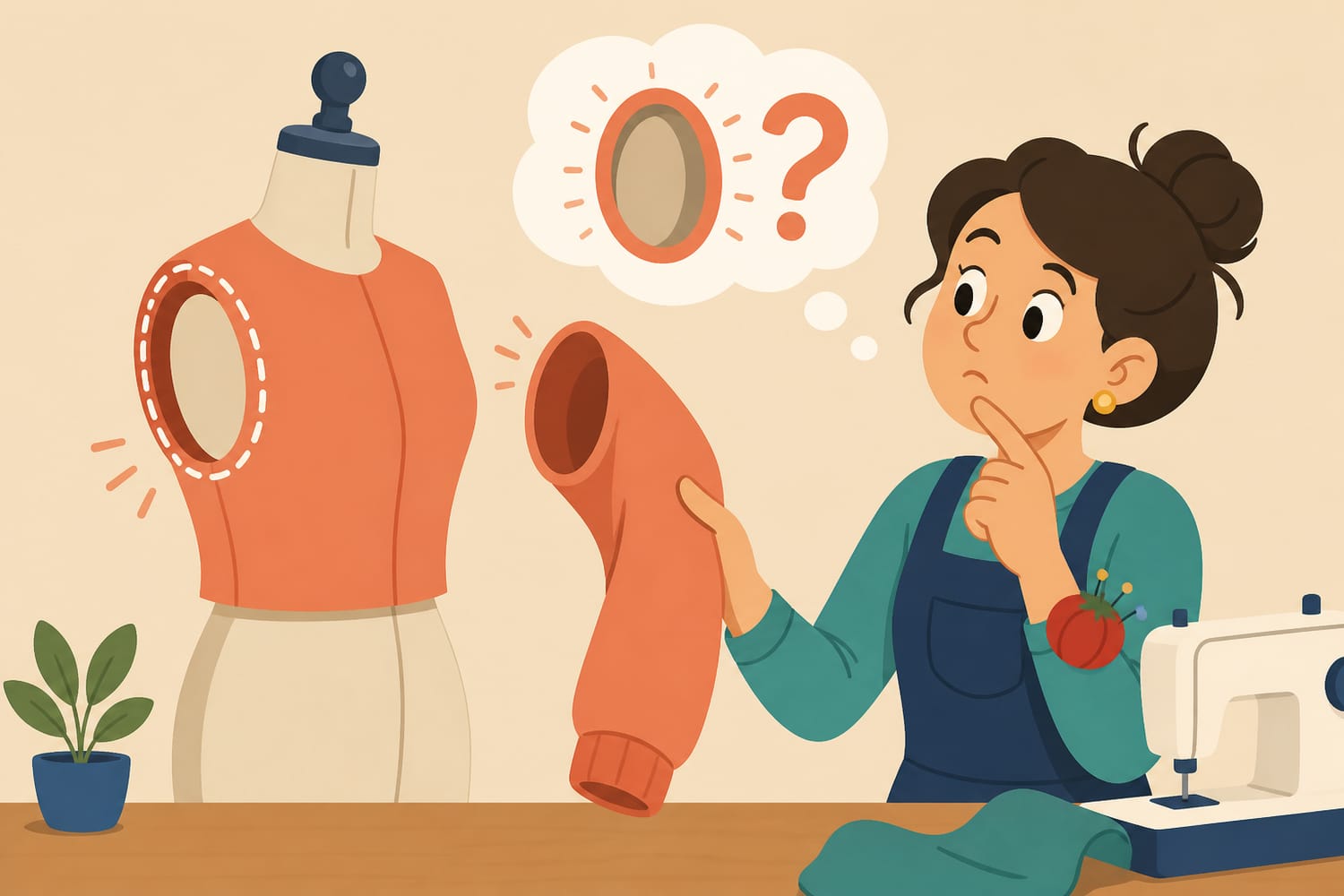
The Short Answer: An Armscye Is an Armhole
An armscye is the armhole of a garment—the opening where your arm passes through and, on a sleeved garment, where the sleeve is attached. In tailoring and dressmaking, the word can also refer more specifically to the curved edge or outline of that opening. It is usually pronounced “ARM-sigh.”
So yes, the humble hole in your shirt has a fancy technical name. And no, armscye is not a typo, a medieval weapon, or the name of a minor character in a fantasy novel.
Where Exactly Is the Armscye?
Put on a T-shirt and trace a finger around the seam that connects one sleeve to the body of the shirt. That entire curved boundary is the armscye.
On a sewing pattern, the armscye appears as a curved line running from the shoulder down beneath the arm and back up again. Once the garment is assembled, this opening surrounds the place where your arm joins your torso.
You will find armscyes on all sorts of clothing, including:
- Shirts and blouses
- Dresses
- Jackets and coats
- Vests and waistcoats
- Bodices
- Sleeveless tops
A sleeveless garment still has armscyes even though no sleeves are attached. In that case, the raw edges are typically finished with fabric bindings, facings, linings, or another neat treatment.
In ordinary conversation, almost everyone simply says armhole. Armscye tends to appear in sewing instructions, pattern-making guides, tailoring discussions, and fitting rooms where people own far more pins than the average household requires.
How Do You Pronounce “Armscye”?
The most common pronunciation is:
ARM-sigh
Some speakers pronounce the second syllable with a slightly voiced sound, closer to ARM-zigh. Both pronunciations are recognized by dictionaries. The spelling may look as if it requires a complicated verbal maneuver, but the word has only two syllables.
Its plural is armscyes:
“The armscyes on this jacket are too low.”
“Both armscyes need to be adjusted before the sleeves are attached.”
If you would rather avoid saying it aloud, armhole remains perfectly acceptable. But where is the fun in learning armscye if you never get to casually unleash it near a clothing rack?
Why Isn’t It Just Called an Armhole?
Most of the time, it is.
Armhole is the familiar, everyday term, while armscye belongs to the more specialized vocabulary of dressmaking and tailoring. Depending on the context, the two words can be treated as synonyms.
However, sewing professionals may use armscye more precisely to describe the shape, curved seamline, or measured edge of the opening. That distinction becomes useful when constructing or altering clothing.
A tailor might say:
- “The armscye needs to be raised.”
- “The sleeve cap does not match the armscye.”
- “There is some gaping at the back armscye.”
- “The armscye curve needs to be redrawn.”
“Fix the armhole” communicates the general idea. “Adjust the armscye curve” points to a particular part of the garment’s construction.
English is full of specialized words for ordinary-looking things. A zarf, for example, is the holder wrapped around a handleless cup—and it is another excellent example of an oddly specific word for an everyday object. An armscye just happens to be hiding in your closet rather than your kitchen cupboard.
Is “Armscye” Related to “Arm’s Eye”?
It certainly looks that way. An armhole is vaguely eye-shaped, after all, so arm’s eye feels like a charming and logical origin.
Unfortunately, language is under no obligation to choose the most charming and logical explanation.
According to the etymology given by Merriam-Webster’s entry for armscye, the word combines arm with the dialect term scye or sey, meaning an armhole. The precise deeper origin of scye is unclear. The spelling armseye also exists, but it appears to have developed through folk etymology—the reshaping of an unfamiliar word into something that seems more understandable.
In other words, people encountered the mysterious-looking armscye and mentally tidied it into arm’s eye. That explanation made sense, even though it did not reflect the word’s actual formation.
This is one reason etymology can be so entertaining: the neatest story is not always the true one. If you enjoy vocabulary that appears to have been invented during a particularly chaotic spelling bee, explore more words that look fake but are completely legitimate.
Why the Shape of an Armscye Matters
An armscye may look like a simple hole, but its size and shape have a major effect on how a garment fits, hangs, and moves.
If the armscye is too small or high in the wrong places, the garment may pinch beneath the arm. If it is too large, it may gape, droop, expose more than intended, or distort the surrounding fabric.
A poorly fitted armscye can produce several telltale problems:
Tightness under the arm
The opening may dig into the wearer or create tension lines across the chest and back.Restricted movement
Reaching forward or lifting an arm may pull the entire garment upward.Gapping
Excess fabric may stand away from the body, particularly at the front or back of a sleeveless garment.Twisting sleeves
If a sleeve is attached at the wrong angle, it may rotate around the arm or develop diagonal wrinkles.A drooping shoulder
An armhole that extends too far past the natural shoulder can make a fitted garment look oversized or unbalanced.
Curiously, a lower and larger armhole does not always provide greater freedom. In a fitted garment with sleeves, a reasonably high, close-fitting armscye can improve movement because it allows the arm to move more independently of the bodice. An armhole that hangs very low may cause the whole shirt or jacket to rise whenever the wearer raises an arm.
That does not mean an armscye should be jammed tightly into the armpit. Good fit depends on the garment’s style, the wearer’s body, the fabric, and the intended range of movement.
The Armscye and Sleeve Cap: A Delicate Partnership
The armscye is only half of the sleeve-fitting puzzle. The other important shape is the sleeve cap, the curved top of a set-in sleeve.
These two curves must work together:
- The armscye is the opening in the body of the garment.
- The sleeve cap is the rounded upper edge of the sleeve inserted into that opening.
They may not have identical measurements. In many patterns, the sleeve cap includes a controlled amount of extra length called ease. This fullness is distributed around part of the armscye so the sleeve can curve smoothly over the shoulder without visible gathers.
Alter one curve, and you may need to alter the other. Raising, lowering, widening, or reshaping an armscye changes the space into which the sleeve must fit. This relationship is one reason setting a tailored sleeve can be a famously fiddly sewing task. Threads magazine’s guide to the sleeve-cap seam and armscye explains how the two shapes are drafted and balanced.
Imagine trying to fit a curved lid onto the wrong container. You might force it into place, but something is going to wrinkle, buckle, or stage a tiny fabric rebellion.
Are All Armscyes the Same Shape?
Not at all. An armscye changes according to the style and purpose of a garment.
A tailored jacket usually has a carefully shaped armscye designed to support a structured sleeve. A loose sweatshirt may have a deeper, more relaxed opening. A sleeveless evening dress may be cut close to the body to prevent gaping, while a tank top may have a broader opening for comfort and style.
The front and back curves are not necessarily identical, either. Human bodies are three-dimensional and inconveniently unwilling to behave like symmetrical cardboard cutouts. The chest, shoulder blades, posture, and natural position of the arms all influence the required shape.
Design choices also produce noticeably different armholes:
- Set-in sleeves use a defined armscye at the natural shoulder.
- Dropped shoulders extend beyond the shoulder before the sleeve begins.
- Raglan sleeves run diagonally from the neckline and do not use a conventional set-in armscye.
- Dolman or batwing sleeves may be cut as part of the bodice, creating a much deeper underarm shape.
The “correct” armscye is therefore not one universal curve. It is the curve that works with the garment, sleeve, fabric, and wearer.
How to Use “Armscye” in a Sentence
You probably will not hear armscye while buying socks, but it fits naturally into sewing and clothing conversations:
“The dress fits at the waist, but the armscye is gaping.”
“Mark the notches before attaching the sleeve to the armscye.”
“A tailor reshaped the jacket’s armscyes for a cleaner fit.”
“I thought armscye was a printing error until I looked it up.”
The last example may be the most realistic.
A Small Word Hidden in Nearly Every Closet
Armscye is a wonderfully specialized name for something most of us encounter every day without thinking about it. It means the armhole of a garment, especially the curved opening or seamline where a sleeve is fitted.
The word is pronounced ARM-sigh, comes from arm plus the dialect word scye, and has nothing to do with your arm developing its own eye—disappointing though that may be.
The next time a shirt pinches under your arm, a jacket lifts when you reach for something, or a sleeveless top gapes at the side, you can identify the possible culprit with impressive precision:
“Ah. An armscye problem.”
Will that fix the garment? No.
Will it make you sound like you know exactly what is going on? Absolutely.