The Word That Sounds Like a Dinosaur but Isn’t
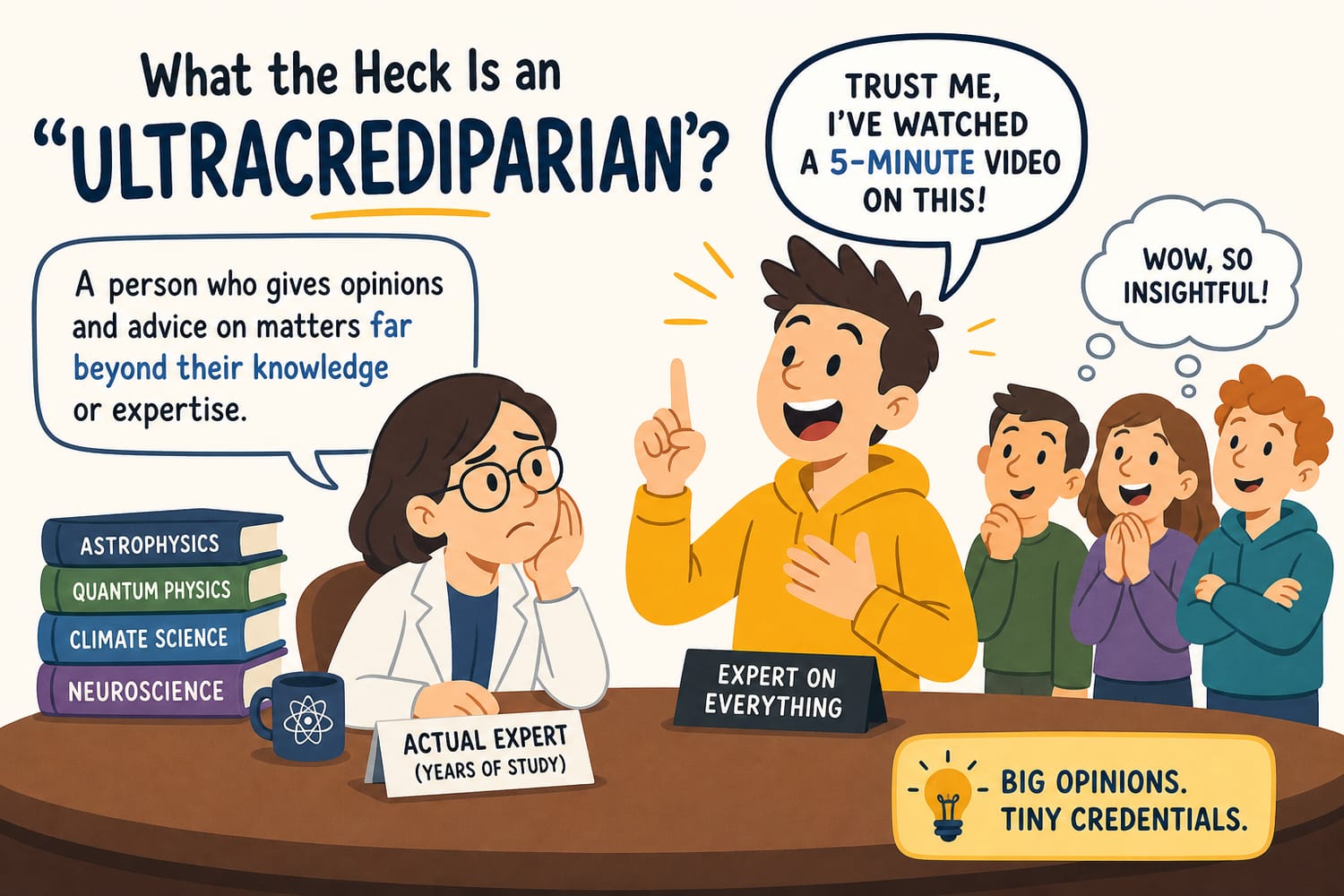
An ultracrepidarian is someone who gives opinions or advice on subjects they know little or nothing about.
In other words: the person at dinner who confidently explains quantum physics after watching half a YouTube video. The coworker who has never touched a guitar but tells the band how to improve their solos. The stranger online who diagnoses your car, your cat, your taxes, and your life choices in a single comment thread.
The word can be used as both a noun and an adjective:
- Noun: “He’s an ultracrepidarian when it comes to medicine.”
- Adjective: “That was a wildly ultracrepidarian take.”
It’s a deliciously fancy word for a very familiar human habit: talking beyond the limits of one’s knowledge.
And no, despite appearances, an ultracrepidarian is not a prehistoric creature with unusually judgmental eyebrows. Though honestly, it could be.
How Do You Pronounce “Ultracrepidarian”?
Let’s break it down:
ul-tra-krep-i-DAIR-ee-un
Or, in a more phonetic style:
ul-truh-krep-ih-DAIR-ee-uhn
The stress usually falls on the “DAIR” part: ultra-crepi-DAIR-ian.
It may look intimidating at first, but once you say it a couple of times, it becomes oddly satisfying. It has the same mouthfeel as words like sesquipedalian, antidisestablishmentarian, and I-definitely-know-what-I’m-talking-about-ian.
Okay, that last one isn’t real. But it probably should be.
Where Did “Ultracrepidarian” Come From?
The origin of ultracrepidarian is one of the best parts of the word.
It comes from a famous ancient story involving the Greek painter Apelles, who lived in the 4th century BCE and was considered one of the greatest artists of antiquity. According to the Roman writer Pliny the Elder, Apelles once displayed a painting and hid nearby to listen to public criticism.
A shoemaker, or cobbler, noticed that Apelles had painted a shoe incorrectly. Fair enough—the cobbler knew shoes. Apelles reportedly corrected the mistake.
Encouraged by this success, the cobbler then began criticizing the painting further, commenting on the subject’s leg. At that point, Apelles is said to have snapped back with a phrase that became famous in Latin:
“Sutor, ne supra crepidam.”
This is commonly translated as:
“Shoemaker, not beyond the shoe.”
Or more loosely:
“Cobbler, stick to shoes.”
The key word here is crepida, a Latin word referring to a sandal or shoe. Add ultra, meaning “beyond,” and eventually we get ultracrepidarian: someone who goes “beyond the shoe,” so to speak—offering opinions outside their area of expertise.
The English word ultracrepidarian appears to have entered use in the early 19th century. It has never been a common everyday word, but it has survived because, frankly, we keep needing it.
Why This Word Still Feels So Modern
You might think a word rooted in an ancient painting anecdote would feel dusty and irrelevant. But ultracrepidarian may be more useful now than ever.
We live in the golden age of instant opinions. Everyone has a platform. Everyone has a comment box. Everyone has access to enough information to become slightly informed—and enough confidence to become dangerously loud.
This doesn’t mean people shouldn’t discuss things outside their profession. Curiosity is wonderful. Learning is wonderful. Asking questions is wonderful. The problem begins when curiosity puts on a fake mustache and introduces itself as expertise.
An ultracrepidarian doesn’t merely say, “I wonder if…” or “I read somewhere that…” They say:
- “Trust me, I know exactly how to fix the economy.”
- “Doctors don’t understand this one weird trick.”
- “As someone who once saw a courtroom drama, here’s how the law works.”
- “Climate scientists are missing something obvious I noticed during lunch.”
The ultracrepidarian spirit thrives wherever confidence outruns competence.
Is Being Ultracrepidarian the Same as Being Wrong?
Not exactly.
A person can be wrong without being ultracrepidarian. We all make mistakes. We all misunderstand things. We all occasionally misremember a “fact” that turns out to be something we heard from a raccoon in a trench coat.
Being ultracrepidarian is less about simply being incorrect and more about speaking authoritatively outside your knowledge.
For example:
- If you say, “I’m not sure, but I think octopuses have three hearts,” and you’re correct—great.
- If you say, “I’m not sure, but I think octopuses have four hearts,” and you’re wrong—still not necessarily ultracrepidarian.
- If you declare, “Marine biologists are fools; octopuses clearly have twelve emotional backup hearts,” despite knowing nothing about octopuses—now we’re getting ultracrepidarian.
The key ingredients are limited knowledge plus excessive certainty.
It’s the confidence that gives the word its flavor.
A Close Cousin of the Dunning-Kruger Effect
The word ultracrepidarian is often linked to the Dunning-Kruger effect, a psychological phenomenon in which people with low ability or knowledge in a particular area may overestimate their competence.
The Dunning-Kruger effect is more specific and comes from psychological research. Ultracrepidarian, meanwhile, is a broader word describing the behavior of speaking beyond one’s expertise.
They are not identical, but they are friendly neighbors.
A Dunning-Kruger moment might be someone overestimating their skill at chess after learning how the horsey piece moves. An ultracrepidarian moment might be that same person writing a 12-part thread on why grandmasters are playing chess incorrectly.
In both cases, humility has quietly left the room.
How to Use “Ultracrepidarian” in a Sentence
Because ultracrepidarian is a rare and slightly flamboyant word, it works best when you want to be precise, playful, or gently savage.
Here are some examples:
- “My uncle becomes an ultracrepidarian every time the news is on.”
- “The article was full of ultracrepidarian claims about nutrition.”
- “She wisely avoided making ultracrepidarian comments about a field she hadn’t studied.”
- “Social media has turned ultracrepidarianism into a competitive sport.”
- “I try not to be ultracrepidarian about plumbing, especially after the sink incident.”
You can also use the noun ultracrepidarianism to describe the habit itself:
- “The meeting suffered from a severe outbreak of ultracrepidarianism.”
- “A little research can prevent a lot of ultracrepidarianism.”
Admittedly, these words are not ideal if you’re trying to sound casual. If you call someone an ultracrepidarian at a barbecue, you may have to explain the word, the Latin, the cobbler, and possibly why you weren’t invited last year.
But that’s part of the fun.
Ultracrepidarian vs. Know-It-All
Is an ultracrepidarian just a know-it-all with a dictionary subscription?
Almost, but not quite.
A know-it-all is someone who acts as if they know everything, often in an annoying or superior way. An ultracrepidarian specifically gives opinions outside their knowledge or expertise.
So a know-it-all might correct your pronunciation, your posture, and your pasta sauce. An ultracrepidarian might confidently explain heart surgery despite being an accountant whose closest medical experience is owning a thermometer.
The difference is subtle but useful:
- Know-it-all: annoying because they always have an answer.
- Ultracrepidarian: annoying because they have an answer where expertise is required and they don’t have it.
Of course, one person can be both. Language is generous that way.
Why We’re All a Little Ultracrepidarian Sometimes
Before we start hurling “ultracrepidarian” at everyone else like a fancy verbal snowball, it’s worth admitting something uncomfortable:
We’ve all done it.
Maybe you’ve given relationship advice while your own love life looked like a raccoon got trapped in a filing cabinet. Maybe you’ve criticized a movie’s editing without knowing what editing involves. Maybe you’ve confidently explained a news story based solely on the headline.
Human beings are pattern-making creatures. We like to understand things quickly. We like to feel competent. We like to have opinions because opinions make us feel oriented in a confusing world.
The problem isn’t having thoughts. The problem is forgetting the difference between:
- “Here’s my impression.”
- “Here’s my question.”
- “Here’s what experts generally say.”
- “Here’s my absolute ruling as Supreme Emperor of Facts.”
The first three can be useful. The last one is where ultracrepidarianism builds a little throne.
How to Avoid Becoming an Ultracrepidarian
The cure for ultracrepidarianism is not silence. You don’t need three PhDs and a ceremonial robe before speaking about anything.
The cure is intellectual humility.
Here are a few helpful phrases:
- “I’m not an expert, but…”
- “From what I understand…”
- “I could be wrong, but…”
- “That’s outside my area, so I’d want to check.”
- “What do people who study this say?”
These phrases don’t make you sound weak. They make you sound trustworthy.
In fact, people who acknowledge uncertainty often come across as more credible than people who bluff. Confidence can be impressive, but well-placed caution is underrated.
If the ancient cobbler had said, “The shoe looks wrong to me, but I can’t speak to the anatomy,” he might have gone down in history as a model of professional restraint. Instead, he helped give us a word for overreach.
So, thank you, ancient shoemaker. Your mistake was not in vain.
A Word Worth Keeping in Your Vocabulary
Ultracrepidarian is a big word for a common problem: people talking beyond what they know.
It’s funny, sharp, and oddly elegant. It reminds us that expertise matters, that confidence is not the same as knowledge, and that sometimes the wisest thing you can say is, “I don’t know.”
The next time someone confidently explains a topic they clearly don’t understand, you have options. You could sigh. You could change the subject. You could politely ask for sources.
Or, if the moment is right, you could smile and think:
“Ah. An ultracrepidarian in the wild.”
Just be careful when using the word aloud. If you explain it too confidently and get the origin wrong, well…
That would be terribly ultracrepidarian of you.