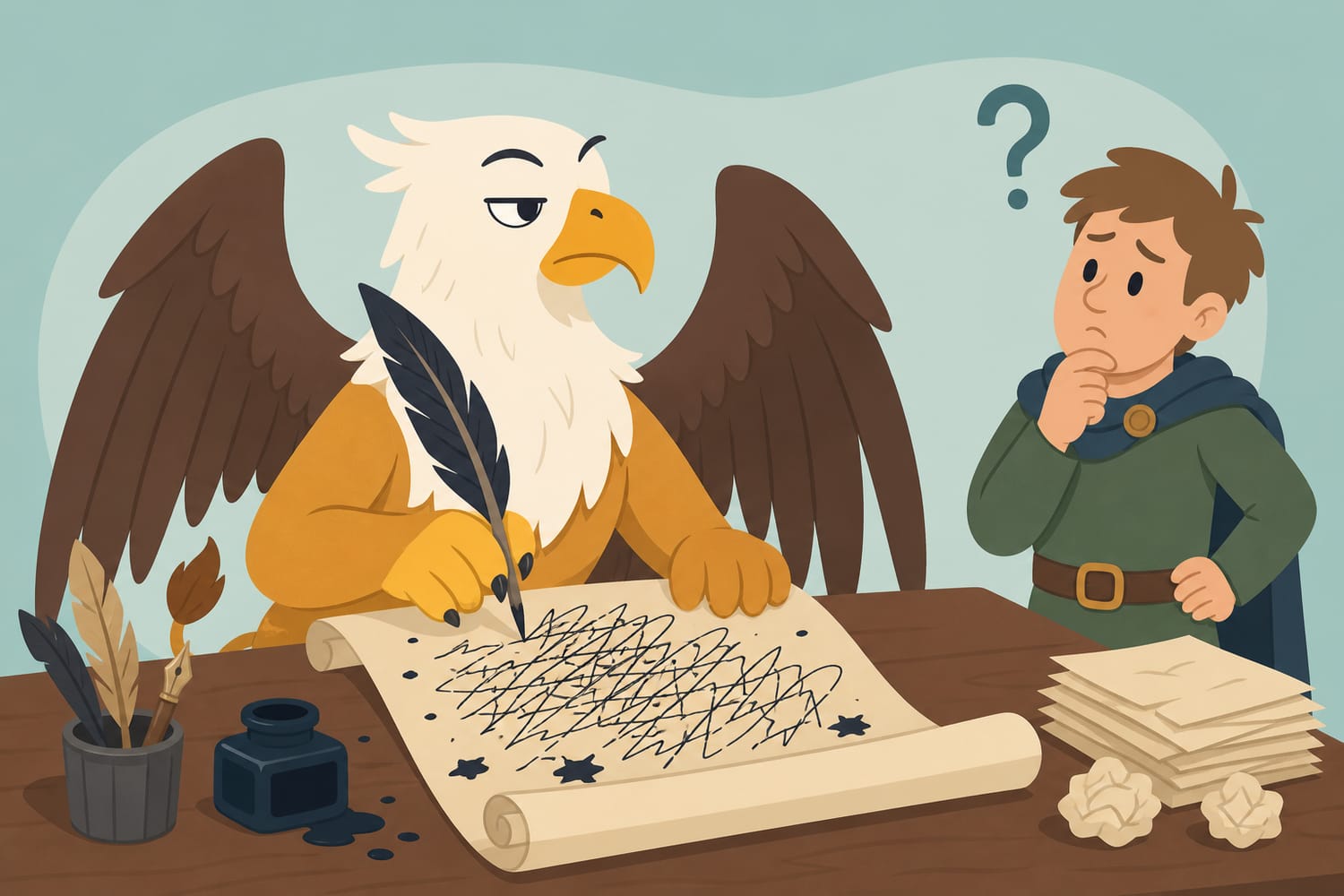
Meet “Griffonage,” Your Handwriting’s Evil Twin
Have you ever written a grocery list so chaotic that “bananas” looked like “banshees”? Or taken notes in a meeting and later discovered that your own hand had betrayed you? If so, congratulations: you may have produced a fine specimen of griffonage.
Griffonage is a rare and wonderfully dramatic word meaning careless, messy, or illegible handwriting. In plainer terms, it’s scrawl. Scribble. Chicken scratch. The kind of handwriting that makes readers tilt the paper, squint, rotate it sideways, and briefly consider calling in a codebreaker.
It’s pronounced roughly like GRIF-uh-nij or sometimes with a more French-flavored ending, grif-oh-NAHZH. Because the word is so uncommon in everyday English, you may hear a little variation. But however you say it, it sounds much fancier than “my handwriting looks like a spider fell into an inkpot.”
That’s part of the charm. “Griffonage” takes an ordinary annoyance—bad handwriting—and gives it the flair of a mysterious old manuscript, a Parisian notebook, or a medieval curse.
Where Did the Word Come From?
“Griffonage” comes from French, specifically from griffonnage, meaning scribbling or scrawling. That comes from the French verb griffonner, “to scribble” or “to scrawl.”
The word is likely connected to griffe, the French word for “claw.” That makes a lot of sense. Truly terrible handwriting often does look like something scratched onto the page by a nervous bird, an impatient cat, or a tiny dragon with poor pen control.
So at its roots, griffonage carries the idea of writing that seems clawed rather than written. It’s not neat loops and tidy lines. It’s marks. Scratches. Urgent little slashes of ink.
And no, despite the spelling, it is not directly about griffins—the mythical creatures with the body of a lion and the head and wings of an eagle—though, honestly, if a griffin tried to write a thank-you note, “griffonage” is probably what you’d get.
Griffonage vs. Other Words for Bad Writing
English has many words for messy writing, because apparently humans have been disappointing each other with handwriting for a very long time.
Here are a few related terms:
- Scrawl: messy, hurried writing. This is the everyday word.
- Scribble: quick, careless marks or writing, often hard to read.
- Chicken scratch: informal and vivid; handwriting that looks like a chicken walked through ink.
- Cacography: bad handwriting or bad spelling. This is another fancy one, from Greek roots meaning “bad writing.”
- Illegible handwriting: the practical, no-nonsense phrase.
- Dysgraphia: a neurological or learning-related difficulty with writing. This is not just “messy handwriting” and should not be used casually to insult someone’s penmanship.
- Agraphia: loss or impairment of the ability to write, often due to brain injury or disease.
So where does griffonage fit? It’s best used as a colorful synonym for messy, careless, hard-to-read handwriting. It doesn’t necessarily imply a medical or learning condition. It’s more about the result on the page: a battlefield of letters.
Why Is Some Handwriting So Terrible?
Before we shame the scribblers too harshly, let’s admit something: handwriting is actually a complicated skill.
To write clearly, your brain and body have to coordinate language, memory, attention, finger movement, wrist control, spacing, pressure, posture, and visual feedback. That’s a lot happening just to write “milk.”
Messy handwriting can happen for many reasons:
Speed.
The faster you write, the more your letters tend to collapse into each other. Many people can write neatly when they slow down, but during lectures, meetings, or exams, their handwriting goes full griffonage.
Fatigue.
A tired hand is not a graceful hand. After pages of writing, even the neatest script can start to sag like a wilting houseplant.
Lack of practice.
In the age of keyboards and touchscreens, many people simply don’t write by hand as much as they used to. Handwriting, like juggling or parallel parking, gets rusty.
Awkward tools.
A bad pen can ruin everything. Too slippery, too scratchy, too thick, too faint—suddenly your signature looks like it was forged by a raccoon.
Personality and priorities.
Some people care deeply about beautiful handwriting. Others just want the words out of their brain and onto the page before they disappear forever. Neatness is not always the top priority.
Motor or learning difficulties.
For some people, handwriting is genuinely difficult because of coordination, fine motor control, or learning differences. In those cases, messy writing is not laziness—it’s effort meeting a challenge.
The Legendary Case of Doctors’ Handwriting
No discussion of terrible handwriting is complete without mentioning doctors.
For decades, doctors have been famously mocked for handwriting so illegible that prescriptions seemed to require priestly interpretation. This reputation is not entirely random. Medical professionals often write quickly, under pressure, using specialized terminology, abbreviations, and patient notes. Historically, that combination could produce spectacular griffonage.
But illegible medical handwriting has never been just a joke. It can be dangerous. Misread prescriptions and unclear instructions have contributed to medication errors. This is one reason many healthcare systems moved toward electronic prescribing and digital medical records. A typed prescription may lack romance, but it’s much less likely to be mistaken for a spell from an ancient scroll.
So yes, doctors’ handwriting is a classic punchline—but it also shows why readability matters.
Is Bad Handwriting a Sign of Genius?
You may have heard that messy handwriting is a sign of intelligence. This is a comforting thought for anyone whose notes look like they were assembled during an earthquake.
But the truth is more complicated.
Messy handwriting does not automatically mean someone is brilliant. Neat handwriting does not mean someone is boring. Handwriting style alone is not a reliable measure of intelligence, creativity, honesty, personality, or destiny. Graphology—the practice of analyzing personality from handwriting—has not held up well as a scientific tool.
That said, there is one reasonable explanation behind the “messy genius” idea: some people think faster than they can write. When ideas arrive quickly, handwriting may become rushed and compressed. The page becomes less about presentation and more about capture. In that case, griffonage may be a side effect of speed, not genius itself.
In other words: your messy notes might be evidence that your brain was moving quickly. Or that your pen was terrible. Or that you were writing on a bus.
Griffonage in the Digital Age
You might think handwriting no longer matters. After all, we type emails, text friends, tap notes into apps, and let autocorrect turn “definitely” into “defiantly” at the worst possible moment.
But handwriting has not disappeared. We still use it for:
- birthday cards
- signatures
- classroom notes
- brainstorming
- journals
- sticky notes
- forms
- recipes
- labels
- quick reminders
- heartfelt letters
Handwriting also has a different feeling from typing. A handwritten note can feel personal in a way that a typed message often doesn’t. It shows time, presence, and human imperfection. Even slightly messy handwriting can be charming.
Griffonage, however, is where charm becomes archaeology.
If the reader must excavate meaning from the page like a fossil, you may have crossed the line.
How to Use “Griffonage” in a Sentence
Because “griffonage” is rare, it works best when you want to be playful, literary, or gently dramatic. It’s the sort of word that makes people pause and say, “Wait, what does that mean?”—which is exactly why we love weird words.
Here are some examples:
- “I tried to read my lecture notes, but they had dissolved into pure griffonage.”
- “His postcard was sweet, though the griffonage required three family members to decode.”
- “The recipe was passed down from my grandmother, along with her legendary griffonage.”
- “My signature used to be elegant; now it’s just legal griffonage.”
- “If this meeting goes on much longer, my notes will become a museum-quality sample of griffonage.”
You can also use it as a polite insult for your own handwriting:
“Apologies for the griffonage—I wrote this before coffee.”
That sounds much more refined than:
“Sorry my handwriting looks like a goose had a panic attack.”
Can Griffonage Be Fixed?
If your handwriting is more cryptic than communicative, don’t despair. You don’t need to become a calligrapher. A few simple changes can make handwriting more readable.
Slow down slightly.
Even a small reduction in speed can make letters clearer.
Write larger.
Tiny handwriting often turns into a dense knot. Give your letters room to breathe.
Choose a better pen.
A smooth pen with good ink flow can instantly improve control.
Focus on spacing.
Clear spaces between words can make even imperfect letters easier to read.
Use print instead of cursive.
For many people, printed letters are more legible than joined writing.
Practice problem letters.
If your “a,” “o,” and “e” all look identical, spend a little time separating them.
Don’t aim for beauty—aim for readability.
The goal is not perfection. It’s communication.
Of course, if handwriting causes serious difficulty, pain, or frustration—especially for a child in school—it may be worth speaking with a teacher, occupational therapist, or medical professional. Sometimes what looks like simple messiness has a deeper cause.
Why “Griffonage” Deserves a Comeback
“Griffonage” is one of those words that feels too good to leave buried in old dictionaries. It’s specific, funny, and slightly extravagant. It turns a mundane problem into a miniature event.
Bad handwriting is universal. Nearly everyone has either produced it, received it, or pretended to understand it. That makes griffonage a surprisingly useful word, even if it sounds like something you’d find in a dusty library next to a candle and a suspiciously locked cabinet.
It also reminds us that language has a word for almost everything. Not just love, anger, beauty, and fear—but also the tragic moment when your handwritten “meeting at noon” looks like “melted raccoon.”
So the next time you can’t read your own notes, don’t simply call them messy. Call them griffonage.
It won’t make them easier to read, but it will make the situation sound much more sophisticated.