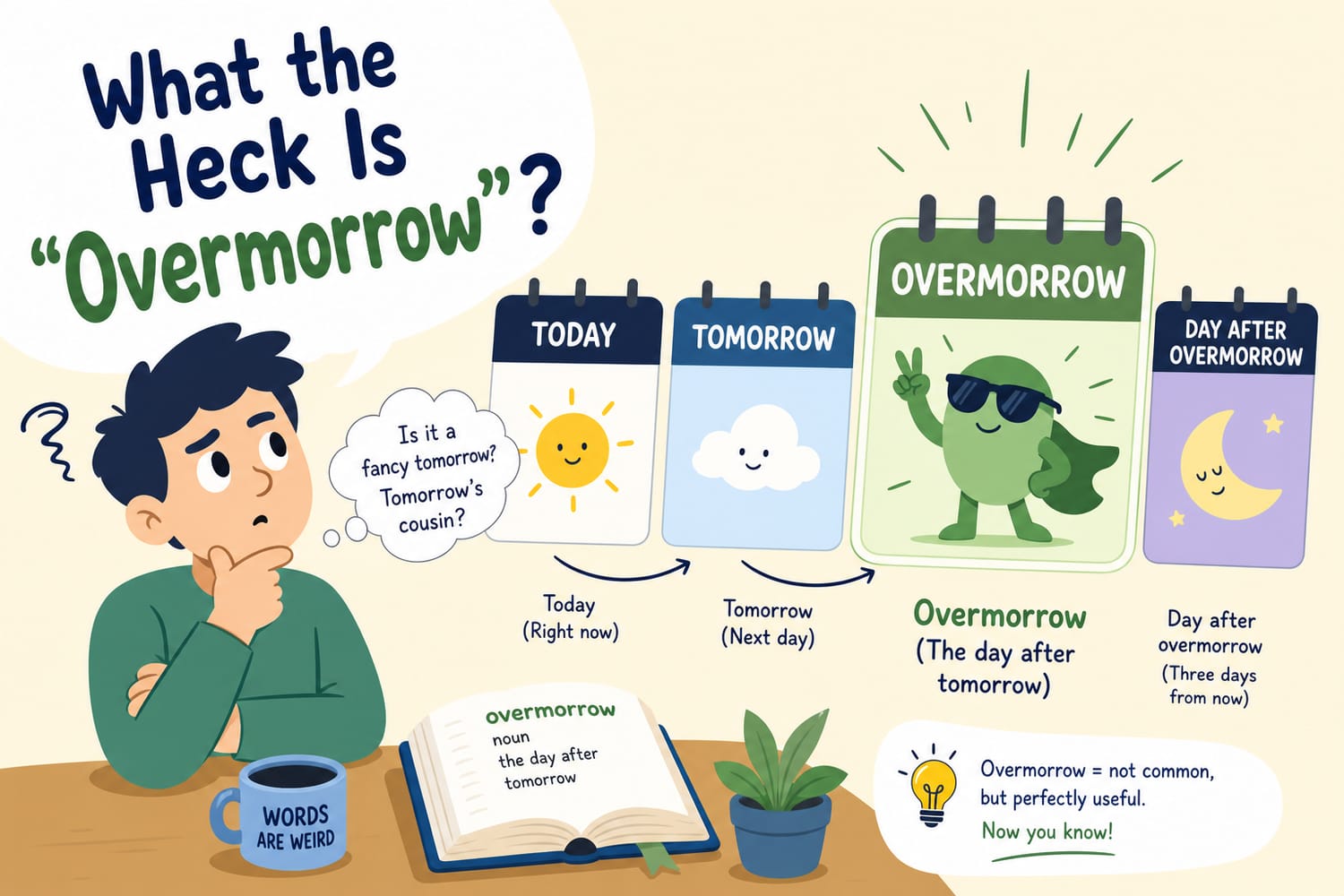
The Short Answer: It Means “The Day After Tomorrow”
“Overmorrow” is a wonderfully odd English word meaning the day after tomorrow.
So if today is Monday, tomorrow is Tuesday, and overmorrow is Wednesday.
You can use it as a noun:
“Overmorrow is going to be busy.”
Or as an adverb:
“We leave overmorrow.”
In other words, “overmorrow” does the job of a whole phrase in one neat little package. It’s compact, logical, and slightly whimsical—like a word wearing a tiny waistcoat.
The catch? Almost nobody uses it in modern everyday English. If you say, “Let’s meet overmorrow,” there is a decent chance the other person will either ask for clarification or assume you’ve just invented a fantasy kingdom.
But no: overmorrow is a real word. It’s simply old-fashioned, rare, and mostly forgotten.
Why Is It Called “Overmorrow”?
To understand “overmorrow,” we need to dust off the word morrow.
“Morrow” is an old English word meaning the next day or the following morning. You may have heard it in phrases like:
“Good morrow!”
That old greeting essentially meant “good morning,” though today it sounds less like something you’d say to a coworker and more like something you’d say while holding a lute.
The word tomorrow also comes from “morrow.” Historically, it developed from a phrase meaning something like “on the morrow” or “to the morrow.” Over time, the parts fused into the single word we use constantly today.
Now add over to “morrow.”
The “over” in “overmorrow” carries the idea of beyond or after. So “overmorrow” is literally something like:
“beyond tomorrow”
Which is exactly what it means: the day after tomorrow.
That makes “overmorrow” surprisingly sensible. It is not some random antique oddity like “flibbertigibbet” or “snollygoster.” It’s a practical word with a clear structure.
Honestly, English had a perfectly good little tool here and then left it in the shed for several centuries.
Is “Overmorrow” Still a Real Word?
Yes, but with a big asterisk.
“Overmorrow” is real in the sense that it appears in dictionaries and has historical use in English. However, it is generally labeled archaic, obsolete, or rare. That means it belongs more to the history of English than to normal conversation today.
You could use it, and you would not be wrong. But you might not be understood.
That distinction matters. A word can be correct and still not be useful in most situations. For example, if you tell your dentist, “I shall return overmorrow,” your grammar may be defensible, but your dentist may pause with the scheduling software open and wonder whether this is a medieval-themed appointment.
Modern English speakers overwhelmingly prefer the phrase:
“the day after tomorrow”
It’s longer, yes, but everyone understands it instantly.
Why Did English Stop Using It?
There isn’t one dramatic moment when English speakers gathered in a candlelit hall and voted to banish “overmorrow.” Language rarely works that way, although it would make linguistic history much more theatrical.
Instead, words fade when people stop using them.
“Overmorrow” probably lost ground because the day after tomorrow is clear and transparent. Even if it takes more syllables, it is easy for everyone to understand. English often favors phrases over compact single words, especially when the phrases feel more natural to speakers.
There may also have been competition from regional habits, changing speech patterns, and the simple fact that English is messy. Some words survive because they are used constantly. Others vanish because people only need them occasionally.
Think about how often you actually need to refer to the day after tomorrow. You might say it when making plans, scheduling appointments, or talking about travel. But it’s not as essential as “today,” “tomorrow,” or “yesterday.”
Words with lower everyday demand are more vulnerable to being replaced or forgotten. “Overmorrow” was useful—but apparently not useful enough.
English Once Had More Tiny Time Words
One of the delightful things about “overmorrow” is that it belongs to a family of older English time words that sound like they deserve a comeback tour.
For example, English also had ereyesterday, meaning:
the day before yesterday
The word ere means “before,” so “ereyesterday” is basically “before yesterday.” Again, perfectly logical! If today is Thursday, yesterday was Wednesday, and ereyesterday was Tuesday.
There’s also yestreen, an old or poetic word meaning:
yesterday evening or last night
You might encounter it in Scottish or literary contexts. It has a soft, misty sound, as if it should appear in a ballad about someone standing on a cliff.
Then there’s sennight, meaning:
a week
It comes from “seven nights,” much like fortnight comes from “fourteen nights.” “Fortnight” is still widely used in British English, but “sennight” has mostly faded away.
And if you really want to impress—or alarm—your friends, there is nudiustertian, a rare and delightfully overstuffed word meaning:
relating to the day before yesterday
It comes from Latin and looks like it should require a permission slip to pronounce.
Compared with “nudiustertian,” “overmorrow” seems refreshingly friendly.
Other Languages Kept Their Version
Here’s where English starts to look a little silly: many other languages still have common words or compact expressions for “the day after tomorrow.”
In German, übermorgen means “the day after tomorrow.” It is very similar in structure to “overmorrow”: über means “over” or “beyond,” and morgen means “morning” or “tomorrow,” depending on context.
Dutch has overmorgen, also meaning “the day after tomorrow.”
Swedish has övermorgon, with the same basic idea.
These words are not dusty museum pieces in those languages. They are normal, everyday vocabulary. A German speaker can casually say something equivalent to “I’ll see you overmorrow,” and nobody will assume they’ve wandered out of a historical reenactment.
English, meanwhile, is standing there with “the day after tomorrow,” carrying five words where one used to do.
To be fair, English does this kind of thing all the time. It borrows, drops, stretches, compresses, and rearranges vocabulary with reckless enthusiasm. Sometimes it keeps efficient words. Sometimes it misplaces them behind the sofa.
How to Use “Overmorrow” Without Sounding Too Strange
If you want to use “overmorrow,” the safest approach is to treat it as a fun word rather than a practical scheduling tool.
Good places to use it:
- In writing with a playful or old-fashioned tone
- In a conversation about weird words
- As a fun caption or social media post
- In fantasy, historical fiction, or poetry
- When you are around word nerds who will appreciate it
Riskier places to use it:
- Booking flights
- Giving medical instructions
- Confirming a legal deadline
- Telling your boss when the report will be ready
- Any situation where confusion could cost money, time, or sanity
For example, this is charming:
“Adventure begins overmorrow!”
This is less ideal:
“Your court appearance is overmorrow.”
In everyday life, clarity usually wins. But as a vocabulary treat, “overmorrow” is excellent.
Is It Time for a Comeback?
Honestly? Maybe.
“Overmorrow” has a lot going for it. It’s short, useful, easy to understand once explained, and built from familiar parts. It also fills an obvious gap in English. We have “today,” “tomorrow,” and “yesterday,” but then suddenly we fall off a cliff into phrases.
Why not have:
- yesterday
- today
- tomorrow
- overmorrow
It feels like a missing puzzle piece.
The problem is that reviving old words is harder than simply liking them. For a word to return to everyday speech, lots of people have to use it naturally and repeatedly. It needs momentum. It needs memes, books, shows, influencers, teachers, and ordinary people casually dropping it into conversation.
Could “overmorrow” come back? Sure. Stranger things have happened. English has revived, reinvented, and popularized plenty of words through literature, technology, and internet culture.
But until then, it remains a charming linguistic fossil: not extinct exactly, but not roaming freely through conversation either.
The Final Word on “Overmorrow”
“Overmorrow” means the day after tomorrow. It comes from “over” plus “morrow,” giving us the beautifully literal idea of the day “beyond tomorrow.”
It’s old-fashioned now, but it’s not nonsense. It’s a real English word with cousins in other languages and relatives among other forgotten time words like “ereyesterday” and “sennight.”
Should you use it? Absolutely—if your goal is to delight, educate, or mildly confuse someone.
Just maybe don’t use it to schedule surgery.
Overmorrow deserves a little love. It’s practical, quirky, and oddly elegant. And if English ever decides to bring it back, we’ll all save ourselves a few syllables the day after tomorrow.