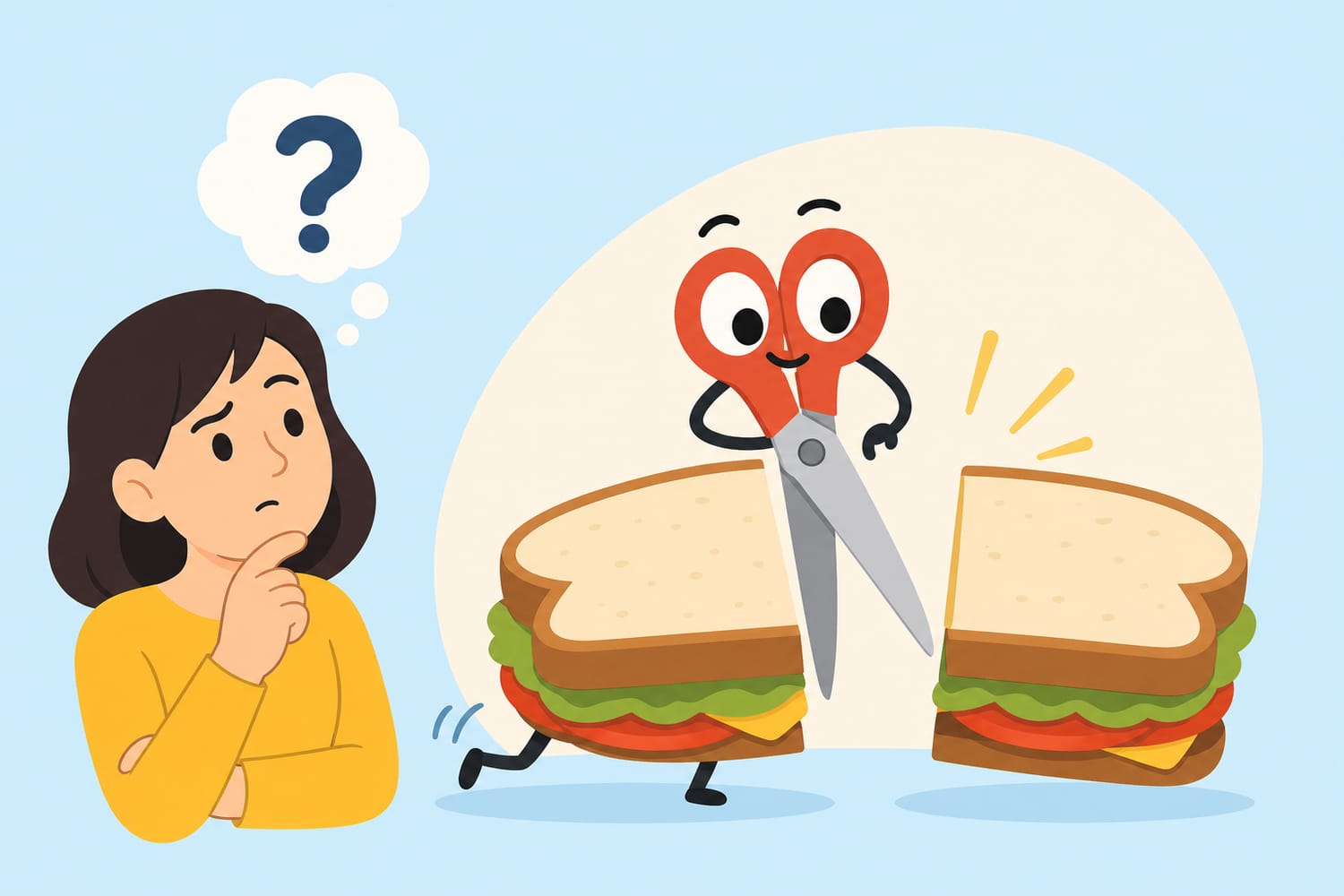
A Word That Gets Cut in Half
Tmesis is one of those words that looks like someone dropped a handful of Scrabble tiles and decided to keep the result.
It’s pronounced tuh-MEE-sis — and, fittingly, it describes a word or phrase that has been split apart so another word can be tucked inside it.
In other words, tmesis is the linguistic trick behind expressions like:
- abso-freaking-lutely
- fan-bloody-tastic
- un-flipping-believable
- any-old-where
The word comes from the Greek tmēsis, meaning “a cutting.” That’s exactly what happens: a word gets cut open, and another word gets inserted into the gap.
So if you’ve ever said, “That is ri-damn-diculous,” congratulations. You have performed tmesis. Possibly with flair.
The Basic Definition of Tmesis
At its simplest, tmesis is the separation of parts of a word or phrase by inserting another word between them.
A classic modern example is:
abso-bloody-lutely
The original word is absolutely. The inserted word is bloody. The result is a more colorful, emphatic version of the original.
Tmesis can happen inside a single word, especially in informal speech. It can also happen inside a compound word or a fixed phrase. The key idea is that something normally treated as one unit gets interrupted.
Here are a few examples:
| Normal form | Tmesis form | |---|---| | absolutely | abso-freaking-lutely | | fantastic | fan-bloody-tastic | | unbelievable | un-flipping-believable | | nevertheless | never-the-blooming-less | | somewhere | some other where |
That last one may sound strange today, but splitting words and compounds was much more common in older forms of English and in poetry.
Tmesis is not just random word vandalism. It follows patterns, and those patterns tell us something interesting about how language works.
Why “Abso-Freaking-Lutely” Sounds Right
One curious thing about tmesis is that some versions sound natural while others sound deeply wrong.
For example:
abso-freaking-lutely
Sounds normal.
But:
absolute-freaking-ly
Sounds like a robot trying to swear.
Why?
Because English speakers tend to insert the extra word just before the most strongly stressed part of the word. In absolutely, the main stress falls on loot: ab-so-LOOT-ly. So the inserted word goes before that stressed syllable:
abso-freaking-LOOT-ly
Likewise:
fan-BLOODY-tastic
un-FLIPPING-believable
The inserted word adds emphasis, and it usually lands where it can create the most dramatic rhythm.
This is why tmesis often feels punchy, funny, or theatrical. It plays with the beat of a word. It turns ordinary vocabulary into a tiny performance.
The Sweary Cousin: Expletive Infixation
The most famous type of tmesis in modern English is often called expletive infixation.
That’s the technical term for sticking a swear word — or a swear-ish word — inside another word.
Examples include:
- abso-bloody-lutely
- fan-freaking-tastic
- un-freaking-believable
- Cinder-bloody-rella
- guaran-damn-tee
“Expletive” here means a strong or emphatic word, often profanity. “Infixation” means inserting something inside a word.
Strictly speaking, linguists sometimes distinguish between tmesis and infixation. Infixation involves adding a meaningful element inside a word as part of word formation. Tmesis is more about splitting an existing word or phrase and inserting another word into it.
But in casual discussion, especially when talking about English examples like abso-freaking-lutely, people often use tmesis as the umbrella term.
Either way, the effect is clear: the inserted word turns up the volume.
“Absolutely” means yes.
“Abso-freaking-lutely” means YES, and possibly I am wearing sunglasses while saying it.
Tmesis Is Older Than It Looks
Tmesis may feel modern because many examples involve casual speech, slang, or swearing. But the device itself is ancient.
The term comes from ancient Greek grammar, and examples appear in classical literature. In Greek and Latin, words that later became fused together could be separated in poetry. Ancient poets had metrical needs — they had to make lines fit a rhythm — and tmesis gave them flexibility.
Old English and other early Germanic languages also had structures that could be split in ways that look tmetic to modern readers. What we now think of as compound verbs or fixed combinations were sometimes more separable.
English has changed a lot since then. Many word parts that once moved more freely have become fixed. Still, tmesis survived — not as an everyday grammatical necessity, but as a playful tool.
It pops up in poetry, comedy, advertising, political slogans, and ordinary conversation whenever someone wants to make a word more dramatic.
Is “A Whole Nother” Tmesis?
One commonly discussed example is:
a whole nother
As in:
“That’s a whole nother problem.”
At first glance, this looks like tmesis. The word another appears to have been split into a and nother, with whole inserted in the middle.
The standard form would be:
“That’s another whole problem.”
or:
“That’s a completely different problem.”
But a whole nother is extremely common in informal English, especially in American speech.
Is it tmesis? Sort of — but with a caveat.
Historically, another comes from an other, meaning “one other.” Over time, the words fused into another. In a whole nother, speakers seem to treat nother as if it were a word on its own. So the phrase may be less a clean example of tmesis and more a case of reanalysis, where speakers reinterpret the structure of a word.
Still, it behaves a lot like tmesis, and many popular discussions include it as an example. Language is messy. That’s part of the fun.
Tmesis in Literature and Pop Culture
Writers love tmesis because it attracts attention. It interrupts the expected shape of a word, forcing the reader or listener to slow down.
Shakespeare used wordplay of this general kind. In Romeo and Juliet, Mercutio says of Romeo:
“This is not Romeo, he’s some other where.”
Here, somewhere is pulled apart into some other where, creating a witty little twist.
Modern writers and comedians use tmesis for comic timing. A mild phrase like:
“That was un-freaking-believable.”
feels bigger than:
“That was unbelievable.”
It signals emotion, attitude, personality. Depending on the inserted word, it can sound excited, annoyed, sarcastic, delighted, or completely fed up.
Advertisers also enjoy tmesis because it makes slogans memorable. A familiar word split in an unexpected way can stick in your head, even if you wish it wouldn’t.
Why Tmesis Works So Well
Tmesis works because it breaks a rule without fully destroying the word.
When you hear abso-freaking-lutely, you still recognize absolutely immediately. The original word remains intact enough to understand, but altered enough to surprise you.
That combination — recognition plus surprise — is powerful.
It also gives speakers a way to express intensity. Compare:
“That is ridiculous.”
with:
“That is ri-bloody-diculous.”
The second version doesn’t add much literal meaning. It adds emotional meaning. It tells us how the speaker feels.
Tmesis also creates rhythm. Many examples have a satisfying bounce:
fan-freaking-tastic
abso-bloody-lutely
un-be-lievable becomes un-freaking-believable
It’s not just what the words mean. It’s how they land.
How to Use Tmesis Without Sounding Ridiculous
You can use tmesis whenever you want extra emphasis, humor, or drama. But like hot sauce, it works best when used with judgment.
A few tips:
Keep it informal.
Tmesis is great in conversation, jokes, casual writing, headlines, and dialogue. It is less great in a tax return.Use rhythm.
Insert the word before the main stressed syllable:
- abso-freaking-lutely
- fan-bloody-tastic
- un-flipping-believable
Mind your audience.
Some classic tmesis examples involve profanity. If you’re writing for a broad audience, softer versions like freaking, flipping, blooming, or ever-loving may be safer.Don’t overdo it.
One tmesis is funny. Six in a paragraph may sound like your sentence stepped on a rake.Make sure the base word is recognizable.
If the original word disappears completely, the joke may disappear with it.
Tmesis vs. Infixes: A Tiny Grammar Detour
Since we’re among weird words, it’s worth mentioning a related term: infix.
A prefix goes at the beginning of a word:
unhappy
A suffix goes at the end:
happiness
An infix goes inside a word.
English does not use infixes very much in its standard grammar. We mostly use prefixes and suffixes. But some languages use infixes regularly as part of normal word formation.
In English, examples like fan-bloody-tastic are sometimes casually called infixes, but they are not grammatical infixes in the same way you might find in languages where infixation is a standard pattern. They are expressive insertions.
That’s why tmesis is such a handy word: it captures the cutting-and-inserting trick without pretending English has suddenly become an infix-heavy language.
The Plural, Because Of Course There Is One
If you want to talk about more than one example of tmesis, the plural is usually:
tmeses
Pronounced something like tuh-MEE-seez.
So yes, you could say:
“This article contains several tmeses.”
Will people understand you? Maybe not. Will you sound like someone who collects rare grammatical beetles? Absolutely.
Or should we say:
abso-tmesis-lutely.
Actually, no. Please don’t say that.
So, What the Heck Is Tmesis?
Tmesis is the art of cutting a word or phrase open and inserting another word inside it. It’s behind playful, emphatic expressions like abso-freaking-lutely and fan-bloody-tastic.
It has ancient roots, modern swagger, and a surprisingly strong sense of rhythm. It can be poetic, comic, rude, clever, or just plain fun.
Best of all, tmesis reminds us that language is not a museum exhibit sealed behind glass. It’s alive. People stretch it, bend it, interrupt it, and occasionally shove bloody into the middle of it for emphasis.
And that is fan-freaking-tastic.