One Word, Two Very Different Chores
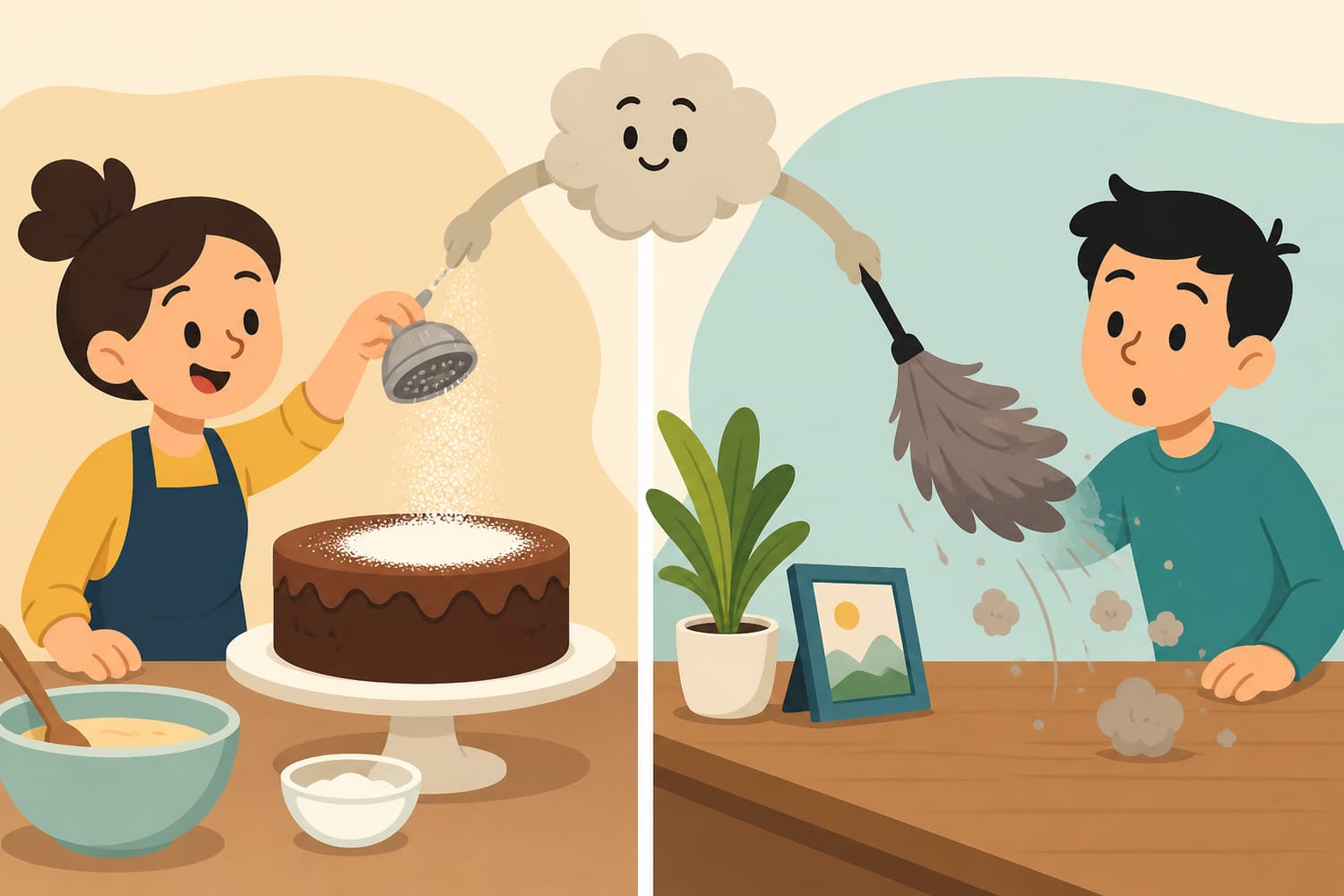
You dust a bookshelf to remove fine particles. You dust a cake with powdered sugar to add them. Both uses are standard English. The trick is that dust names the powdery stuff, while the verb can describe either taking that stuff off a surface or putting a fine layer onto one.
It sounds like a recipe for disaster. Imagine being asked to dust the living room and returning with a sieve full of flour. Yet outside that imaginary housekeeping mishap, we almost always know which direction the powder is traveling. The bookshelf needs cleaning; the cake needs finishing.
So how did one little word wind up doing two opposite jobs?
The Powder Is the Starting Point
Before dust became a verb, it was a noun: the fine, dry particles you might find on a windowsill. English has a handy habit of turning nouns into verbs. We hammer a nail with a hammer and brush a coat with a brush. But a noun-to-verb conversion does not always spell out exactly what we intend to do with the thing named.
Take a shelf covered in dust. To dust it is to deal with its dust by removing it. Now take a chocolate cake awaiting its grand entrance. To dust it with sugar is to deal with fine powder by scattering it over the top. Same word, same general idea of powder on a surface, opposite directions.
That is the answer in a nutshell: “Dust” points to the material, not automatically to whether the material is arriving or leaving. The rest of the sentence—and our knowledge of cakes and shelves—does the sorting. Oxford Learner’s Dictionaries lists both verb senses, including removing dust from furniture and covering something with fine powder.
There is another small twist. In the cake example, the powder usually is not household dust. It might be sugar, cocoa, or flour. Here dust suggests a light sprinkling of fine particles, not a specific substance scraped from the top of a cabinet. Thankfully.
Does “Dust” Have a Name for This Trick?
It does: dust is a contronym, a word with meanings that oppose each other. You may also see such words called auto-antonyms or Janus words. The last name refers to Janus, the Roman god often shown with two faces—a fitting mascot for a word that can look in opposite directions.
The label is fun, but it can make the word sound more mysterious than it is. Dust does not mean “add powder” and “remove powder” at the same time in a normal sentence. Rather, English has two established uses of the verb, and context selects one.
Compare:
- “Dust the mantelpiece.” The aim is to remove what has collected there.
- “Dust the brownies with cocoa.” The aim is to add a thin coating.
- “Dust the fingerprints.” In a crime-story scene, this means apply powder to help reveal prints—not wipe the surface clean.
Notice what the examples give us: a surface, a purpose, and sometimes the name of the powder. With those clues, the apparent contradiction rarely causes trouble. It is much like knowing that “put on a coat” means something different when the coat belongs to a person rather than a wall.
Which Meaning Came First?
The noun dust goes back to Old English. The verb has been around for centuries too, though its uses have changed over time. According to the Online Etymology Dictionary’s history of dust, the verb is recorded around 1200 with a sense involving dust rising into the air. The “remove dust” sense is recorded from the 1560s, and the “sprinkle with dust” sense from the 1590s.
Those dates are useful clues, not footage of the first person ever cleaning a table or sprinkling powder. Historical dictionaries work from surviving written evidence; people may have spoken a particular use before anyone happened to write it down in a text that survived.
Still, the timeline makes an important point. Neither modern meaning is a recent joke or a mistake that somehow escaped the dictionary. Both have long histories. English speakers have been making room for the two directions of dust for hundreds of years.
It is tempting to imagine a single dramatic moment when someone flipped the verb around: “We’ve spent long enough taking dust off things. From now on, let’s put it on!” Language usually develops less theatrically. Related uses can grow side by side because people find them useful, especially when a sentence makes the intended action clear.
The Clue Is Often a Tiny Word
If you need to know whether dust means add or remove, look immediately after the object. “Dust the cake with sugar” points strongly toward adding: with sugar names what is being applied. “Dust the dirt off your shoes” points toward removing: off tells you where the dirt is going.
Sometimes the object alone is enough. “Dust the shelves before the guests arrive” calls for a cloth, not a bag of flour. “Dust the dough before rolling it” calls for flour, not a frantic effort to clean every grain away.
But context is not magic. “Please dust the table” could be unclear if one person is getting ready to serve dinner while another is preparing to roll pastry. In a situation like that, an extra phrase solves the problem: “Wipe the dust off the table” or “Dust the table with flour.” There is no prize for preserving an amusing ambiguity when someone else has to do the work.
This is a good reminder that dictionary definitions are not little switches that turn on in isolation. We understand words as part of whole sentences, shaped by what is happening around us. A cake, a duster, a flour bag, and an approaching guest can all help steer the same verb.
“Dust” Has Company
Another kitchen-and-garden example is seed. You can seed a lawn by adding seeds, but seed a pepper by removing them. Cambridge Dictionary records both uses of seed. Once again, the noun names the thing involved while the object tells us what is happening to it. A bare patch needs seeds; a pepper being chopped might need fewer.
Contronyms are not all built this way, though. They are a collection of words with opposing senses, not evidence of one universal rule for making opposites. That is part of what makes them so satisfying to spot: each one invites its own “Wait, how does that work?” moment.
They are also different from words that merely sound misleading. Dust genuinely has two opposing verb uses. A word that seems to promise one meaning but has another is a different sort of surprise. If that kind of vocabulary twist appeals to you, explore Uncover Words’ words that mean the opposite of what they sound like.
The Final Sweep
Why can dust mean both add and remove powder? Because the word began with the powdery substance, and English developed more than one useful way to turn that noun into an action. You can clear fine particles from a surface or scatter fine particles across it. The surrounding words—and ordinary common sense—tell you which one is meant.
So the next time you dust the bookshelf and then dust a cake, you are not contradicting yourself. You are giving one hardworking verb a change of apron.